

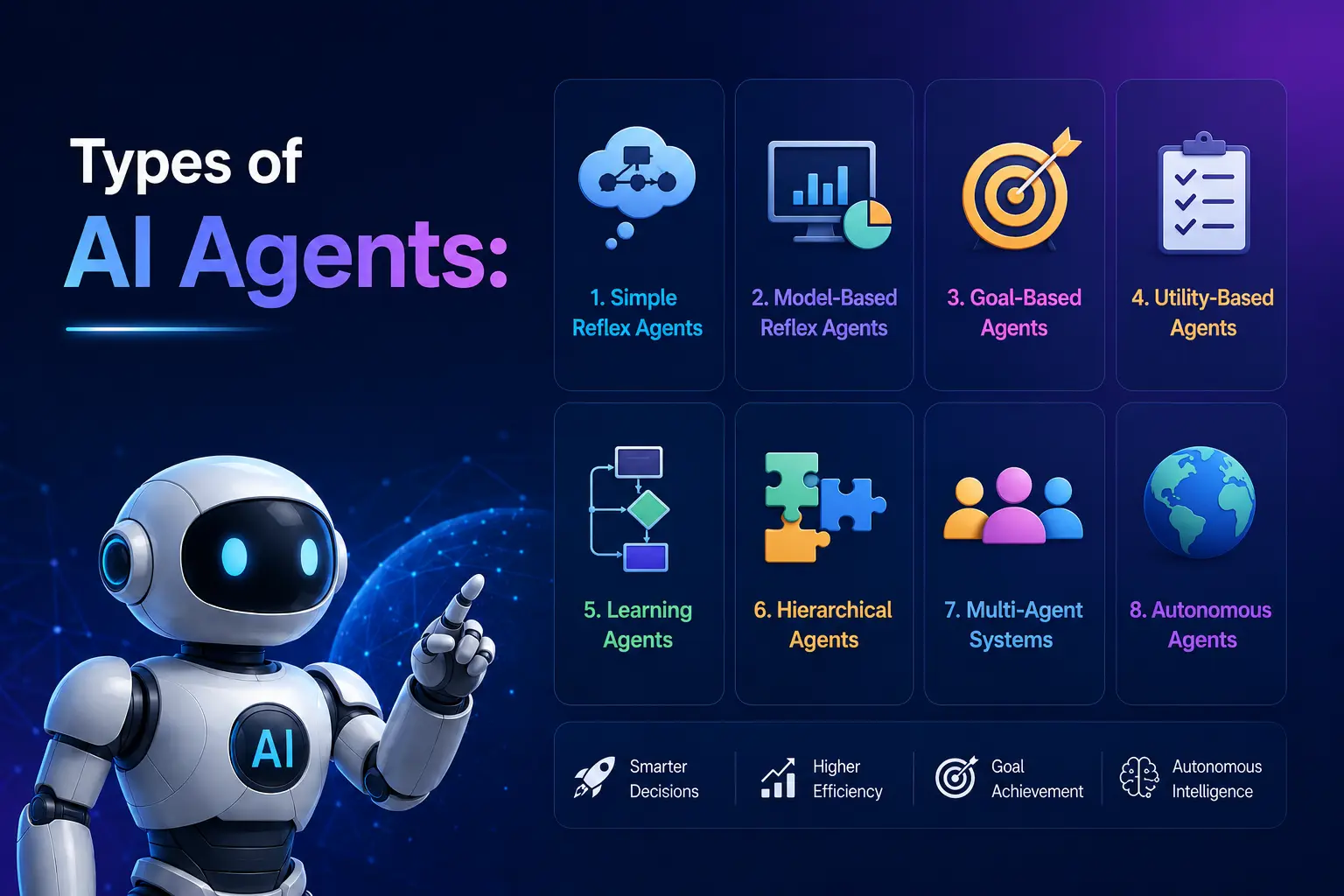
Types of AI Agents: A Complete Guide to the Different Types of AI Agents in 2026
Summarize and save time
Face it — “AI Agent” is one of those buzzwords that’s been tossed around so often that it’s beginning to become meaningless. Everyone is designing one, selling one, or boasting that their product is equipped with one. If you have ever attempted to incorporate an AI Agent into your company and felt disappointed with its performance because it doesn’t seem to be delivering on its promises, then chances are good that the issue is that you didn’t choose the right one.
There are a number of different types of AI Agents, and some may have unique abilities as far as making decisions and performing certain tasks. The AI Agents may just react to stimuli, adapt and learn from experience, or try to predict the outcomes, but they might also evolve and even work best in cooperation with other AI agents. This will determine what sort of tasks the AI Agent will be best equipped to do.
At PSSPL, we have helped many companies understand which AI agent to choose among various options offered by vendors of such technology. It gets overwhelming and hard to choose when all of them promise to provide all the necessary services and perform any kind of job imaginable. That is why in this guide we decided to focus on only one thing – the basic types of AI Agents.
First, What Is an AI Agent?
Before jumping into the categories, let us clarify the concept first. An AI agent can be defined as any entity or process that is capable of perceiving the environment, analyzing this perception, and acting on it in a way to achieve a particular goal. That’s the general picture of what an AI agent means. By saying the “environment,” one can think of various options – this may be a communication, a database, physical surroundings, websites, and many others.
It’s the ability to make decisions on the spot that distinguishes AI agents from typical computer programs. The latter operate strictly in accordance with pre-written commands while agents make decisions according to the circumstances.
Regardless of category, all forms of AI agents exhibit these characteristics:
- Perception – receiving inputs from their environment.
- Decision making – coming up with solutions for these inputs.
- Action – performing the action.
- And finally, goals – a target goal that they pursue.
What separates these categories of agents is how they approach decision making, whether they remember previous states of the system, their ability to plan, and also their learning capabilities. Let’s delve in further.
The 6 Types of AI Agents
(1) Simple Reflex Agents
They are some of the simplest types of agents around, and in fact, they are more common than one would think. An instance of a reflex agent uses the if this then that kind of decision making process where it observes the current state of affairs, compares it to a set of predetermined conditions, and acts accordingly.
There is no knowledge about what was encountered before nor any foresight about what will be observed later. The agent simply reacts to whatever is currently being observed.
An everyday example is the thermostat which turns on whenever the temperature goes below 20 degrees and turns off when it exceeds 24 degrees.
Where you’ll find them in the real world:
- Spam filters that flag emails containing certain trigger phrases
- Traffic lights running on fixed timing sequences
- Manufacturing floor alerts that fire when a sensor crosses a threshold
Basic chatbots that respond to specific keywords
What they’re good at: Speed, simplicity, reliability in predictable environments. They’re cheap to build and easy to maintain. If the task is well-defined and the inputs are always going to look the same, a simple reflex agent is often the most sensible choice.
Where they struggle: The moment something unexpected happens, they’re lost. They have no way to reason about partial information, no ability to improvise, and no capacity to improve. If your environment changes — even slightly — they can start producing wrong answers and you’d never know unless you caught it manually.
For businesses, these agents work well for things like rule-based email routing, automated IT alerts, or simple FAQ bots. Don’t overthink it — sometimes the simple thing is the right thing.
(2) Model-Based Reflex Agents
This is where it starts to get more interesting. All the behaviors of a simple reflex agent are preserved in a model-based reflex agent, but this one has something more important. It maintains an internal model of the world – an internal map of its current environment which changes with new inputs. Why is that significant? Well, for one thing, it means the agent can make rational decisions based on partial knowledge.
For example, let’s consider a self-driving car trying to navigate through an intersection. At first, it sees a cyclist in front of it, and then, the cyclist is obscured by a large truck driving through. The simple reflex agent will forget about the cyclist completely, while the model-based one will know he was there, will be able to estimate his position, and continue being careful.
Where you will find them in the real world:
- Autonomous cars detecting nearby objects using short periods of blind spot
- Robots working in warehouses who know about objects they had placed previously in their day’s work
- Maintenance services which learn and build history of equipment health
- E-mail management services which analyze a user’s sorting process and apply similar technique for upcoming emails
What they’re good at: They are able to cope better with the real environment where not everything can be observed in one go. They are more adaptable and aware of the context and also degrade much more gracefully in case of lack of information.
Where they struggle: Creating and keeping an up-to-date model requires significant effort. If this model becomes outdated or is inaccurate from the start, the decisions made by the agent will be based on the wrong assumptions, even worse than having no model at all. They require additional computational resources compared to reflex agents.
In supply chain and logistics work, model-based agents are particularly valuable. You’re often working with partial visibility — shipments in transit, inventory counts that lag reality — and having an agent that maintains a coherent picture of the whole system makes a real difference.
(3) Goal-Based Agents
This is where AI agents start actually thinking ahead. Goal-based agents don’t just react to what’s happening — they reason about what they want to achieve and then work backwards to figure out the best path to get there.
Once you provide a goal-oriented agent with a goal, the agent will consider various possible action sequences, assess which will help the agent reach its goal, and pick a course of action. This is what sets apart a reactive system from a planning system.
Perhaps GPS navigation is the one instance with which everyone can relate. When the user inputs a destination, the system does not just give a general direction; rather, it takes into account several alternative routes, assesses live traffic updates, evaluates the pros and cons of time versus distance, and suggests a particular route to follow. If the user misses a turn along the way, the system will recalculate from there.
Where you’ll find them in the real world:
- Route optimization for delivery fleets
- Chess and other strategy games algorithms
- Multi-step manufacturing planning on robotic assembly lines
- Meeting scheduling by AI assistants taking into account time zones and priorities
What they’re good at: Complex, multi-step tasks where the path to the outcome isn’t fixed. They’re far more adaptable than reflex agents because if circumstances change, they can rethink their plan rather than just continuing blindly.
Where they struggle: Planning gets expensive fast. The more possible states and actions involved, the more computation is needed to evaluate paths — and in some environments, plans become outdated almost as fast as they’re made. They also rely on goals being clearly defined upfront, which is harder than it sounds in real business contexts.
If your organization has optimization problems — scheduling, routing, resource allocation — goal-based agents are worth serious consideration.
(4) Utility-Based Agents
Here’s a question goal-based agents can’t answer: when there are multiple ways to reach the goal, which one is actually the best? Getting from A to B is easy when there’s one road. But what if there are five roads, and each involves different trade-offs between time, fuel cost, road quality, and tolls? That’s where utility-based agents come in.
In other words, they do not simply ask whether there is any way to reach the goal but rather how satisfactory a particular outcome is. The approach is based on a concept of a utility function which allows calculating the value of the outcome according to the criteria set by the system and selecting the most valuable action accordingly.
One could easily give an example of such an agent – the film recommendation system for online movie theaters. Instead of suggesting you a film to watch, it selects the film that would satisfy you the most, taking into consideration all kinds of factors related to the content you have seen before.
Where you’ll find them in the real world:
- Suggestions of content that is likely to be enjoyable on streaming websites
- Ride sharing applications optimizing distance, price for the user, and optimal route all at once
- Artificial intelligence portfolio management programs trading off risk vs reward using many parameters
- Decision-making systems in healthcare weighing the benefit of a treatment option against the side effects
What they’re good at: Multiple possible options exist, and you want the optimal one instead of one that would suffice. Utility models really excel in the presence of trade-offs between various conflicting aspects – cost-effectiveness, efficiency, time vs. accuracy, etc.
Where they struggle: Utility functions are tricky to design. Preferences are complicated by nature, depending on context and situation, which makes their expression in numbers problematic. Besides, they can get computationally expensive when the search space becomes large.
Utility models tend to be part of the algorithm for any PSSPL client developing recommendation systems, price prediction models, optimization engines, etc.
(5) Learning Agents
This is probably the type most people picture when they hear “AI” today. Learning agents start with some baseline capability and then get better over time through experience. They don’t need to be reprogrammed when the world changes — they adapt to it.
A learning agent has four different components working together to form one whole system. The first is the performance component that makes decisions and performs tasks. Next, there is the learning component, which looks at how the agent performs and figures out the areas in need of improvement. The third component is the critic, which evaluates performance based on certain standards. Finally, there is the problem generator, which pushes the learning agent into situations it is yet to experience.
There are instances where you deal with learning agents even without realizing it. For instance, as Alexa learns your accent, Spotify adapts its recommendations in accordance with your evolving tastes. On the other hand, fraud detection systems adapt their algorithms to reflect the changes that fraudsters bring.
Where you’ll find them in the real world:
- Personalized assistants that learn from individual users over time
- Fraud and anomaly detection software systems that remain ahead of attack trends
- Web-based personalization software for e-commerce applications
- Medical image analysis applications that become more accurate with experience
What they’re good at: Environments that keep changing their rules. They can find patterns that programmers could never code into the agent. And once they get going, they’re self-maintaining for the most part.
Where they struggle: They’re hungry — for data, for compute, for time. But training a learning agent right takes serious effort. They may also absorb some bad behaviors from bad data sources, and not necessarily detectable ones. They can also be inscrutable because sometimes it’s not clear why the learning agent acted in a certain way.
In 2026, learning agents are at the heart of most serious AI deployments. If you’re building something that needs to stay relevant as your business and your data evolve, this is likely where you’ll end up.
(6) Multi-Agent Systems
All five types above assume a single agent working through a problem on its own. Multi-agent systems (MAS) throw that assumption out entirely. Here, you have multiple agents operating in a shared environment, each with their own perceptions, goals, and decision-making logic, and the overall outcome emerges from how they interact.
This may seem rather complex, but it does indeed reflect reality in most businesses. Take, for example, a storage facility: there is not one single control system overseeing everything. There are picking robots, conveyor systems, inventory systems, schedulers, and dispatchers working independently yet in concert with each other. Multi-agent systems simply formalize this concept.
The interactions between the agents involved can be cooperative, meaning a group effort, as in drone delivery vehicles collaborating to achieve blanket coverage in a given area; or competitive, as with trading algorithms in the same market vying for profit. Sometimes, both happen simultaneously.
Where you’ll find them in the real world:
- Autonomous drone fleets managing logistics or search-and-rescue operations
- High-frequency trading platforms where many agents buy and sell simultaneously
- Smart city traffic systems where agents at each intersection negotiate signal timing
- Complex supply chains where sourcing, logistics, and demand-forecasting agents share information and adapt together
What they’re good at: Scalability, robustness, and concurrency. Tasks which are too big or far-reaching for a single agent to manage by itself. Even if an agent fails, the process will continue. The collective intelligence that comes out of the interaction between agents can truly surpass anything one agent could achieve on its own.
Where they struggle: Coordinating things is difficult. It requires skillful planning on how to make several agents coordinate in their efforts without leading to conflicts, bottlenecks, and even unpredicted outcomes. Poor communication might trigger a chain reaction. Troubleshooting a multi-agent system is definitely not easier than troubleshooting an individual agent.
Multi-agent systems have been transitioning from experimental stages to more practical applications as the AI ecosystem evolves throughout 2026. This has primarily been spearheaded by companies working in industries where operations are inherently distributed, such as logistics and manufacturing.
| Agent Type | Has Memory? | Plans Ahead? | Learns? | Multi-Agent? | Best For |
|---|---|---|---|---|---|
| Simple Reflex | No | No | No | No | Rule-based automation, alerts |
| Model-Based Reflex | Yes | No | No | No | Partial-visibility environments |
| Goal-Based | Yes | Yes | No | No | Routing, scheduling, optimization |
| Utility-Based | Yes | Yes | No | No | Recommendations, trade-off decisions |
| Learning | Yes | Yes | Yes | No | Personalization, adaptive systems |
| Multi-Agent Systems | Yes | Yes | Often | Yes | Large-scale distributed operations |

Case Study: AI-Powered Scope Generator Bot for Enhanced Conversions
At PSSPL, we built PIRI — an intelligent AI chatbot — for our own website to fix a problem many businesses quietly struggle with: website visitors were leaving without engaging, and the ones who did reach out weren’t always the right fit.
Challenge: Generic contact forms were driving high bounce rates. Unfiltered queries from job seekers and casual visitors were mixing with real prospects. Manually creating Scope of Work documents was slowing down the pre-sales process, and we had almost no visibility into what visitors actually wanted.
Solution: PIRI uses GPT-4 via Azure OpenAI and LangChain RAG to act as a 24/7 virtual business analyst. It identifies visitor intent in real-time, routes users to the right team (Sales, HR, Support), and automatically generates tailored Scope of Work documents — turning a conversation into a qualified lead.
Quantifiable Impact
- Tripled the quality of leads within weeks of going live.
- Significant reduction in website bounce rate.
- SOW generation fully automated — zero manual effort.
- Sales team receives only pre-qualified, high-intent prospects.
So Which One Do You Actually Need?
This is something that arises in nearly all discussions with our clients, and the truth of the matter is that it does depend on your particular issue, not trends in the market.
In the case of straightforward problems with known input variables, do not make things more complicated than they are. Reflexive agents work faster, cheaper, and are easier to maintain than learning agents that are doing the exact same thing. Complexity costs money.
In environments in which there are areas that lack information and cannot be observed at will, model-based agents help you play according to the rules.
Goal-based agents help with problems that have a number of possible paths.
When your problem involves multiple valid solutions, but you only want the optimal one, then that is when utility-based thinking truly shines.
If you are working in an environment that is constantly changing, learning agents are the key.
If the scale of the issue is indeed too great for one agent to solve, then multi-agents make this possible by scaling up while retaining coordination.
In practice, it is rare to see a single type deployed at any time. A customer service AI might deploy a learning agent to understand user intent, goal-directed agents to solve the problem, and a utility agent to assign priorities among several tickets. Types of AI agents are not mutually exclusive.
How PSSPL Fits In
We’ve built AI systems across all six of these categories, for businesses ranging from early-stage product companies to large enterprises managing complex operations. What we’ve learned is that the technical choice is actually the easier part — the harder part is figuring out exactly what problem you’re trying to solve and what “success” looks like before you start building.
That’s where we spend the most time with clients: getting that clarity first, then designing the right agent architecture around it. Whether that’s a fast, focused reflex system for a specific workflow or a multi-agent platform handling decisions across an entire supply chain, the approach is the same — start with the problem, not the technology.
If you’re working through an AI implementation and aren’t sure which direction to take, we’re happy to talk it through. No sales pitch, just a straight conversation.
Wrapping Up
By 2026, artificial intelligence (AI) agents were ubiquitous, and would continue to become increasingly sophisticated. Understanding the different types of AI agents helps organizations select the right architecture for their business goals, technical requirements, and scalability needs. However, just because an agent was capable did not automatically make it suited for every application. Simple reflexive agents had critical roles on manufacturing lines and in server farms, while learning agents revolutionized customer service interactions.
The key is to know how they differ, beyond merely understanding how they function – but in practical terms, what they could and could not accomplish. The ability to distinguish between types of agents is what will make AI applications succeed.
The good news is you don’t have to figure all of this out alone.
Ready to build the right AI agent for your business?
“Not sure which AI agent fits your needs? Let’s figure it out together.”
You’ve seen how differently simple reflex agents, learning agents, and multi-agent systems behave — and choosing the wrong one wastes time, budget, and trust. At PSSPL, our AI consultants work with you to identify exactly which agent architecture fits your problem, then build and deploy it. No guesswork, no overselling — just the right solution for your specific needs.
Talk to an AI agent specialist and get clarity on your next move.
I've done quite a number of computer vision projects for retail companies, but there are some projects that really make an impact, and they all have one thing in common: the model integrates seamlessly with their current POS and inventory system, and the team has absolute confidence in what the model tells them. Installing the cameras and setting up the algorithms? It's the easy part. The hard part is making sure everything works together and the people are prepared to take action. This is where most out-of-the-box solutions fail, and this is where we focus most of our efforts.