
AI Agents Vs. AI Chatbots: Core Difference
Summarize and save time
Here is a brief comparison of AI agents vs. AI chatbots; they are often confused to be the same, but we aim to enlighten you by offering the core differences regarding their autonomy, workflow automation, use cases, and how each helps businesses to improve their outcomes.
Let’s start!
In today’s digitally driven world, most of us must have interacted with an AI chatbot in some way or other. For example, be it asking about “how to bake sourdough bread?” or asking Siri about the directions to your favourite resto, or maybe while scrolling through the website of a popular clothing brand, and inquiring about your size or colour preference to the chatbot.
These handy and easy-to-use digital assistants are getting better day by day at answering queries and offering user support. Advancements in AI technology have become a big blessing to industries where customer service matters the most. This sector was struggling to stay updated with the rising call volumes and increasingly complex customer demands.
Customer of today expect responses that are fast, personalised, and solve their complex challenges. By keeping these demands in mind, it’s safe to say that traditional methods need to go.
Understanding AI Agent Vs. AI Chatbot
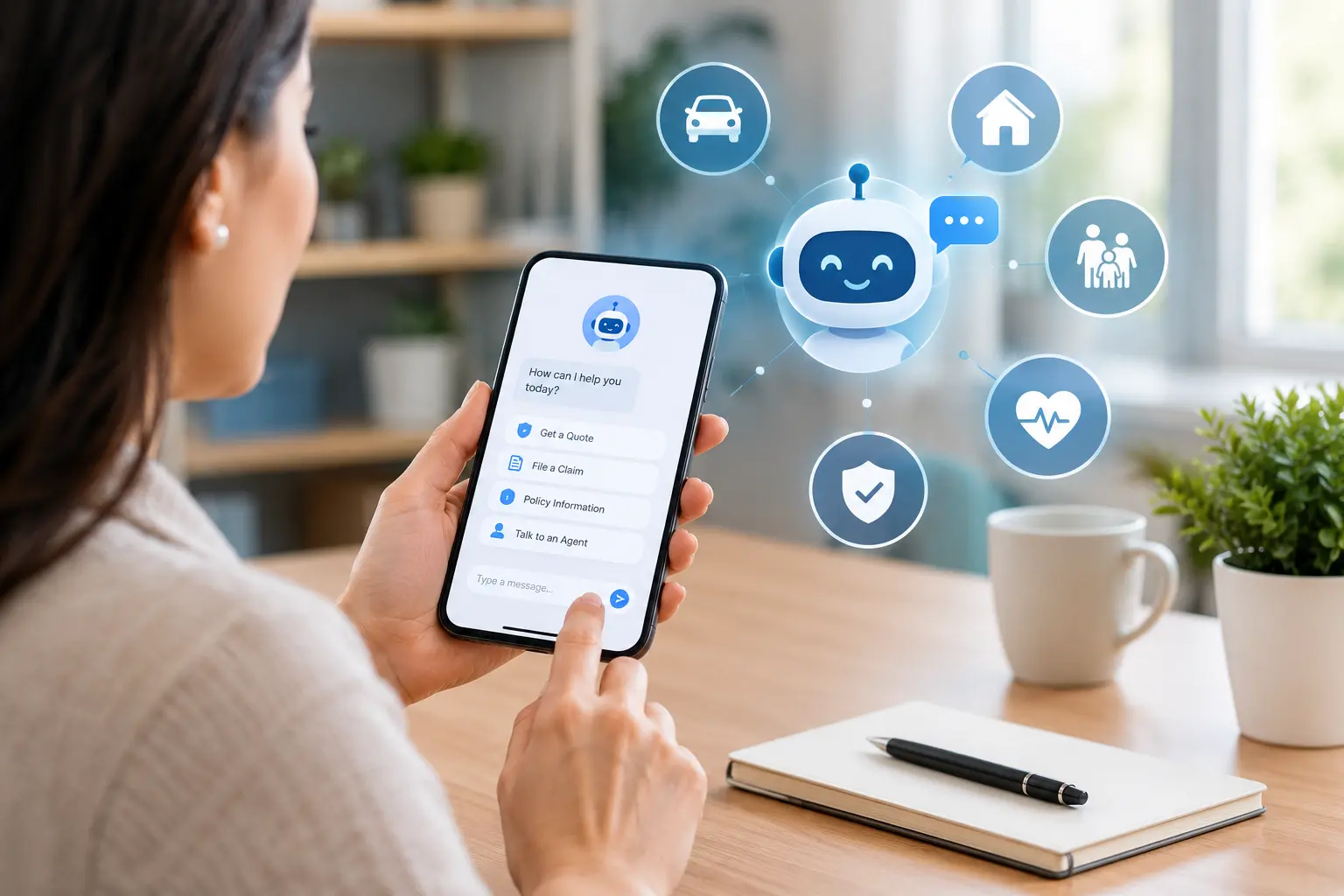
Both AI agents and AI chatbots automate support interactions, but they both have different ways of working and different levels of complexity. Chatbots typically handle conversational assistance, such as answering easy questions, helping users navigate through scripted flows, and handling simple requests.
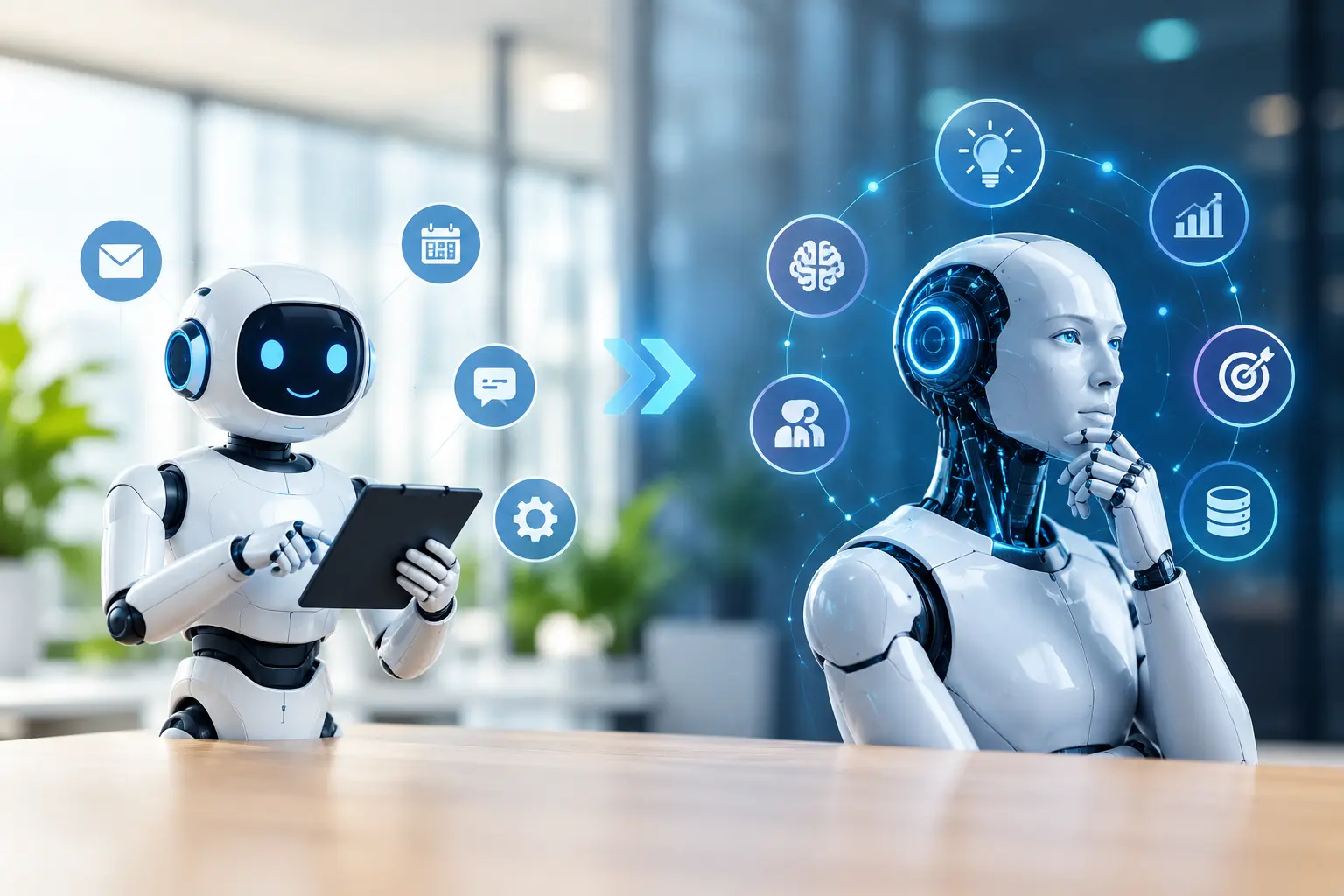
On the other hand, AI agents are capable of making decisions that are context-based, can take actions across connected systems, and managing multi-step workflows. In today’s world, customers and employees want support that is faster, more reliable, and smarter than ever before.
Users get frustrated if their needs are not met, when they have to repeat themselves or wait until their request gets passed from one customer representative to another. They also demand services that feel personalised, tailored to their special needs, and address complex issues.
AI chatbots and AI agents are very useful to address the issues of today’s users. While both of them provide automated support, their way of working is completely different.
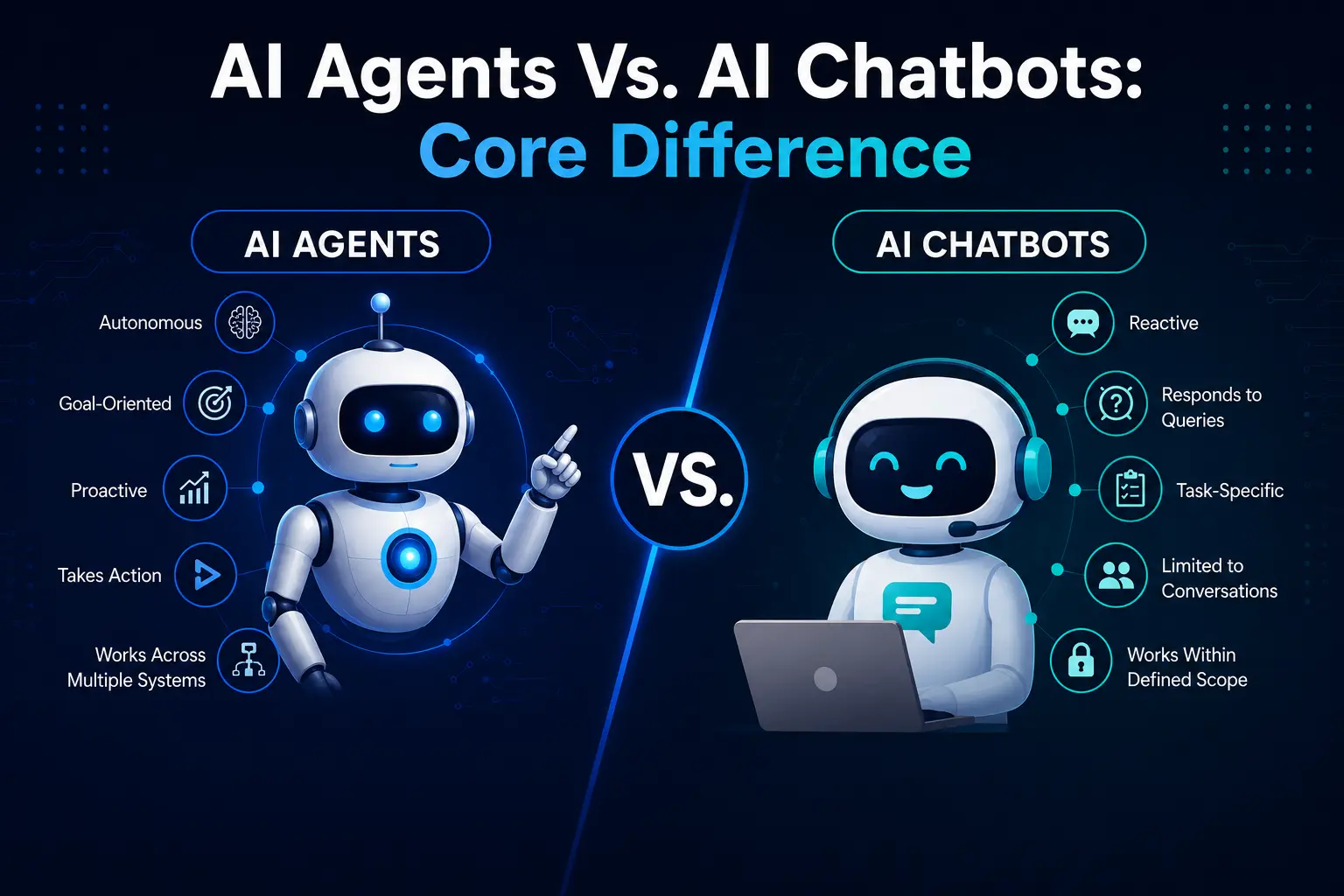
- AI chatbots – AI chatbots are mainly built for conversations; they follow scripts and answer basic questions.
- AI agents – AI agents are powered by agentic AI; they act as the human mind, think through challenges, make decisions based on data and complete support tasks.
AI chatbot vs AI agents: why knowing the difference helps you make intelligent decisions?
When you become aware of the core difference between these two, you can make smarter decisions about which technology to invest in. Depending on the needs of your business, you need basic chat support, fully automated problem-solving, or a combination of both.
More To Our Guide:
What is an AI Chatbot?
AI chatbot has all the capabilities of enhancing your business by leveraging artificial intelligence to maximise productivity and stakeholder satisfaction. 91% of small and medium-scale businesses have witnessed revenue growth after adopting AI technology. In today’s world, businesses are not only competing to be the best, but they are also competing when it comes to offering their services 24/7.
Customers need help that goes beyond regular business hours, like browsing products and seeking support at any time of the day. By leveraging AI, this digital assistant processes and responds to user queries in real time, interacting in a way that feels natural rather than in a robotic way. AI chatbots leverage natural language processing (NLP) and machine learning (ML) to enable better understanding of user input and respond to their questions on time.
How Does an AI Chatbot Work?
There are two main types of AI chatbots: rule-based and AI-powered chatbots. The simplest and most common type is a rule-based chatbot. They are programmed in a way to respond to keywords and commands. On the other hand are AI-powered chatbots; they are built for advanced interactions, backed by modern technology – artificial intelligence. They are trained to respond more humanly, aiming to make the interactions feel natural and engaging. These AI chatbots are powered by natural language processing (NLP) and Machine learning (ML).
Now that you know the basics about the two different kinds of chatbots, let’s have a look at how they work step by step:
Whenever you or anyone interacts with an AI chatbot, this is what usually happens:
- Initially, the conversation starts with a message, either typed or spoken into a chatbot’s
- Next, your request is processed using NLP (natural language processing) to figure out the actual intent of the user.
- The chatbot will go through its stored set of ready-made responses to come up with the most accurate and relevant response.
- The answer is displayed back to the user on the same
- Lastly, if the user chooses to stay on the chat, they respond again, and this back-and-forth keeps going until the interaction wraps up.
Use Case of AI Chatbots
AI chatbots have gained a huge amount of popularity and can be employed across various industries and functions. Let’s have a look at them:
(1) Customer Support:
The job of customer representatives has been completely overtaken by chatbots. They help solve basic queries of customers at any time of the day, from issues like password resets, order tracking, or troubleshooting.
(2) FAQs:
Many times, the small and repetitive queries of users are solved through frequently asked questions.
(3) Reservations and Booking:
Chatbots are very useful in assisting with making reservations for hotels, restaurants, or transportation.
(4) Basic IT Support:
Initially, the customer service representative has to perform a tedious, time-consuming, and repetitive job, which used to affect their ability to respond accurately and with the same enthusiasm. With AI chatbots, the routine IT requests are carried out easily helping users with simple to complex issues and carry out routine IT requests.
(5) Appointment Management:
AI chatbots help schedule appointments for various services; they send reminders and provide support for users who are willing to reschedule.
What is an AI Agent?
You set a goal, and the AI agent will work on your behalf; you have to provide it with an objective, and it works by deciding the next step to take, leverage the tools available to it, verifying the outcomes, and returning control to you. The core difference between an AI chatbot and agent is that it can learn and adapt.
There are different types of AI agents, and all of them have different ways of behaving and use cases. Reflex or rule-led agent, model-based agent, goal-based agent, utility-oriented agent, multi-agent system, and learning or adaptive agents. AI agents bring lots of benefits to any business; mainly, they bring continuity across workflow. Think of AI agents as the smarter and more capable version of a chatbot; they can handle and manage complicated customer requests and their service tasks. Users can choose their preferred way of interacting: voice or text.
AI agents process their query and map out the best way to solve it. The core difference lies in how both chatbots and AI agents are trained. AI agents begin by learning from LLMs (large language models) and built-in knowledge, and beyond that. These agents keep on improving from real customer conversations by leveraging both short-term and long-term memory to memorise the context and past interactions.
How does an AI Agent work?
(1) Perception: By leveraging sensors or input mechanisms, AI agents perceive their environment. They collect data from a wide range of sources such as cameras, microphones, or other sensors.
(2) Reasoning: Once they are done perceiving the environment, the agent processes the information to make the best decision possible, applying reasoning and logical rules or learned knowledge to interpret the data.
(3) Action: Based on the reasoning, AI agents take appropriate actions to acieve its goals, involving physical actions or digital actions.
(4) Learning: The performance of AI agents tends to get better with time, as they learn from past chat history.
Use Case of AI Agents
Unlike traditional chatbots, AI agents are more flexible and can easily adapt when a customer changes direction or information is missing. They can complete tasks, making them best for multi-step resolutions and autonomous workflow execution.
Advanced automation resolution: Multi-step issues such as billing disputes or rebooking a flight without taking any help from humans.
Provide 24/7 support: Helping customers as per their convenient timeline, and in their preferred time zone.
Workflow orchestration: Prioritise, escalate, route, and coordinate requests dynamically based on customer intent, urgency, and business context.
AI Agent and AI Chatbot: The Core Difference
Autonomy is the primary difference between an AI agent and an AI chatbot. A chatbot’s primary job is to converse with its users, while AI agents can reason, make decisions, and act across connected systems.
Let’s have a closer look at the major differences:
(1) Customer Service Interactions
AI agents are best when it comes to maintaining customer interactions, as they can maintain the context, remember relevant details, and guide conversations toward successful resolution. They can ask follow-up questions, suggest next steps, and respond to changing information based on the user’s intent.
Conversations conducted by AI chatbots are more transactional, as they follow a scripted path. Customers might need to repeat their queries or restart the conversations when their request does not fall under an expected category of questions. They are limited when it comes to responding. They struggle and consume a lot of them when the user asks questions that go beyond their predefined flow.
(2) Autonomy and Decision- Making Capabilities
In the case of AI chatbots, there are predefined patterns and fixed logic. Some chatbots do leverage NLP, but they depend on scripted responses and explicit user input to take the conversation forward. On the other hand, AI agents work completely differently. They can help users with multi-step tasks, answer complex queries, and don’t depend on prompts.
(3) Integration and Action-Taking Abilities
Chatbots usually connect to other systems through simple APIs, which is why they can perform limited actions such as answering simple questions or sending information to a scheduling tool. They are best when businesses are looking to assist their users with one-step tasks, like filling out a form, checking account details, and more.
AI agents, on the other hand, can be leveraged by businesses that want to offer advanced setup behind the scenes. To handle complete workflows from start to end, they connect with multiple systems at once and actually perform actions within them.
(4) Task Complexity
AI chatbots work better when it comes to completing simple tasks with fixed rules and predictable outcomes. They work best for solving issues such as troubleshooting, FAQs, and guided flows, but they fail/struggle when it comes to solving requests that are complex and require flexibility, or coordination across systems.
An AI agent works best when it’s about managing complex tasks that require context, judgement, and multiple steps. They process user requests and interpret their goal. Capable of taking actions across systems and adjusting when new information changes the path to resolution.
(5) How Much They Know
AI agents can pull together information from many different sources at once: knowledge bases, customer profiles, company policies, and other connected business tools. But they don’t just find answers and stop there. They actually use that information to complete real tasks, like updating an account, checking if something’s in stock, processing a return, or modifying a subscription.
AI chatbots, on the other hand, work with a much smaller, fixed set of information, usually just help centre articles or pre-written scripted answers. So if someone asks something that falls outside this limited knowledge, the chatbot either gives a vague, generic reply or passes the conversation over to a human agent.
This difference becomes especially important in industries like retail, travel, and banking/finance, where good support often depends on having real-time information and making decisions based on current policies, not fixed scripts.
Will AI Agents Replace Chatbots?
AI is evolving at a rapid speed, and they are ready to witness dramatic growth in the future. Agents will tend to become more intuitive across text, voice, and visual mediums and will eventually get better at understanding user intent and context.
If we ask the question of whether AI agents can replace chatbots or not, it would be safe to comment that they won’t, because both of them have different use cases. A small-scale business would have different needs than those of an organisation, and that’s where both AI agents and chatbots play their crucial role.
AI Chatbot Development Cost vs. AI Agent Development Cost
Building a chatbot is usually cheaper and faster because the process usually involves setting up scripted conversations, basic NLP and connecting it to one or two simple tools such as an FAQ page or website of your business.
On the other and the AI agent development cost is on the higher side as they require more advanced technology. They need to be connected with multiple systems, leverage large language models (LLMs) for performing tasks such as reasoning, maintaining memory of past chats, and have the ability to interact with humans naturally.
Why Choose PSSPL?
By now, it’s clear that AI chatbots and AI agents aren’t competing technologies; they are built to solve different problems. Chatbots are great when you need fast, reliable answers to simple, repetitive questions. AI agents step in when your business requires something intelligent.
AI agents are best for businesses that want a system that can think, decide, and actually fulfil tasks across various platforms without constant human intervention. So you shouldn’t be asking which one is the best; you need to ask which one fits best for your business, as per your future goals.
PSSPL helps you make the difference, whether you are looking to build a simple, conversational chatbot or a fully autonomous AI agent that is capable of reasoning, making its own decisions, and growing as your business evolves. PSSPL brings the right mix of technical expertise and real-world experience to get it right.
They offer end-to-end expertise to ensure that every step is handled with precision, rather than depending on off-the-shelf templates. They deliver custom-built solutions tailored to the unique needs of your business and its industry. Their system are crafted for smooth integration, enabling them to work seamlessly with existing setups. AI solutions grow alongside your business, while remaining cost-effective throughout the development process
Dhanashri Dimke is a literature graduate-turned technical content writer and copywriter with 4 years of experience crafting clear, persuasive, conversion-focused content. She writes emails, articles, blogs, whitepapers, and social copy for tech and business clients, turning complex ideas into stories people want to read. Partnering with product teams and marketers, she shapes content that drives real results. Writing is her genuine passion, and Pride and Prejudice remains a lifelong favourite.