

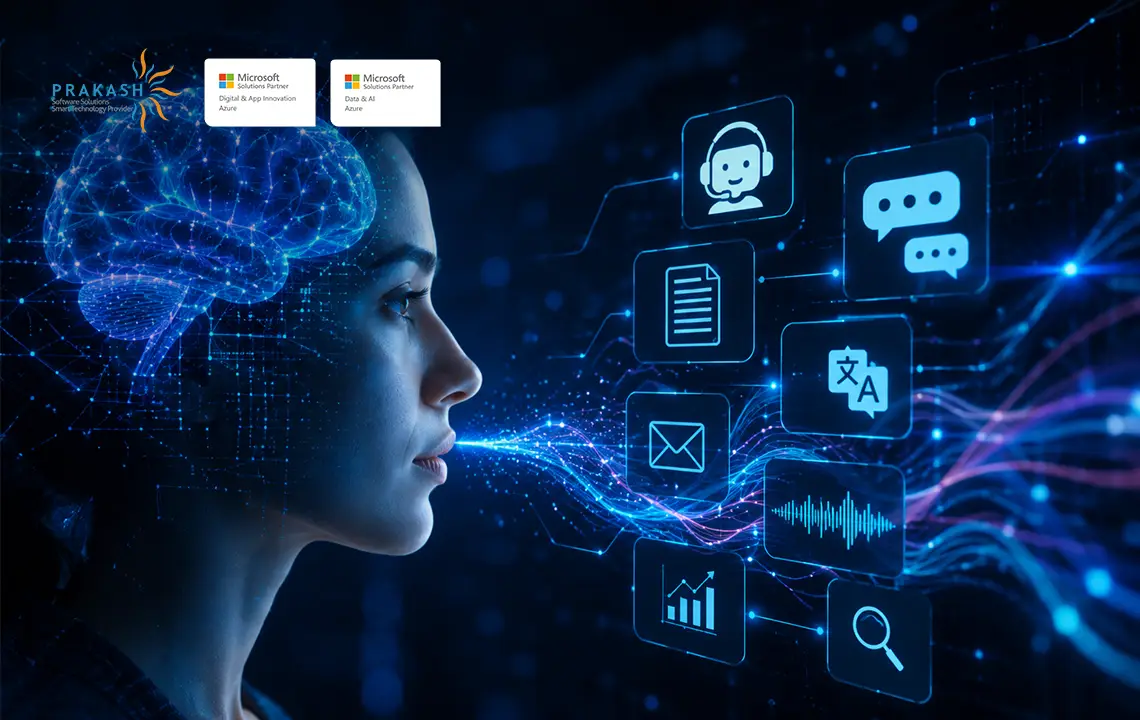
Top Natural Language Processing Use Cases in 2026 for Smarter Operations
Summarize and save time
Think about how much of your work revolves around text. Messages you must read and then respond to. A contract that requires a quick search for the critical piece of information concealed in there. Customer messages which need to be interpreted so that a proper response can be drafted. Call transcripts, customer service issues, compliance documents, product reviews – it is all text, all the time. And it is just too much text for any organization to keep track of without automation.
That’s the gap natural language processing (NLP) was built to close. It is the field of artificial intelligence which makes it possible for a machine to understand, process and generate human language in a manner that is meaningful.
A technology which once seemed futuristic is now part of the budgeting process of companies on an annual basis. Chatbots that do not seem to be chatbots. Search functions that understand what you wanted to say, even if you didn’t actually write it right. Technologies that can scan through thousands of contracts in one night and tell you which three require your legal attention. If you are wondering about where NLP can fit in with your company, then the best way to find out is to see what others are doing first – industry by industry, use case by use case.
That’s precisely what is illustrated in this blog. In addition to this, we will be revealing how the PSSPL, being a practical NLP development firm, develops these very abilities for its clients.
What NLP Actually Does (In Plain Terms)
But strip out the jargon, and what NLP actually excels at doing is taking unstructured information, such as text and speech, understanding it, and then doing something with it either by taking action or providing an organized response. On a technical level, it relies heavily on machine learning and deep learning models trained on enormous amounts of language data, which allows today’s NLP applications to not only recognize the sarcasm in a product review but comprehend a convoluted customer complaint or summarize a 40-page document in four sentences.
And why does any of this matter to business? It’s not about the technology – it’s about what the technology allows people to do. All the time that your employees don’t spend sorting through emails, transcribing phone calls, and reading through contracts one-by-one is time they can devote to making decisions that require human judgment.
Natural Language Processing Use Cases Across Industries
Let’s get into the specifics. Here’s how different industries are putting NLP to work today.
NLP in E-Commerce and Retail
Online retail runs on customer data, most of which is unstructured text — reviews, search queries, support chats. NLP turns that mess into something usable.
- Semantic search that finds you: This kind of search understands not the exact keyword used but the shopper’s intention behind it. For instance, a search for something “warm to wear in the cold office” should show cardigans and blankets, rather than items which merely contain the word “warm.”
- Personalized recommendations: Using NLP technologies, companies analyze customers’ searches and previous purchases, and based on it, the engines come up with product recommendations.
- Review and sentiment analysis: Hundreds of thousands of reviews about various products are analyzed and classified as positive, negative and neutral in order to give a heads-up about potential quality issues.
- Voice-assisted shopping: Voice is going mainstream when it comes to searches, and retailers develop their shopping assistants capable of interpreting natural speech.
NLP in Healthcare
Healthcare generates a staggering amount of text — clinical notes, discharge summaries, lab reports, patient messages — most of it unstructured and locked away in formats that are hard to search or analyze.
- Clinical documentation: NLP analyzes structured data in physician’s notes, reducing paperwork that prevents them from seeing patients because they spend all their time on the keyboard.
- Disease prediction and early risk factors identification: Based on patients’ history and laboratory results, NLP algorithms may identify early risk factors which would remain unnoticed amidst a bunch of documents.
- Voice-enabled patient monitoring: Some NLP technologies can analyze speech characteristics of a person in order to reveal any changes in cognition and breathing before an appointment is made.
- Medical literature mining: Pharmaceutical companies use NLP to study huge amount of clinical trials data and other papers in order to speed up initial stages of drug development.
NLP in Finance and Banking
Finance is a language-heavy industry disguised as a numbers-heavy one — think contracts, disclosures, news, transaction narratives, and customer communications.
- Fraud detection: An NLP system is capable of detecting linguistic warning signs such as suspicious language or inconsistent documentation in the descriptions of transactions and interactions that may have been overlooked by a numerical fraud detection algorithm.
- Risk assessment: Unstructured data in the form of loan agreements, credit history, and even media coverage is analyzed in order to detect potential exposure at an early stage.
- Sentiment analysis for market signals: Analysts analyze the sentiment in financial news and social media in order to get information about market sentiment and add this factor to investment decision making.
- Automated financial reporting: Rather than having analysts sift through all the numbers and create their own interpretation, NLP extracts key information and produces reports that are readable within five minutes.
- Improved chatbots for banking services: Answering customer questions about balance, transactions, and loans instantly without being put on hold, while also allowing complicated matters to be handled by a human representative.
NLP in Marketing
Understanding the consumers’ sentiments is key for the survival of the marketing teams, and NLP allows them to do this on a grand scale without making assumptions.
- Social sentiment monitoring: Instead of looking through social media mentions to see if they portray a positive or negative sentiment toward a brand, NLP is capable of classifying sentiments automatically from thousands of social media posts.
- Email personalization campaigns: With the help of NLP, you can understand what kinds of headlines or content a particular client would be interested in based on previous interactions.
- Trend detection: By scanning through industry news and customer reviews and identifying emerging trends, marketers have an advantage to act before any changes in public sentiment occur.
NLP in Legal
Legal work is almost entirely language work, which makes it one of the most natural fits for NLP.
- Contract analysis: The NLP system automatically extracts the clauses, commitments, and deadlines in any given contract, so that the legal team only needs to focus on the flagged risks rather than go through each page of the entire agreement.
- Legal document categorization: Case files, filing documents, and correspondence are automatically classified into appropriate categories making research and discovery quicker.
NLP in Manufacturing
There are lots of unstructured text that results from manufacturing activities as well – maintenance logs, inspection reports, technician reports, and so forth, and NLP technology is employed together with computer vision to analyze all of that.
- Predictive maintenance: The application of NLP on maintenance logs, notes and sensor data allows finding patterns of the equipment that is getting closer to the point of breaking down.
- Quality control: With the help of NLP on customer complaints, inspection reports, and technician reports, it is possible to identify any recurrent issues.
- Intellectual property and patents: Using of NLP in patent libraries and technical documents helps to identify the overlap of patents more quickly than this is done by using manual analysis.
NLP in HR and Recruitment
Hiring is a process where languages play a crucial role throughout; from resumes to interviews – it’s a perfect match for NLP automation.
- Resume parsing: Rather than a person browsing through hundreds of resumes, NLP automatically picks up skills and experience and matches them with the job requirements.
- Interview transcription and analysis: Automatic transcription of interviews allows interviewers to avoid taking notes, while NLP highlights major themes in the interviews that can be analyzed further.
- Employee sentiment analysis: HR analyzes feedback collected through surveys to look for any major sentiment trends among employees.
NLP in Telecom
Telecom providers deal with enormous volumes of customer interactions and network data every single day.
- Customer experience monitoring: The natural language processing tool is used to analyze calls and chat transcripts to identify any frustrations and enable a faster escalation to a live agent before the customer hangs up.
- Gaining network insights through logs and tickets: Logs and tickets that contain mostly text information are analyzed to identify any consistent patterns that would point out the infrastructure problems.
- Personalized services: Thanks to natural language processing, telecommunications can personalize their offerings by learning the behavior and sentiment of each customer.
NLP in Cybersecurity
The security professionals today are more and more inclined to use NLP for detecting threats that may be hidden not in the code, but in the language.
- Phishing and spam identification: The NLP models learn to identify signs of phishing scams and spam, and get adjusted as hackers evolve their strategies.
- Data exfiltration detection: Using the analysis of internal communication and data transfer, it is possible to identify signs of language-based data exfiltration.
General-Purpose NLP Use Cases
A few NLP applications show up across virtually every industry:
- Real-time translations, helping to overcome linguistic challenges for international teams and clients.
- Document summarization, condensing lengthy documents and articles into key sentences.
- Virtual assistants, which are similar to Siri and Alexa, turning verbal commands into actionable results.
- Content moderation, eliminating spam, abusive content, and policy violations at an enormous scale.
- Speech-to-text technologies, enabling access for people who cannot hear the audio material.
- Question-answering systems that allow individuals to ask questions and receive direct answers rather than a list of links.
- Survey and feedback analysis tools to convert unstructured customer comments into topics for action by the management.
How PSSPL Builds NLP Solutions That Go into Production?
Reading about NLP use cases may be one thing. But delivering an NLP solution that works effectively and at scale for your unique data is something completely different altogether. This is where our NLP development services will help. Let’s see what we do here.
Enterprise Chatbots, AI Copilots, and RAG-Based Knowledge Assistants
This is where we see the true intersection between machine learning and natural language processing and also one of the most rapidly growing enterprise AI spending categories. As opposed to the old school chatbot that falls down at the first sign of a question being asked in a way even remotely different than expected, we create Enterprise AI Chatbots & Virtual Assistants that maintain the context through an entire conversation. In addition, our AI Copilot & RAG (Retrieval-Augmented Generation) solutions allow employees or customers to ask questions as they would normally, and instead of getting a generic answer that could be wrong, get an answer based on your documents: contracts, policies, manuals, helpdesk tickets. This is how we do all of that: the retrieval model architecture, vector search infrastructure, conversational interface, and integration with existing enterprise solutions.
Document Intelligence and Automated Data Extraction
All businesses are swamped with documents – bills, contracts, claims forms, etc. The Document Intelligence Platform combines Optical Character Recognition, document classification and information extraction to change hours of manual data inputting into just minutes regardless if it is bill processing, contracts analysis or end-to-end document heavy process management.
Semantic Search and Enterprise Knowledge Retrieval
Keyword search fails completely when one uses anything but the exact terms used in the document itself. With our Semantic Search Solutions, vector embeddings can comprehend the actual intent and meaning of the content, making enterprise and knowledge search actually useful for the first time.
Speech-to-Text and Call Analytics
Tens of thousands of recorded calls are produced each week, but not much use is made of this information. Our Speech & Call Analytics solutions include speech to text conversion, call summarization, sentiment analysis, and quality management – enabling managers to have insight into all calls, not just the randomly selected 2%.
Email Intelligence and Workflow Automation
The inbox is one area that has been largely ignored as an automation opportunity within a company. We design systems that can categorize emails that come into the inbox, recognize intent, route them to the appropriate department and even draft a response for you.
Content Intelligence: Summarization, Translation, and Generation
Our Content Intelligence Solutions help teams create and process text at a volume that just isn’t realistic manually — summarizing lengthy documents, translating content across languages, and generating first drafts of routine communications.
Core NLP Building Blocks
Underneath most of the applications above sit foundational NLP capabilities: Named Entity Recognition, text classification, keyword extraction, sentiment analysis, and question-answering. Our Enterprise NLP Solutions deliver these as modular building blocks that can be combined into whatever larger application a business actually needs.
LLM Engineering and Agentic AI
Large language models have changed what’s realistically possible in enterprise software — but using them well takes more than an API key. LLM Engineering, in our world, means prompt engineering, custom LLM integration, fine-tuning models on your specific domain, and building agentic AI workflows that can plan and carry out multi-step tasks on their own. This is where we help clients move past chatbot gimmicks and into genuinely useful automation.
Choosing the Right NLP Solutions for Your Business
With this many possible applications, the real question isn’t “can NLP help us?” — it’s “where should we start?” A few honest questions tend to point the way:
- Where is your team spending the most time on repetitive reading, sorting, or writing? Document processing and email triage are usually the fastest wins because the ROI is easy to measure.
- Where does customer experience break down today? Chatbots, sentiment analysis, and call analytics tend to address friction points directly.
- Where is data already piling up but going unused? Call recordings, support tickets, and customer reviews are often sitting there, untapped, waiting for an NLP layer to make them useful.
- Where does search or knowledge retrieval frustrate people internally? That’s usually a sign semantic search or a RAG-based assistant would make an immediate difference.
A good NLP development company won’t just jump straight into building — they’ll run a short discovery phase first, checking that your data is clean enough, available enough, and structured enough to actually support the outcome you’re after.
Why Work With PSSPL?
Building an NLP proof of concept is the easy part. Getting it to hold up in production — with real users, real data drift, and real uptime requirements — is where most projects quietly stall. That’s the gap PSSPL closes.
The entire NLP model lifecycle is covered from API integrations where our NLP models integrate into any systems that you might be working with, scalable cloud deployments on AWS, Azure, or Google Cloud Platform, containerization with Docker & Kubernetes, model versioning, continuous monitoring, and high availability inferences where the system is always available whenever your team requires it.
If you are just beginning to explore NLP development services for the first time in a real application or looking at scaling up a pilot and making it an integral part of your business process, our expert team at PSSPL can help you make that happen – from the first data conversation all the way through to a deployed, monitored, continuously improving system.
Ready to see what NLP could do for your business?
Get in touch with PSSPL’s AI and NLP engineering team to talk through your use case and explore how our NLP solutions can be shaped around your industry, your data, and the problems your team actually deals with every day.
I have developed a good number of computer vision, speech, and LLM projects over the years, and let's be honest about the important ones: whether the model is reliable where it is expected to work – at the edge, on-device, in the pipeline, and whether people can trust what the model produces. Training the model, beating a benchmark – that is not my biggest problem. My biggest problem is getting the model fast and reliable in CoreML or ONNX, and making sure that everything else doesn't fall after we move it to production. Almost all prototypes die on this stage, so I focus my efforts here.