

Types of AI Chatbots: How to Select the Right One for Your Business
If you’ve been doing any research on AI chatbot development services, you might have noticed that every provider uses the same buzzwords such as “AI-powered,” “conversational,” “generative,” “hybrid” and others, treating these terms interchangeably. But not only do they differ significantly but selecting the wrong option may cost you many months of frustrated users, a support team working with a chatbot rather than being relieved from it and an awkward explanation in your budget allocation report during the next review meeting.
At PSSPL, we’ve been implementing different types of chatbots in various fields such as retail, health care, fintech, logistics, and other industries. And one thing we always learn from our experience in each of those areas is that there is no such thing as the “ideal” chatbot. There is only a “correct” one based on specific challenges faced by a client. So, before you sign off on any AI chatbot development services, it helps to understand exactly what’s on the menu.
Why the “Type” of Chatbot Actually Matters?
It is a mistake that we come across all the time, and here is an example. An enterprise spends money on an advanced, generative AI assistant to answer “What are your business hours?” It is like employing a consultant for telling the time. Conversely, we have seen rapidly growing companies who are using an entry-level script bot that breaks down the second someone asks it a question in a different way — every conversation becomes a support ticket.
Understanding chatbot types isn’t just a technical exercise. It directly affects your cost, your timeline, and whether your customers actually enjoy talking to the thing you built. So, let’s go type by type.
The Main Types of AI Chatbots
(1) Menu or Button-Based Chatbots
This is the most basic way that a chatbot can be used. This involves a series of click-through prompts where users tap buttons instead of typing responses. It would be something like, “Track my order,” “Chat with sales,” or “Report a problem.” This type of chatbot does not require any typing and has zero chance of miscommunication with the user.
These are perfect if your application really only has one narrow and predictable purpose. Examples include scheduling appointments, FAQ responses, or lead qualification. These chatbots are easy to set up and have very little chance of failure.
Best for: Simple, structured journeys where speed and clarity matter more than flexibility.
(2) Rule-Based Chatbots
The traditional “if-then” bot. The rule-based bot relies on logic and decision tree paths; it is designed based on particular key words or phrases that elicit programmed responses. Ask about the opening hours or about their returns policy, and you will get it right. If you ask anything else, you may not be that lucky.
Rule-based bots can be described as inflexible and predictable – like a highly trained receptionist relying solely on an instruction manual. They are inexpensive and easy to implement and very useful for repetitive tasks. However, they do not deal well with anything beyond the script.
Best for: Frequently asked questions, order updates and tracking, basic troubleshooting steps and any workflow where the questions rarely change.
(3) AI-Powered Conversational Chatbots
Now it gets exciting. Chatbots with artificial intelligence are capable of making sense of the actual meaning behind what a customer wants, using NLP and machine learning capabilities. This way, “my login doesn’t work”, “I’ve been locked out”, and “password’s not working” will be sent to the same solution because the bot knows the meaning behind what was said.
These bots keep learning as time passes and can keep context within one interaction. The cost of developing such a bot is higher, but the benefit comes right away in lower numbers of escalated interactions and much more humanlike customer support.
Best for: Companies that deal with customers who ask the same question in various ways.
(4) Generative AI Chatbots
Generative AI chatbots are the most advanced and powerful type of AI chatbots, utilizing the capabilities of large language models. As opposed to using the content in the form of pre-written answers to user queries, these models create the answers by drafting an explanation, summarizing relevant information, and conducting a natural conversation.
The benefits are tremendous: a well-trained generative AI chatbot is able to clarify complex questions, adjust its answers based on the context, and learn your organization’s industry-specific knowledge. However, the downside is that the generative AI chatbots should be thoroughly controlled as a poorly configured bot can confidently deliver false information, for example, mentioning an incorrect period of time within your company’s return policy.
Best for: Technical support, in-depth product guidance, and any scenario where customers need real explanations, not canned replies.
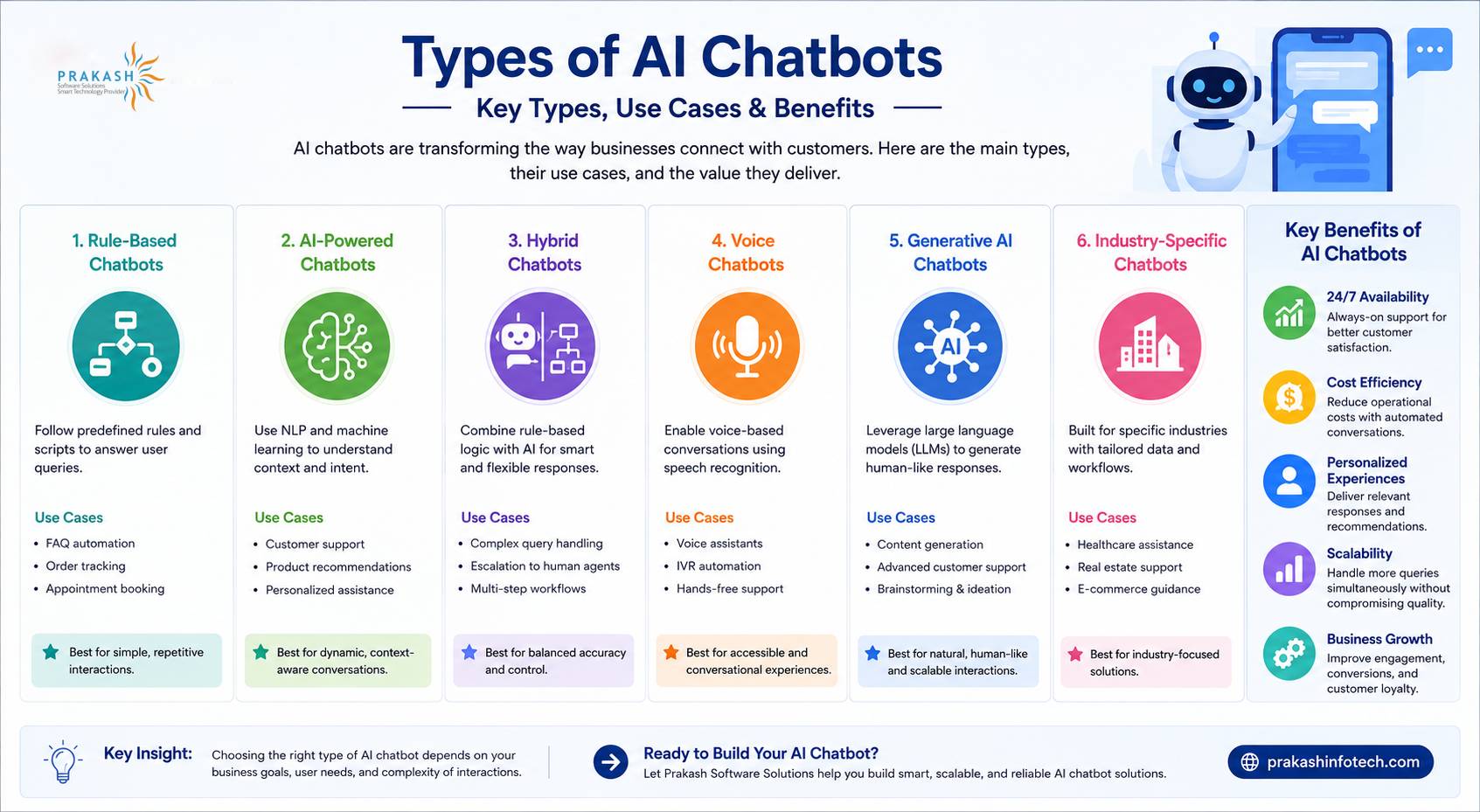
(5) Hybrid Chatbots
A hybrid chatbot is a combination of rule-based and AI-based technologies. While the former is applied in scenarios where the task performed is predictable, AI steps in once the interaction becomes unpredictable and/or emotional. Consider an airline chatbot that uses rules in order to change the date of a ticket, while once the customer begins complaining about their flight cancellation, the chatbot switches to the adaptive mode.
This solution provides businesses with the benefits of both the rule-based and AI technologies and is usually the optimal choice for growing businesses that do not want to risk it all by choosing one option or another.
Best for: Growing businesses that need both consistency and flexibility, without an all-or-nothing AI commitment.
(6) Voice-Enabled Chatbots
Voice chatbots communicate via spoken dialogue instead of text using a blend of speech recognition, NLP, and text-to-speech capabilities. Voice chatbots are what makes possible smart speakers, in-vehicle AI assistants, and contact center IVR bots that don’t have you screaming “REPRESENTATIVE” into your phone.
Most useful for accessibility purposes, such as elderly users who prefer to say “I need an appointment with Dr. Roberts on Tuesday” as opposed to navigating an onscreen form, and hands-free communication, such as for field workers or drivers. The downside is voice recognition is prone to failing when faced with accents, noise, and low-quality phone calls, thus making a handover to human agent inevitable.
Best suited for: Contact centers, healthcare appointment scheduling, any hands-free or phone-based scenario.
(7) Contextual Chatbots
Contextual bots remember. These bots store information about your previous conversations with them – your preferences, problems you have encountered before, or even that nagging problem that you brought up last month – to ensure that each subsequent conversation is personalized instead of treating every conversation as a brand new one. This will work well if the CRM integration is very strong, because the more information the bot has, the more it can help you.
Best for: Subscriptions, loyal customers, and companies that want support to be personalized.
(8) Transactional Chatbots
Bots of this kind are made solely for the purpose of getting things done – processing a return, updating an order, changing the shipping information – without any chatter at all. Here, speed and efficiency come much before anything else, and they usually require integration into back-end systems in order to really perform the transaction.
We have witnessed transactional bots processing order extensions or order changes within one minute and freeing up agents to work on more complex cases.
Best for: High-volume, repetitive transactions like returns, bookings, and account updates.
(9) Social Messaging Chatbots
These bots are designed to serve you where your customers already are – on WhatsApp, on Instagram DMs, on Facebook Messenger – handling every query or complaint your customers have without forcing them out of the platform they’re currently on. Tone is important, too; the wrong tone will make the bot stand out like a sore thumb.
Best for: Consumer brands with a younger, social-first audience and high DM volume.
(10) Predictive Chatbots
The final and most sophisticated kind is predictive chatbots, which make use of history and pattern recognition to determine a customer’s problem before he contacts them. For instance, an internet service provider’s bot could notice repeated disconnections and send the user advice on how to fix the problem – all of this before he even had time to contact them. This one requires a lot of history and a smart way of collecting information, since “helpful” may easily become “invasive” very quickly if not done carefully.
Best for: Businesses with large volumes of historical customer data looking to move from reactive to proactive support.
Also Read: AI Chatbot Integration for Business: A Practical Guide