
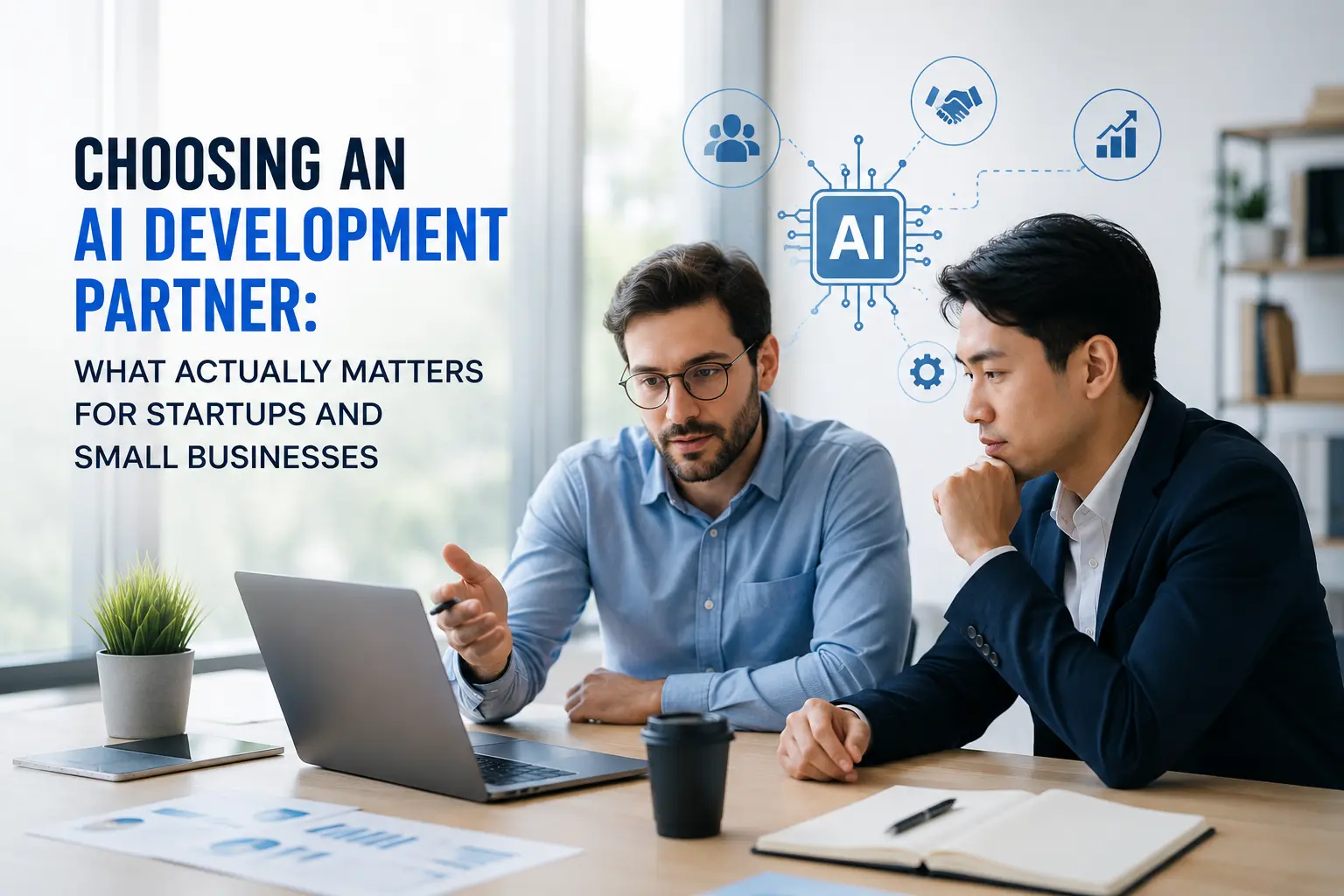
Choosing an AI Development Partner: What Actually Matters for Startups and Small Businesses
Summarize and save time
Quick Summary
This article will help you identify the most appropriate AI development partner based on realistic criteria of fit, not on rankings. Here is an analysis of what “top-rated” really stands for as far as vendors catering to startups go. This article will give you an overview of how custom AI development costs break down (proof-of-concept, MVP, ongoing maintenance), and what to check when evaluating US-based AI companies, including compliance and delivery model. It outlines important questions to ask before you sign the contract — data ownership, error-handling plans, and requesting a small first deliverable — as well as it provides cost guidance for small businesses. It also explains how to vet computer vision and machine learning specialists using practical, verifiable signals.
The first and foremost question when we seek to hire anyone that comes to our mind is whether we can trust them with the job.
Choosing an AI development partner is exactly that kind of decision, except most people go into it blind. Every vendor site says the same things — “top-rated,” “enterprise-grade,” “trusted by industry leaders” — and none of it tells you whether that team is actually right for your project, your budget, or your timeline.
The truth is, there’s no single “best” AI development company. The right choice of a software development partner for your startup with an initial concept differs significantly from the right choice of a partner for a small business that wants to automate its repetitive process, and all of them differ from the partner required by an enterprise.
It is all about fit — and there are a few practical criteria to make sure that a company matches your needs before you sign anything with them: experience in working with companies of your scale, transparency regarding costs, previous experience in your industry or geography, and their answers to difficult questions.
This guide is aimed at the entrepreneur who evaluates proposals in the middle of the night, the small business owner who would like to purchase a chatbot but doesn’t want to get tricked, and the product manager who is looking for a computer vision provider from the second page of Google results. We will take you through this step-by-step without using buzzwords or sales speak, just the facts you need as the signee of the contract.
So, let’s get started.
What are the top-rated AI development services for startups?
Startups are offered another sales pitch compared to enterprises for obvious reasons; there are differences in risk. A big company can absorb a bad pilot run. Startups often cannot afford to waste three months and 50 percent of their runway on a flawed build.
When we are asked which AI development services are “top-rated” for startups, our honest answer would be: it depends it depends less on rankings and more on fit. Good startup partners will have certain common features regardless of their positions in review websites:
- They’re not afraid of starting from scratch, because usually there’s no specced-out document in startup at all.
- They can deliver a product within weeks, not months — a startup needs signal, not perfect architecture drawing.
- They know where limitations of the AI are and won’t promise anything. Saying yes to anything on the first call is a huge warning sign.
- Previous experience of their teams was working with startups, not enterprises. This is a completely different thing and skill set.
Online reviews on Clutch and GoodFirms are a fine starting point, but use the star ratings only as a filter to cut the list down, not as the final call. Read the case studies; see if they discuss tangible results or use fancy words only. The former typically implies doing the job, while the latter implies writing the copy.
What custom AI software actually costs?
This is the question everyone wants answered first, and the question everyone dances around, so let’s not dance.
Custom AI development is not associated with a fixed cost, since “AI project” can mean anything from an AI-based chatbot integrated into the website to computer vision used on a production line in the factory. Nonetheless, here’s how the money flows in reality:
PoC/Pilot:
This stage takes weeks rather than months and requires budget similar to the budget for marketing campaigns rather than product development. It’s all about answering one question at this stage – will this solution work with our data? – before putting any serious investments.
An MVP or first production version:
All the costs lie here, and they vary greatly depending on how complex the dataset is, on the number of systems integrations required and whether you choose to reuse existing foundation model (cheaper and faster) or train one from scratch (rather uncommon and expensive).
Operating expenses:
People tend to overlook this point. AI systems are never done once they’re released; there’s always hosting, monitoring, retraining when needed, and the day when usage changes and you need to adjust something. Get any vendor to explain what year two costs will look like, not only year one.
The number-one factor determining pricing is data. Having clean, organized, accessible data reduces the time and cost of your projects significantly. The situation with dirty data distributed across five different platforms with unclear permissions and access rights is when the budget grows stealthily and unexpectedly.
Which companies provide custom AI development services in the US?
There’s no shortage of firms claiming US presence, so the more useful question is what “custom AI development in the US” should actually mean to you:
- Time zone overlap: If your business is in New York and your development partner is twelve time zones away, every little question becomes a 24-hour round trip. That may be OK in certain situations; it might be a nightmare in others.
- Compliance familiarity: US healthcare, finance, and insurance companies operate under HIPAA, SOC 2, and various state-level privacy laws. If you find a partner who knows his way around these regulations, it will help you avoid future troubles.
- Physical or legal presence: Some businesses require their vendors to be incorporated in the USA, for contract or procurement or any other kind of reason. Worth considering upfront if applicable.
- Delivery model, not just address: Many businesses operate with a US presence but actually deliver development via teams elsewhere. Nothing wrong with that; rather that’s how you get top talent at good prices most times – but you need to know what you are getting into.
A practical way to shortlist: search directories like Clutch, GoodFirms, and G2 filtered by location and by the AI subcategory you actually need (machine learning, NLP, computer vision), then cross-reference with LinkedIn to see if the team behind the case studies still works there. Agencies change hands and shed senior talent more often than their marketing pages let on.
Choosing an AI partner when you’re a startup (the questions that actually matter)
Forget the 20-point vendor scorecards for a second. If you’re a startup founder with limited time, here’s the shorter version — the handful of things that predict whether a partnership will go well.
Get them to critique your idea:
Good AI partners will offer a little bit of skepticism regarding your initial pitch request not out of malice, but because one-half of all failures in AI projects comes from addressing the wrong problem well versus the right problem poorly. If they agree with everything you have to say, they are selling you, not advising you.
Find out what goes wrong when the AI fails:
AI systems fail in output occasionally. Those partners you want to work with will have already considered strategies for handling those cases including fallback actions, human verification procedures, and failure detection mechanisms. Those that have not had to think through this aspect yet probably do not really understand AI solutions yet.
Request a small, scoped deliverable first:
You want to see some proof of concept within your product line in a matter of weeks, with a tangible method of measuring whether or not it is valuable. When a proposal starts off with a six-month timeline and nothing else, it may be a comfort level issue with them.
Ask who owns what afterward:
Confirm in writing that you own the code, the trained model, and the data — not just a license to use them. This matters more with AI vendors than traditional dev shops, because the “model” itself can feel like a black box if ownership isn’t spelled out clearly.
Trust your gut feeling from the initial call as much as their presentation:
After all, you are going to work closely with the team for months to come. If communication was difficult already at the sales stage, it won’t become easier once the deal is sealed.
How much do AI development services typically cost for small businesses?
Small businesses ask this separately from startups for good reason — the math is different. A ten-person accounting firm automating invoice processing has a completely different budget reality than a venture-backed startup building a product from scratch.
The great news for small businesses is that many useful AI applications don’t have to be built from scratch. It might even prove cheaper to use pre-built models and existing AI applications that can be set up and integrated at a small fraction of the price needed to create something from scratch – something such as automating some repetitive task (extracting invoices, sorting emails from customers, booking appointments).
How you should budget for that: start with the most frustrating repetitive task at hand, find out what it will cost to automate just this one task, and then treat it as an experiment to see how well the vendor and the process works before expanding from there. The small business doesn’t need – nor does it benefit from – a lengthy AI roadmap on the first day.
Beware of any vendor who quotes a small business the same figures that he would quote to an enterprise. If the smallest package from the vendor is no different from the largest one, then it is clear that there is no separate small-business package.
Who’s actually good at computer vision
Computer vision gets lumped in with “AI” broadly, but it’s genuinely its own specialty — reading images and video is a different skill set than processing text, and it shows up in the questions vendors should be able to answer confidently.
If you’re evaluating computer vision specialists, look past the demo reel and ask about the boring stuff that determines whether it works in the real world:
- What’s their strategy regarding lighting, angle, and image variations? The model might be working great on perfect images but completely fail on an actual phone camera in a dark warehouse.
- What kind of strategy do they use for data labeling? The quality of computer vision depends entirely on the quality of the labeled training data, which is often the most time-consuming (and least done) part of any project.
- Do they have experience in your particular category of application? Quality control, biometric verification, retail analytics, and medical imaging are very different in terms of how accurate they need to be and what failures mean.
- How do they make sure it can handle edge cases before launch and not after people complain?
A vendor with a genuine computer vision track record will talk comfortably about model accuracy trade-offs, real-world testing conditions, and what happens when confidence is low — not just showcase a polished video of the system working under ideal conditions.
Where can I find AI development services specializing in machine learning?
If general web searches are turning up more marketing pages than substance, here’s where the search tends to work better:
B2B review platforms
(Clutch, GoodFirms, DesignRush) let you filter specifically by “machine learning development” rather than generic “AI,” which cuts out a lot of noise.
GitHub and open-source contributions:
There are an underrated signal — a team that publishes real ML tooling or contributes to major frameworks is usually doing real engineering, not just reselling APIs.
Case studies with actual numbers:
“We built an ML-powered forecasting model” tells you nothing. “We reduced forecast error by a specific, stated percentage” tells you they measured something.
Referrals from your own network:
If you know another founder or operations lead who’s shipped an ML feature, their vendor recommendation is worth more than ten star ratings from strangers.
A direct technical conversation:
Before you commit to anything, ask a genuinely hard question about your specific data or use case in the first call. How a team responds — curious and specific, versus vague and reassuring — tells you almost everything you need to know.
The Bottom Line
There’s no universal “best” AI development company — there’s the right fit for your data, your timeline, your budget, and how hands-on you want to be. The right partners are going to ask you more questions than give you answers during their first phone call, will be truthful in quoting and tell you honestly what cannot be done yet despite the tempting “top-rated” badge and beautiful company logo.
If you are thinking about making the final decision today and want an independent review of the offer, or simply need to discuss your idea and the possible scope of work and budget, this is a conversation definitely worth holding.
Frequently Asked Questions
There isn't a single "best" list worth trusting, and anyone who hands you one without asking about your project first is guessing. Things that you can check yourself: the period of operation of the company in providing AI development (and not software under the guise of AI development), if there are clear statistics mentioned in the company's case studies, and whether or not the senior people who created earlier projects are still in the company - here the search for information via LinkedIn works much better than any award page.
Cross-reference a shortlist across Clutch, GoodFirms, and G2, filtered by your specific niche (NLP, computer vision, ML), and you'll get a far more honest picture than any "top 10" roundup.
Reliability is evident in the small details before it is evident in the contract itself. Is the team thorough in asking tough questions concerning your data prior to providing a quotation, or do they provide their quotation and then ask their questions? Is there any mention of the potential problems, or is the only mention of the guaranteed success? A reliable firm would be very willing to take you through their experience of an unsuccessful venture and how they modified because of it.
What startups need is for “top-rated” to actually mean “quick, upfront, and comfortable with uncertainty,” because startups rarely come prepared with complete specifications.
Those that deserve consideration are those who have the capability to provide a working proof of concept in weeks rather than months, and who will actually give you the straight truth on feasibility issues instead of just going with the flow. Star ratings may be okay as an initial guide on review websites, but read the cases first.
The real answer is time and risk rather than innate talent. To develop your own AI skills, you have to hire professionals that you may not necessarily require full-time, make costly mistakes on your own, and wait for several months to determine whether your idea is going to work at all.
The right AI partner knows all about the costly mistakes that others paid for him, has the required infrastructure and tools at hand, and gets you there sooner rather than later.
The specifics depend on what point you're at and the cleanliness of your data, but the profile of the spending remains relatively similar: the proof-of-concept phase typically takes weeks and requires a spend that's more marketing budget than product budget, because its purpose is to answer the question: "Will this work on our data?" Real spending kicks in during the MVP or the first production release, where the complexity of data, number of systems required, and existing or non-existing foundation models dictate the scale of the spending.
Then there's the bit that people never factor into their budgeting — the continuous hosting and monitoring costs, and potential retraining costs after deployment. Ask anyone selling this their costs for year two, not just year one.
Of course, there are the obvious directories (Clutch, GoodFirms, DesignRush), but the good indicators are not all there. The Github activity will tell if the company is doing any real development or just reselling the APIs of other companies.
The recommendation of another founder who used a particular company and built something with their help will be worth more than a bunch of glowing reviews from strangers. One test that will work for you is to come to the first call with a tough, specific question regarding your data and see how the answer is delivered.
Yes – and the trick lies in understanding that there’s no need to build anything from scratch. Many helpful AIs for startups are essentially the application of pre-built models to just one repetitive process – the classification of emails, data extraction from invoices, appointment booking and so on. This costs much less than a custom build and provides an effective method of testing whether a particular vendor is good enough and the process can be implemented successfully.
The sign that needs to be taken into account is when a vendor’s cheapest option is exactly the same as the enterprise one – this means he or she doesn’t have a product for small businesses at all.
Forget all the marketing jargon; it’s just about fit. What you really want is a team with experience in your size business, honest estimates of cost and time frame, history in your space or a space similar to yours, and a team that isn’t afraid to challenge your ideas instead of saying yes to everything you suggest. Make sure you know what will happen if the AI is wrong, make sure it’s in writing that you own the software and the algorithm after the project is over, and make sure you get a little bit delivered before you agree to a lot.
And remember what the conversations are like at the beginning; you’re going to be working with these people for months to come, and if talking was hard at the sales stage, it’s not going to get easier.
Being involved in building a significant amount of generative AI applications I can say that the success of these apps lies in one thing — their model is integrated into a user’s workflow and people trust their results. Building some LangChain agents or ML models in a notebook? Piece of cake. The real deal is to build something useful in production, to ground it so that it won't start hallucinating and doing stuff for no reason. This is where most demonstrations fail silently, and this is what we concentrate on the most.