
AI Chatbots for Insurance: Use Cases, Benefits, and Implementation Guide
Summarize and save time
When it comes to the insurance industry, demand is usually at uncertain times, as the moments when support might be needed are unforeseen. It can be a driver who met with an accident, a homeowner filing a property claim, or a business owner looking for help to renew the policy. In all such situations, long wait times, repeated identity checks, lack of clarity about the next steps, or fragmented tools, can all create frustration among the users and drive them away.
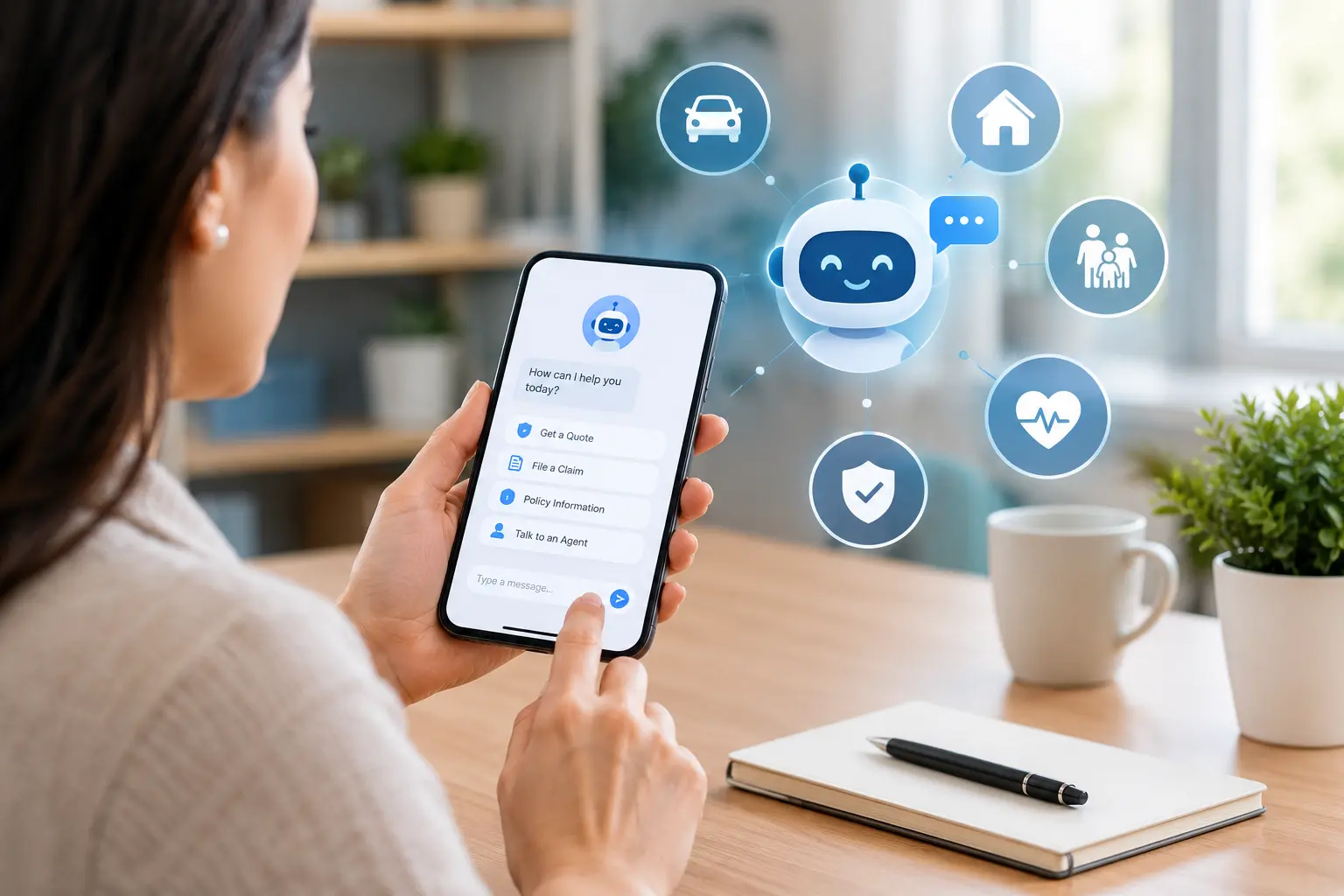
This is where AI chatbots for insurance are offering a unique experience altogether for insurance holders as well as the insurers. The insurance holders can get immense help from the chatbots, such as finding instant answers for policy-related questions, guiding customers for claims-related intake, receiving and processing claim status updates, supporting renewals, and so on. Moreover, AI chatbots for insurance are advanced, which is why, unlike traditional bots, these can interpret human language, maintain context, and provide natural responses by connecting you with the insurance systems.
Subsequently, for insurers, the AI chatbot support spans from underwriting assistance to back-office operations, claims intake, and fraud-detection workflows. By ensuring proper enterprise AI integrations of these bots with policy administration, CRM systems, and document systems, they can serve more than a website widget. The goal of using AI-assisted chatbots is simple: not to replace humans but to reduce the repetitive manual work so that human agents can focus on more complex, sensitive, and high-value interactions.
There are several leading AI development companies like Prakash Software Solutions (PSSPL) that are renowned for offering enterprise-grade AI chatbot development services. At PSSPL, our team of 250+ AI and data engineers are competent in customizing and seamlessly integrating AI chatbots into your digital operating insurance models.
AI Chatbots for Insurance: Statistics and Market Outlook
Among modern businesses, the demand for conversational AI, virtual assistants, and AI chatbots is rapidly growing because of 3 primary reasons:
- Need to bring down service costs.
- Modernizing customer experience with an interactive and effortless user journey
- Improving the response time to avoid user frustration
Considering all these, the demand for AI chatbots for insurance is also witnessing a rapid spike, which can be identified in the below-stated market statistics:
- According to the 2026 forecasts from Gartner, the artificial intelligence industry is expected to reach $2.67 trillion in 2026, up by 49.5% from the last year.
- Following the enterprise AI agent statistics from Gartner, it’s predicted that 40% of the enterprise applications will feature task-specific AI agents by the end of 2026.
- It’s also predicted that agentic AI will autonomously resolve 80% of the customer service issues without any human intervention by 2029.
- As per the 2026 industry estimates, over 60% of the insurers are now running AI-assisted customer communication, which includes chatbots for claims, policy inquiries, and internal agent workflows.
How to Turn Insurance Conversations into Measurable ROI?
Design AI chatbots for insurance around real insurance journeys to witness a reduction in service volume, improve renewals, and foster an improved customer experience.
Hire AI developers from PSSPL to assess data readiness, identify high-value use cases, and build secure conversational AI chatbots for seamless enterprise AI integrations in your insurance systems.
What are AI Chatbots for Insurance?
Insurance-related tasks can be a lot time-taking with several repetitive processes that require a lot of human effort. Conversational AI systems like AI chatbots for insurance replace these laborious tasks with automated text and voice-enabled systems that generate natural-like responses without human intervention.
These chatbots can be of huge assistance to policyholders, insurers, brokers, prospects, and internal teams in completing insurance-related tasks. Here’s everything you can expect from a modern insurance chatbot:
- Interpreting and processing natural-language
- Maintaining context across a conversation.
- Retrieving information from approved knowledge sources with secure user authentication.
- Accessing claims, billing, and policies with approved and seamless integrations.
- Escalating the query to a suitable human agent when needed.
- Automated guidance to users for multi-step workflows.
- Recording interactions for quality, compliance, and analysis.
Let’s understand the functioning of AI chatbots for insurance with an example:
Supposedly, a customer met with a minor accident and instructed the chatbot that he/she needs to file an insurance claim. In such a case, the AI-powered chatbot will gather all essential details, identify the user’s intent, verify policy details, request photos or document proofs of the incident, generate a claim reference, and guide the next steps. In case there is a complex injury or an unusual instance in the claim, the chatbot will route the inquiry to the respective claims specialist.
What did the AI chatbot do?
It eliminated the unnecessary back-and-forth between the policyholder and insurer and saved time for both parties without any further delays. The automation simplifies the claim procedure and provides a straightforward solution with less or no manual effort.
AI Chatbots vs. Traditional Insurance Chatbots
A lot of you might wonder that the emergence and use of chatbots in the insurance industry is no new phenomenon and has been there for quite some time. Well, you are right, but AI chatbots are different from traditional insurance chatbots in more ways than one. Additionally, with customized AI chatbot development services offered by companies like PSSPL, the distinction becomes more extensive.
The biggest difference lies in their operating patterns. A traditional insurance chatbot follows a predefined set of rules where it can answer a limited set of questions, guide users through fixed menus, and escalate the request to an agent only when it’s outside of its script. Whereas AI-assisted chatbots are way more flexible, using advanced AI capabilities like:
- Natural language processing
- Retrieval systems
- Large language models
- And enterprise AI integrations
These AI capabilities help the AI chatbots for insurance to accurately interpret the user’s intent and provide context-aware natural responses.
| Points of Difference | Traditional Insurance Chatbots | AI Chatbots |
|---|---|---|
| Intent understanding | Restricted to predefined keywords and a set of rules. | Understands human intent and context in natural language without the need to make it predefined. |
| Conversation style | Scripted or menu-based. | Natural language conversational. |
| Level of personalization | Limited scope. | Can be fully customized based on the availability and authenticity of the customer data. |
| Knowledge access | Static FAQ content. | Retrieves information from approved knowledge sources and policy repositories. |
| Claims support | Basic form-based routing. |
|
| Integration | Often restricted. | Seamlessly connects to CRM, claims, billing, and payment systems. |
| Scope of improvement | Possible with manual updates. | Based on constant monitoring, user feedback, and AI evaluation. |
| Best use case | Simple FAQs. | Insurance lifecycle workflows. |
Smart Approach:
Many modern-day startups and enterprises are smart enough to combine both approaches. While the traditional insurance chatbots enforce compliance and governance rules, the AI chatbots for insurance offer a broader scope of customization, summarization, natural language understanding, and advanced information retrieval for informed decision-making.
Top AI Chatbot Use Cases Across the Insurance Industry
There are several practical use cases of AI chatbots for insurance that can offer measurable business value. With each use case, there comes a different level of clinical, compliance, security, and operational validation. Let’s look at some of the most popular use cases:
-
Instant Quotes and Policy Recommendations
The AI agents for customer service can help prospects understand the details of the policy, related to policy coverage options, comparison of plans, answering product questions, and generating preliminary quotes.
To provide these details, the chatbot first needs to understand the user’s intent and queries. For this, an AI chatbot asks questions like:
- What property or vehicle is getting insured?
- What is the type of insurance that you are looking for?
- What are the required coverage limits?
- What are the preferred deductibles?
- Are there any existing policies or prior claims to process?
After receiving this required information, the chatbot then retrieves the required product information, calculates the estimated quote, and routes the high-intent prospects to an appropriate advisor.
-
Lead Qualification and Sales Support
Insurance websites do receive multiple queries, but they fail to convert. This is because the prospects don’t receive timely guidance, which is exactly why AI chatbots can help. These chatbots can engage visitors, qualify leads, provide instant answers to queries, collect contact details, and schedule consultations accordingly.
All this skips the part of waiting for human assistance, which is why delayed responses can be avoided, and sales support can be improved. The chatbot also helps identify qualified prospects and pass them to the sales team with useful context and recommended policy coverage options.
-
First Notice of Loss and Claims Intake
Claims intake is one of the highly regarded and common use cases of AI chatbots for insurance. At any time of the day, an AI chatbot helps to guide customers through the first notice of loss. It offers complete information for the claims team to start processing and reduces the laborious work of manual data entry.
It helps to:
- Identify the claim type.
- Verify policy coverage after gathering the incident details.
- Validate required fields by asking for pictures, police reports, invoices, and other documents.
- Creates a claim reference and notifies the claims team.
- Provides the next steps.
-
Customer Onboarding
Customer onboarding includes several steps, such as collecting documents, verifying identity, providing policy explanations, setting up payment systems, and providing product education. AI chatbots that are connected to approved knowledge sources can customize the answers while directing sensitive questions to human agents.
By guiding new customers through each step in the process, AI chatbots reduce the likelihood of incomplete applications. It can answer and resolve several questions pertaining to the policy coverage specifics, the process of submitting claims, the list of required documents, and the timeline of the policy coverage.
-
Claim Status Tracking and Updates
Most of the time, customers frequently get in touch with the insurers to inquire about the claims status. An AI chatbot for insurance reduces inbound calls with improved transparency by retrieving relevant claim information, explaining the current stage, identifying the missing documents, and notifying the customers about the progress.
It handles several questions related to:
- The status of the claim being assigned
- Pending document checklist
- Process to upload additional evidence
- Meaning of the claim status
- And so, on
-
Policy Servicing and Renewals
AI chatbots also assist the insurers and policyholders in renewing policies, updating contact details, reviewing coverage, downloading policy documents, and making payments. They also help send proactive reminders for:
- Upcoming renewal dates
- Premium due dates
- Policy changes
- Missing documents
- Annual coverage reviews
-
Billing and Payment Support
Billing questions are highly common and repetitive in nature, which is why AI agent development services can be of high value. An AI chatbot assists customers to:
- review premium details
- check the due dates for the policy
- understand the payment terms and options
- resolve any failed payments
- connect to secure payment flows
-
Fraud-Flagging Support
AI chatbots for insurance provide support in identifying fraud-risk workflows by spotting unusual patterns, missing information, or inconsistencies in claims conversations. Instead of making final fraud decisions, these chatbots help flag cases for specialist review.
-
Underwriting and Broker Support
Internal AI chatbots also assist underwriters and brokers to retrieve the underwriting guidelines, summarize risk information, ensure the submission is complete, and identify the missing documents, if any. By doing so, the chatbot can confirm a complete submission before it reaches the underwriter.
How AI Agents for Customer Service Improve Insurance Support?
AI agents for customer service don’t simply answer questions, but they take action. They can retrieve essential customer data, update CRM records, create claims, send document requests, verify policy details, schedule appointments, and route the case to the right department or agent.
It’s not simply a conversation, but it’s a workflow with accuracy, security, and reliability. Let’s understand this with the help of an example.
When a customer reports water damage, an AI agent takes over the following actions:
- Does customer authentication
- Retrieves the policy and coverage details
- Confirms the type of claim
- Confirms the incident based on an analysis of photos and other documents
- Creates a claim record and notifies the claims team
- Sends a confirmation and claims reference to the right human agent
Go Beyond FAQs with AI Agents for Insurance
Customers are not simply looking for answers, but they also want their queries to be handled properly. AI agents assist in verifying the policy details, updating CRM records with the collected claims information, notifying teams, and escalating complex cases to human agents.
At PSSPL, our AI agent development services design customized AI agents that ensure seamless enterprise AI integrations while ensuring human oversight.
Key Features of an Enterprise Insurance Chatbot
When considering enterprise insurance chatbots, it’s important to pay attention to customer experience as well as operational governance. At PSSPL, we ensure both by building AI chatbots for insurance with the following key features:
| Feature | What It Means | ||||||
|---|---|---|---|---|---|---|---|
| Natural Language Processing | This feature allows the chatbot to understand and support natural human language and intent. Even if users describe issues in their own words, the AI chatbots for insurance can interpret the context and generate suitable human-like responses. | ||||||
| Secure Authentication | AI chatbots help to safeguard sensitive actions by implementing identity verification, secure customer portal access, and multi-factor authentication. | ||||||
| Context and Memory | The chatbot maintains the context of the entire conversation, such as type of claim, uploaded documents, policy number, previous questions, etc. | ||||||
| Retrieval-Augmented Generation | RAG empowers the chatbot to generate responses based on the information retrieved from approved policy documents, claims procedures, underwriting guidelines, and compliance materials. To ensure auditability, it can also provide citations. | ||||||
| Multilingual Support | Insurance organizations deal with customers from a diverse base, which is why multilingual support becomes essential to improve accessibility and reduce language barriers. | ||||||
| Omnichannel Deployment | This feature facilitates the smooth operation of the AI chatbot
Benefits for Insurers, Agents, and PolicyholdersThere are several parties involved in the use of AI chatbots for insurance companies. The user base largely includes insurers, agents, and policyholders, and here’s how these chatbots can benefit them:
How to Build an AI Chatbot for Insurance?A structured development approach is the key to ensuring an effective, value-adding, and secure AI chatbot for insurance. At PSSPL, we follow a comprehensive end-to-end development plan to help you build production-ready and custom AI chatbots. Here are the steps we follow: (1) Define the Business GoalOur process of developing custom AI chatbots begins with the identification of a specific outcome to achieve. This can be reducing claims-related calls, accelerating the First Notice of Loss, improving quote conversions, or the policy-renewal rates. (2) Map the Customer JourneyBased on an identification of the business goal, we then document the customer journey, which varies based on each use case. We map this by identifying the questions often asked by customers, analyzing the required documents, the systems involved, and the approval steps. (3) Prioritize Use CasesThen we prioritize the use cases from high-to low-risk workflows. Our preferred starting points include FAQs, claim status updates, billing questions, document requests, lead qualifications, and so on. (4) Prepare Knowledge SourcesWe ensure that the knowledge sources are relevant and updated with properly defined access permissions so that accurate information can be retrieved. For this, we clean and organize policy documents, claims procedures, FAQs, product information, and internal guidelines. (5) Select the AI ArchitectureThis is the stage where we decide what type of AI architecture the AI chatbot will need:
(6) Build Secure IntegrationsIn this step, we ensure a secure and seamless connection of the AI chatbot with APIs, existing business systems, and data infrastructure. Our goal is to use least-privilege access and validate every tool call. (7) Test with Real ScenariosWe test and validate the AI chatbot for insurance in real-world scenarios, such as incomplete information, emotional situations, testing common questions, policy exceptions, payment failures, claims disputes, and so on. (8) Phased LaunchOnce the chatbot passes the testing stage, we then launch the chatbot in stages. It begins with a limited pilot and escalates to full-scale launch after monitoring performance, gathering feedback, and refining the conversation flows. This is done to ensure quality and adoption before the expansion of the chatbot. (9) Monitor and ImproveThe support from the PSSPL team of AI experts doesn’t end with the implementation phase. We offer continued maintenance and support by tracking the conversion quality, customer satisfaction rates, resolution rates, cost per interaction, and business outcomes. This data helps us to improve prompts, enterprise AI integrations, workflows, and knowledge sources. Frequently Asked Questions (FAQs)AI chatbots for insurance help foster customer service by:
An AI chatbot for insurance mainly communicates with policyholders, insurers, and agents and provides information. AI agents for customer service can take action, such as creating claims, updating records, retrieving policy details, and triggering workflows. The enterprise AI integrations of these chatbots with an existing system are facilitated by role-based permissions and authentication. The connections happen via:
The chatbots can seamlessly connect with payment systems, claims, billing, CRM, document management, and policy administration. AI chatbots can be secure for insurance data when they are implemented with access controls, authentication, encryption, audit logs, secure hosting, data minimization, and minimal human oversight. Depending on the complexity and use case of the AI chatbot, the cost estimation can vary. A basic chatbot can cost approximately between USD 20,000 and 60,000, while an enterprise solution can range between USD 80,000 and 300,000+. No, chatbots can handle routine questions and administrative tasks. But they can't replace insurance agents because these agents manage complex claims, deal with sensitive conversations, and make decisions requiring human judgment. A basic chatbot can take a few weeks or months. An advanced enterprise AI chatbot with multiple integrations, strict security controls, multilingual support, the need for AI agents, and workflow automation would take several months or even longer depending on the requirements. Final ThoughtsAI chatbots for insurance have evolved beyond simply serving as digital FAQ tools. They have become a prominent part of the broader customer service and operational automation strategy, spanning claims, renewals, policy sales, onboarding, underwriting support, and agent enablement. As a smart insurer, you can’t deploy a chatbot and expect instant results. You must begin with high-value customer journeys, securely integrate AI with core systems, maintain a required level of human oversight, and improve the entire experience based on real usage data. Partner with reputed companies like PSSPL to avail their cutting-edge AI chatbot development services. These services can assist insurers in improving claims experiences, empowering agents, reducing service frictions, and fostering strong customer relations. Design, implement, and integrate secure and scalable AI chatbots for insurance that are aligned with your measurable business outcomes. I have developed a good number of computer vision, speech, and LLM projects over the years, and let's be honest about the important ones: whether the model is reliable where it is expected to work – at the edge, on-device, in the pipeline, and whether people can trust what the model produces. Training the model, beating a benchmark – that is not my biggest problem. My biggest problem is getting the model fast and reliable in CoreML or ONNX, and making sure that everything else doesn't fall after we move it to production. Almost all prototypes die on this stage, so I focus my efforts here. You may also likeAdding {{itemName}} to cart Added {{itemName}} to cart Loading...
|