
AI Agents vs Agentic AI: Key Differences, Use Cases, and Business Value
Summarize and save time
If you look at the technology discussions around you, terms like AI agents, agentic AI, autonomous agents, and multi-agent systems have become very prominent. They are often confused as the same thing and used interchangeably, but that’s not true. Yes, they are closely related as they fall under the same branch of AI agent development services, but each one of them describes distinct levels of capability and architecture.
Let’s look at the distinctions between AI agents and agentic AI in detail in this blog.
An AI agent refers to a software component that is built to assist in understanding business information, making limited decisions, and using approved tools to complete a pre-defined task. Some common tasks that an AI agent can perform include retrieval of employee records, categorization of support tickets, document summarization, creating a service request, and so on.
Agentic AI, on the other hand, refers to a broader approach or system architecture that enables software to pursue a larger goal through proper planning, coordination, adaptation, and controlled actions. This can be applied across multiple agents, tools, data sources, and enterprise applications.
In simple terms, the difference between AI agents vs agentic AI is quite simple:
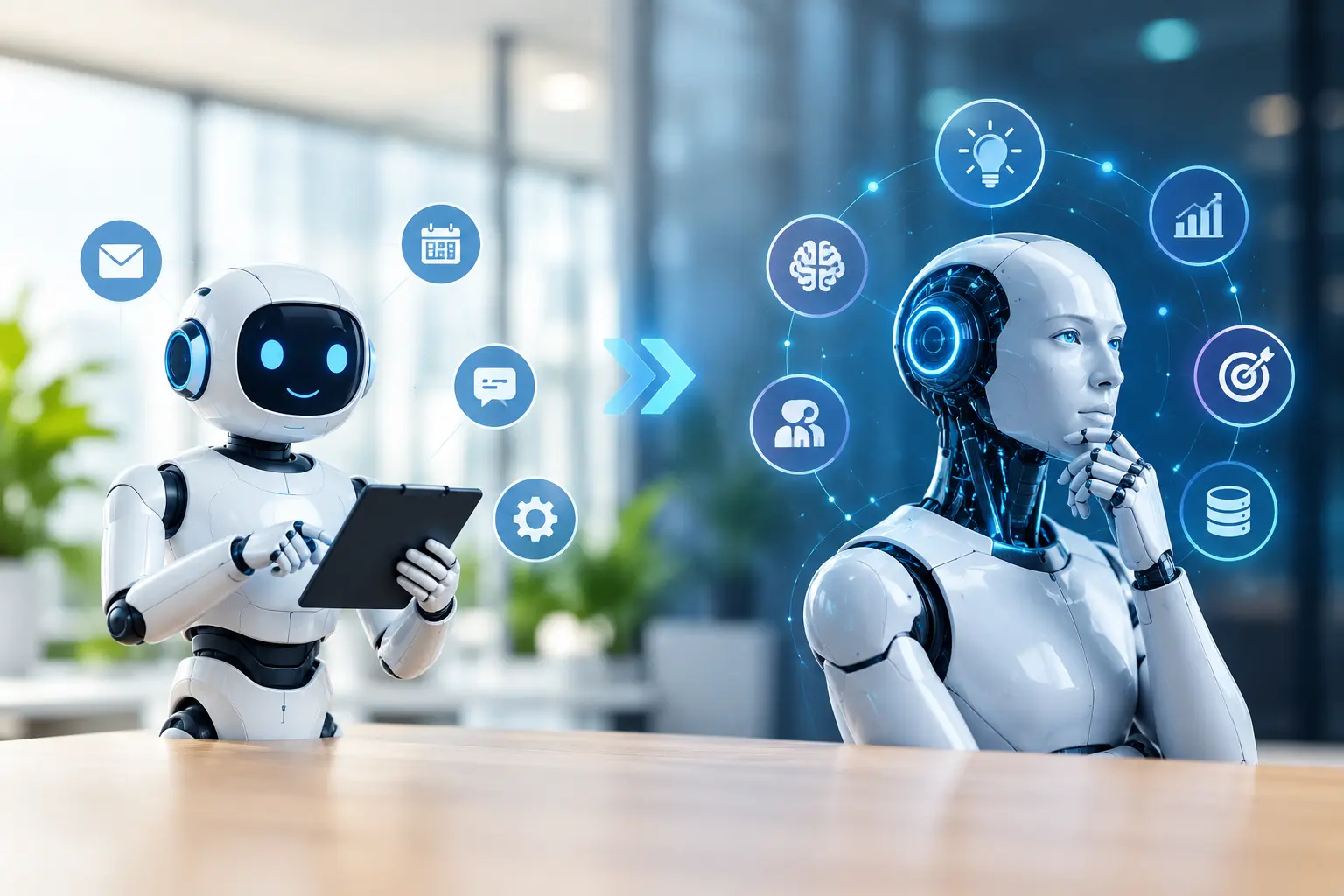
AI agents are used to perform a defined task. Agentic AI is used for task coordination, which includes coordination of actions, decisions, and workflows that help achieve the overall outcome.
It’s vital to understand this differentiation between the terms because the wrong approach can result in fragmented automation and development. As a result, despite deploying multiple useful agents, businesses fail to manage complex cross-functional workflows.
AI Agents and Agentic AI: Statistics and Market Outlook
Let’s first begin the comparison of agentic AI vs. AI agent with the market dynamics:
- As per reports from Gartner, nearly 40% of enterprise applications will feature task-specific AI agents by the end of 2026, up from below 5% in 2025.
- The global agentic AI market is expected to reach USD 205.88 billion by 2033, recording a 40.2% CAGR from 2026 to 2033.
- According to Gartner reports, 33% of enterprise software applications will incorporate agentic AI by 2028.
- McKinsey data indicates that 62% of organizations are experimenting with AI agents, while only 23% are scaling agents in at least one business function.
- The drive towards the use of AI agents and agentic AI systems is growing rapidly, which is why investment in agentic software development is expected to grow 12x by the end of 2026.
What Is an AI Agent?
An AI agent refers to a software system that perceives input, reasons within a defined scope, and takes specific action to attain an expected goal. It utilizes an AI model, instructions, memory, data sources, tools, and controls in generating responses.
A simple AI agent responds to one prompt, whereas a more capable agent can execute a multi-step task by retrieving information, calling APIs, and updating enterprise systems. The core elements of an AI agent include:
| Component | What it Does |
|---|---|
| Model |
|
| Instructions |
Defining:
|
| Context |
Serves relevant information like:
|
| Knowledge Retrieval | Helps find relevant content from approved enterprise sources. |
| Tools |
Enables the AI agent to:
|
| Memory or State | Stores the necessary context of a task or conversation. |
| Guardrails | Sets limits for what the AI agent can do or access. |
| Monitoring |
Records the:
|
What is Agentic AI?
Agentic AI is a broader AI system that works towards specific goal attainment by including everything from planning, tool coordination, choosing actions, adapting to evolving conditions, and tracking progress across the workflow. This is why agentic AI does not respond only to one request at a time but can manage a sequence of decisions.
This is usually done by breaking a request or objective into different steps, deciding which tool or agent will be appropriate to perform the action, evaluating the results, and then revisiting the plan to refine it if needed. The core elements of agentic AI systems include:
- Goal-oriented planning
- Agent and tool orchestration
- Feedback loops
- Adaptive execution
- Persistent workflow and policy enforcement
- Approval gates
- Failure recovery
To understand the role of AI agents vs. agentic AI better, let’s look at a simple example:
In case of a procurement exception, a simple AI agent detects a mismatch between an invoice and a purchase order. Whereas agentic AI systems determine the details of the mismatch, including why it happened, checking the budget availability, identifying the right approval path, notifying and retrying in case of a failed system call, and closing the workflow after all conditions have been resolved. It’s no compulsion that agentic AI systems need to have multiple agents. A single agent can also be sufficient if it has the right planning, tools, and execution plan.
AI Agents vs Agentic AI: The Core Difference
There is always one core difference that distinguishes 2 comparing variants. In the comparison of AI agents vs. agentic AI, that core differentiating factor is the scope of responsibility.
An AI agent usually functions task-oriented by working within a specific domain, using a defined set of tools and rules, and completing a particular sequence of actions. While agentic AI systems are outcome-oriented. They manage the wider process around the end goal, ranging from planning and coordination to exceptions, dependencies, approvals, and adaptation.
Therefore, don’t treat AI agents and agentic AI systems as 2 separate or unrelated technologies. An AI agent can be a building block inside an agentic AI system. The example below will help you clearly understand how an AI agent completes an action, whereas an agentic AI system tracks and manages the progress towards that outcome.
Let’s understand this with a new employee onboarding process:
| What AI Agent Does | What Agentic AI Systems Do |
|---|---|
| Extracts the role details of the employee. | Understand the goal of completing onboarding. |
| Creates an IT support ticket. | Coordinate HR, IT, security, payroll, and training systems. |
| Sends a welcome email. | Check the start date and the job role of the employee. |
| Assigns mandatory training and induction. | Detect and escalate missing approvals, if any. |
| Track completion of the process across all departments. |
Let's look at a side-by-side comparison of AI agent vs. agentic AI systems to give you a better understanding:
| Factors | AI Agents | Agentic AI Systems |
|---|---|---|
| Primary focus area | Defined task completion or a narrow workflow. | Broader goal or tracking the end-to-end outcome attainment. |
| Scope | Individual task, domain, or function. | Multiple tasks, tools, systems, and teams. |
| Planning | Follows a short, predefined sequence of actions. | Breaks the end goal into multiple tasks or steps and adjusts the plan. |
| Autonomy | Bounded by assigned role. | Policy-controlled autonomy across workflows. |
| Tools | Uses approved tools for a specific function. | Selects and coordinates the tools and agents. |
| Adaptation | Responses are limited to inputs within its scope. | Replans if the data, systems, or conditions change. |
| Error Recovery | Limited number of retries available. | Uses broader recovery paths and replanning. |
| Coordination | Can operate in silos or with other components. | Orchestrates agents, tools, systems, and approvals. |
| Best-suited Use Cases | Tasks that are repetitive, well-defined, and predictable in nature. | Multi-step, dynamic, and cross-functional processes. |
Types of AI Agent
There are distinct types of AI agents in the market, each one suited for a different level of complexity, requirement, and autonomy. Let's look at these types below:
| AI Agent Types | What these Agents Do | Examples | Best-Suited for |
|---|---|---|---|
| Reactive or Reflex Agents | These agents respond directly to input depending on the predefined rules. | An IT agent that provides password-reset instructions after receiving a request. | Simple and predictable tasks with well-defined rules. |
| Model-Based Agents | These agents maintain an internal representation of their environment and use context and history to make informed decisions. | A finance agent validating an invoice using current approval status and purchase-order data. | Workflows where decisions are made beyond the current input. |
| Goal-Based Agents | Goal-based agents choose actions that help them attain a defined objective. | A sales agent moves a qualified lead forward after reviewing the account activities and determining the next best action. | Structured workflows that have a clear desired outcome. |
| Utility-Based Agents | These agents compare the potential outcomes using defined criteria like cost, speed, risk, expected value, etc. | A shipping option is chosen by a logistics agent after reviewing details like delivery urgency, shipping cost, customer preference, etc. | Decisions where a choice is to be made between multiple options. |
| Learning Agents | Learning agents improve over time based on feedback, evaluation results, and user corrections. | Improvement in the retrieval ranking by a knowledge-search agent based on the answers that employees find useful. | Repeated tasks involving performance improvements based on feedback loops. |
| Conversational Agents | These agents interact with the users using voice or text. | A customer support agent that checks order details and provides answers for order status. |
|
| Action Agents | Action agents perform tasks in systems like CRM, ERP, ticketing, email, and so on. | An HR action agent updating employee record after the change request is approved. | Workflow automation with controlled actions. |
| Ambient Agents | These agents operate in the background and act only when defined signals take place. | A security agent alerts the team on receiving a suspicious login pattern. |
|
| Multi-Agent Systems | Several agents collaborate together under an orchestration layer. | A procurement system that has separate agents for contract analysis, approval, budget validation, etc. | Complex workflows where roles and permissions need to be separated. |
Bonus Read:
AI agents and agentic AI systems can work together, where individual agents do the specialized work, and the agentic AI system architecture manages the overall process, policy, and outcome. An enterprise automation strategy that is well-planned doesn’t choose between the two; it uses both at appropriate levels.
Technical Components Behind Agentic Systems
It takes more than a large language model for a production-grade agentic system. It requires several technical components, such as architecture, security, reliable actions, measurements, etc.
Foundational Models
Large Language Models interpret requests, create plans, summarize content, and select potential actions. Different models might be used for different tasks based on the required level of accuracy, latency, and deployment.
RAG and Knowledge Retrieval
Retrieval-augmented Generation (RAG) retrieves relevant information from the approved documents, databases, policies, and knowledge bases before finalizing a decision.
RAG reduces the risk of unsupported responses and is largely used for enterprise knowledge assistants, customer support systems, and policy workflows.
Orchestration Layer
This layer is responsible for managing the workflow state, agent routing, task dependencies, tool selection, approval, and exception handling.
Tools and APIs
Tools allow the agents to act with restricted access. They can create a case, send a message, schedule an appointment, retrieve an order, and even update a business record.
Policy and Governance Layer
A policy layer applies business rules, permissions, data restrictions, and approval requirements to ensure that the system doesn’t rely only on model instructions for decision-making.
Observability and Evaluation
Observability provides the team’s visibility in identifying where a failure came from: the model, tool, integration, data source, or workflow logic.
Use Cases: When to Use AI Agents vs Agentic AI
Let’s look at the use of AI agents vs. agentic AI systems based on the distinct use cases in different industries.
| Use Case | AI Agents | Agentic AI Systems |
|---|---|---|
| Customer Service |
Use for handling common user requests such as:
|
It identifies the root cause, requests approval, and manages a full case across:
|
| Finance and Procurement | Used for extracting invoice fields, comparing data to purchase orders, and validating totals. |
Helps resolve invoice exceptions by:
|
| HR | Provides answers to policy questions, retrieves leave balance, and creates an access request. | Helps in coordinating onboarding or offboarding across HR, IT, payroll, security, and learning management systems. |
| IT Operations |
Helps with:
|
Coordinates incident response by:
|
| Healthcare Administration |
Used for:
|
Helps to coordinate prior authorization workflows across patient records, clinical documents, staff approvals, and scheduling systems. |
AI Agent Development: A Practical Implementation Roadmap
For successful AI agent development, the process design needs to be accurate, structured, and well-planned. Several AI app development companies like Prakash Software Solutions (PSSPL) follow a comprehensive and well-defined development process. Let’s look at what type of practical implementation roadmap these companies follow.
(1) Identifying a High-Value Workflow
Companies like PSSPL begin with an identification of a process that has measurable friction, clear ownership, data accessibility, and risk management. Some examples include document extraction, customer service requests, invoice validation, knowledge search, etc.
(2) Defining Scope and Success Metrics
Documenting the capabilities of an AI agent, what it can’t do, which tools it requires, when it should escalate, and how success will be measured.
Possible success metrics in such scenarios mainly include:
- Response accuracy
- Time saved
- Escalation rate
- Task completion rate
- Cost per outcome
- User satisfaction
- Reduction of errors
(3) Assessing Data and Integration Needs
This step is about identifying the required data sources, APIs, data-quality issues, user permissions, and compliance needs.
(4) Selecting the Right Architecture
Determine whether the specific use case will require:
- An action agent
- RAG
- A single AI agent
- A multi-agent design
- A conversational interface
- Human approval gates
(5) Building Controls
This step is for building strict controls, such as:
- Implementation of role-based permissions,
- Restricted access
- Validation
- Tool restrictions
- Error handling
- Escalation paths
- Logging and rate limits
(6) Testing and Refining
Companies test the AI agents and agentic AI systems for:
- Incomplete inputs
- Conflicting records
- Unavailable APIs
- Prompt injection
- Unauthorized requests
- High-volume traffic
- Unexpected workflow states
(7) Pilot and Monitor
Most reputed companies begin with a limited user group and limited permissions as a pilot program. This helps them monitor the performance of the AI agents and agentic AI systems and make refinements based on:
- Measuring outcomes
- Collecting user feedback
- Inspecting traces
(8) Scale Carefully
The agent or system is scaled only after it demonstrates security, reliability, user acceptance, and measurable business value.
Why Partner With PSSPL?
You might wonder, out of a list of numerous AI agent development companies, why startups, SMBs, and large-scale enterprises prefer to partner with Prakash Software Solutions (PSSPL)?
Following the 26+ years of software engineering expertise, global exposure serving 500+ clients across 40+ countries, and successfully delivering 1000+ projects, PSSPL helps build practical and production-ready AI applications. With their enterprise-grade technologies and tools, they have competence in building AI agents, agentic AI systems, workflow automation systems, data solutions, and enterprise integrations.
At PSSPL, we have a user-centric approach and focus on production-ready architecture instead of isolated prototypes. Our team of 250+ AI engineers and experts supports organizations with:
- Multi-agent orchestration
- AI agent and agentic workflow architecture
- AI strategy and readiness assessment
- Generative AI and custom LLM applications
- MLOps, LLMOps, monitoring, and evaluation
- Security, permissions, and governance
- Cloud deployment and ongoing support
Choosing between AI agents vs. agentic AI systems depends on your workflow and end goal requirements. If it’s accomplishing a single task, a focused agent can be sufficient, while for complex cross-system outcomes a broader agentic AI system would be required. At PSSPL, our team of experts helps businesses identify their requirements and build custom solutions that meet those requirements.
Frequently Asked Questions (FAQs)
One major difference between AI agents and agentic AI systems is the scope. An AI agent is focused on a specific task, whereas agentic AI systems manage a wider objective that demands careful planning, multiple tools, approvals, and cross-system coordination.
Yes, a single AI agent can demonstrate agentic AI behavior if planned properly with the use of the right tools, adaptation to intermediate outcomes, and working towards goal attainment.
Common types of AI agents include:
- Reactive agents
- Model-based agents
- Goal-based agents
- Learning agents
- Conversational agents
- Utility-based agents
- Action agents
- Multi-agent systems
- And so on
Agentic AI systems should be used when a workflow spans multiple systems, involves exceptions, has dependencies in decision-making, and needs to be managed to reach a specific business outcome.
Some of the key risks with agentic AI systems include:
- Data leakage
- Excessive permissions
- Incorrect tool actions
- Unreliable integrations
- Unclear accountability
- Inadequate monitoring
At PSSPL, we offer customized AI agent development services to businesses by:
- Assessing their workflows
- Recommending the right AI architecture
- Building AI agents and agentic AI systems
- Integrating business tools
- Implementing RAG and data pipelines
- Establishing governance
- Testing and refining
- Running a pilot phase development
- Supporting deployment and long-term monitoring
Ready to Advance from AI Ideas to Measurable Business Outcomes?
Understanding the difference between AI agents vs agentic AI systems is only the first step in the AI implementation journey. The real value is delivered when you choose the right workflow, AI architecture, and deploy a secure and custom solution aligned to your business workflow.
The PSSPL team of AI experts can help you assess a valuable use case, identify the right architecture, and build custom AI agents or agentic workflows tailored to your use case. These are practical systems and not just generic prototypes. With end-to-end development support, you can have expert guidance from AI strategy to AI agent development, system integration, governance, deployment, and ongoing optimization.
Final Thoughts
The choice of AI agents vs. agentic AI systems is not simply about which buzzword to use; instead, it’s more about understanding the level of autonomy, governance, and coordination required. For single, well-defined workflows, AI agents suffice, but for coordination across multi-step workflows, agentic AI systems is the right choice.
The best option is to partner with an AI app development company like PSSPL and begin with a focused agent, measure its value, build the necessary controls, and expand into broader-level agentic AI workflows. Capture the automation value without creating unnecessary technical or operational complexity.
I have written several pieces of technical and SEO content across different SaaS and product companies, and the ones which have been successful possess one common characteristic: they have something valuable to say to a technical reader while still being optimized for ranking. Writing an informative blog post? Easy part. Getting the search intent right, making sure that the technical information is accurate, and aligning each post with its place in the buyer journey? That's where I put all my efforts.