
Machine Learning Use Cases: How Businesses Are Turning Data into Decisions
Machine learning has gone from being just another lab experiment into being an integral part of business. Machine learning is not something nice-to-have any more but rather the very core of the fraud alerts that the banks’ apps send, the recommendations that the stream services provide, the alerts of the motors about to break in the factories, and the automated responses that solve the customer’s problem at two o’clock in the morning without human intervention.
For businesses that are trying to decide where to go and what to do next, the question is no longer “Do we need machine learning?” but rather “Which of the machine learning applications are going to make a difference for us, and which company is able to deliver them to production?”
This is exactly where a specialized machine learning development company like PSSPL comes in. In this blog, we’ll break down the core types of machine learning, walk through high-impact machine learning use cases across industries, and show how PSSPL’s machine learning services — spanning computer vision, industrial AI, and healthcare AI — are already solving these problems for real businesses today.
Why Machine Learning Matters Now More Than Ever?
Three factors have come together to enable machine learning to be done at scale: availability of data, affordable and scalable cloud compute, and open-source software frameworks. Something that previously took a team of researchers and months of engineering effort is now something that can be developed, trained and deployed into a production-grade service in a matter of weeks.
Yet, technology is only one side of the equation. It’s those companies that correctly choose their use case, select appropriate data and back it up with engineers who know how to deploy it, monitor it and scale it that actually reap the benefits of machine learning. This is where a lot of ML projects quietly fail. A model which works in a notebook is an altogether different thing from a model which works in production with live traffic and drifting data.
The Core Types of Machine Learning (And Why the Distinction Matters)
However, before going through the use cases, it makes sense to review the types of learning paradigms since each one addresses particular problems.
Supervised Learning:
In the supervised learning paradigm, the machine learning model learns from labeled past data where input values are associated with output values. It is used for classification (is this transaction a fraud or not?) and regression (how many items will be sold next month?) tasks.
Unsupervised Learning:
In unsupervised learning, the data is unlabeled, and the machine has to learn the patterns on its own by clustering, dimensionality reduction, or finding anomalies in the data. It has widespread applications in customer segmentation, detecting network anomalies, and industrial anomaly detection in the data collected from sensors before an incident occurs.
Semi-Supervised and Self-Supervised Learning:
Both semi-supervised and self-supervised learning use a mix of both labeled and unlabeled data sets, which is extremely beneficial in fields such as computer vision, where labeling all the images and documents manually can be prohibitively expensive. Using unlabeled data to pretrain the models and then fine-tuning them with labeled data sets has become an industry standard.
Reinforcement Learning:
The process where an agent learns by interacting with the environment and receiving rewards or penalties based on its actions. It is not used very often in enterprise settings but can be seen in recommendation systems, pricing, and robotics/process control.
Deep Learning:
Not a distinct category itself but rather a range of techniques (neural networks) which drive breakthroughs in computer vision, speech recognition, and natural language processing. This is the technology behind current video intelligence, speech emotion detection systems, and big language models.
Understanding which paradigm fits a business problem is the first step in any serious machine learning engagement — and it’s a step PSSPL’s ML engineers walk through with every client before a single line of model code is written.
Also Read: ML in Recommendation Systems: Enhancing UX
High-Impact Machine Learning Use Cases Across Industries
Let’s get concrete. Here are the machine learning use cases delivering measurable ROI across industries today — and how they map to the kind of work PSSPL builds for clients.
(1) Predictive Maintenance and Industrial AI
Unplanned machine downtime is one of the biggest cost-drivers in manufacturing operations. With the use of machine learning algorithms supplied with vibration data, temperature data, sound data, and previous failure information, it will be possible to predict if either the bearing or the motor will fail a few days or even a couple of weeks ahead of time. In this case, maintenance will be not reactive, when one tries to repair the machine after it stops operating, but proactive.
PSSPL builds these systems as part of its Industrial AI Solutions, that includes predictive maintenance, machine failure prediction, and manufacturing quality control solutions.
(2) Computer Vision for Quality Inspection and Defect Detection
The manual inspection method is a time-consuming and costly process. Computer vision-based models can inspect products even while they are being moved through a production line at real-time speeds and detect minute defects that the human eye might have overlooked after the tenth hour of work.
Image classification, object detection, defect detection, facial recognition, and complete visual inspection pipelines are some of the areas where PSSPL’s core strengths under Computer Vision for Quality Inspection.
(3) Video Intelligence and Semantic Video Search
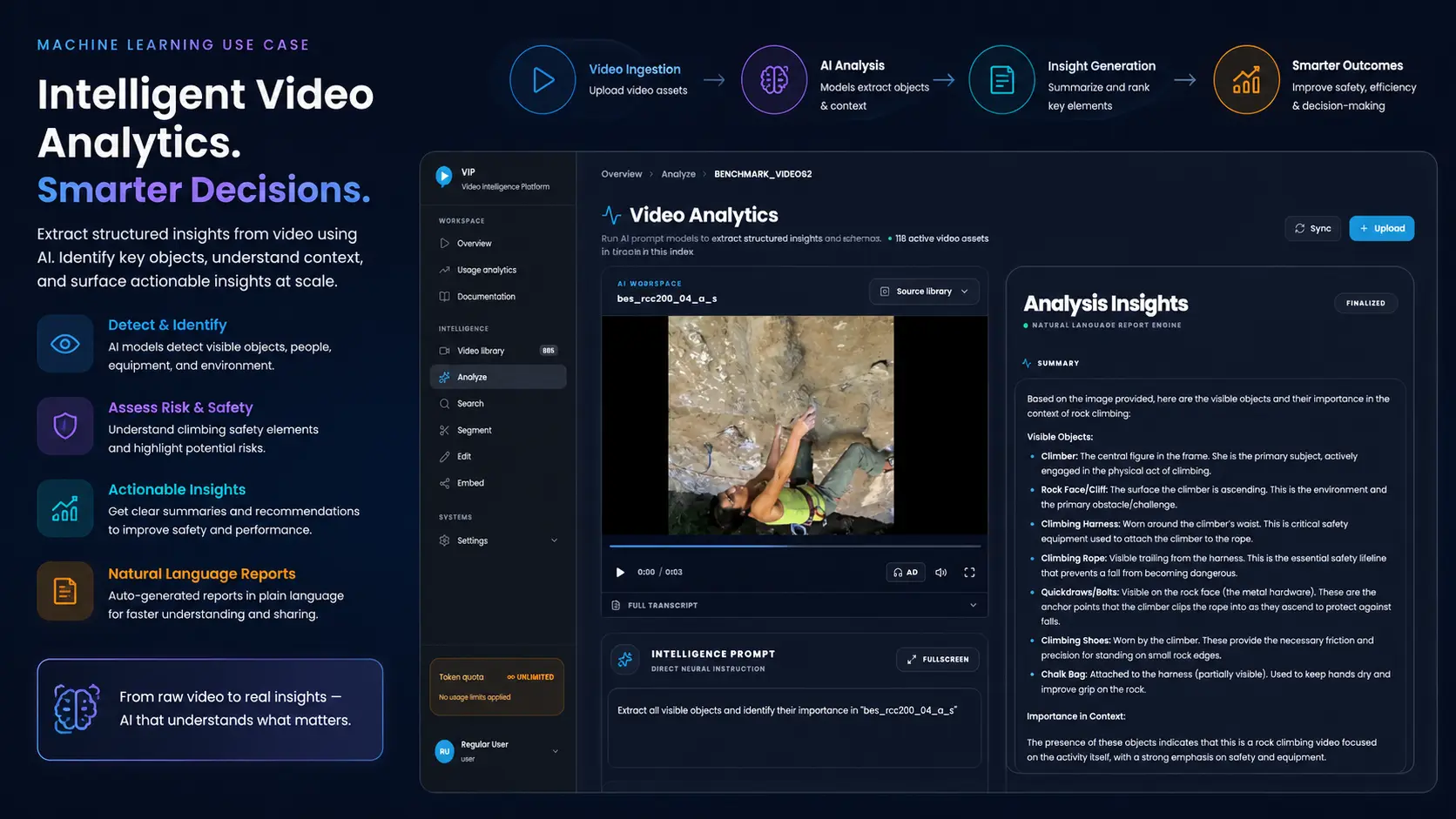
The volume of video footage being created by enterprises is enormous – from surveillance videos, dashcam videos, store camera videos, to media libraries. The manual processing of such vast amounts of video is unrealistic. PSSPL’s Video Intelligence Platform (VIP) uses AI-based video analytics, semantic video search, object detection, scene segmentation, and embedding generation to enable video footage to be made searchable, interpretable, and actionable in real-time – from instantaneously detecting a security breach to searching a video library for “two people shaking hands.”
(4) Speech Emotion Recognition for Customer Experience
Knowing not only what the client has expressed but also how he or she has expressed it can be quite telling. The Speech Emotion Recognition (SER) solutions offered by PSSPL apply deep learning technology to identify emotional states such as frustration, satisfaction and urgency straight from the speaker’s voice. These solutions are being used in the area of customer experience management, healthcare and call centers analytics.
(5) Medical Image Analysis and Clinical Decision Support
AI in the health sector helps the radiologist and physician work fast and more efficiently – not to replace them but rather to complement their work. With the use of labeled medical images, the algorithms can mark suspicious areas in X-ray, MRI, and CT scans, help with prioritization of urgent cases from a queue, and assist in predicting diseases using patient records.
PSSPL’s Healthcare AI Solutions include medical image analysis, disease prediction, and clinical decision support systems.
(6) Fraud Detection and Risk Scoring
However, the ability of anomaly detection systems to identify outliers is exceptional, as they can easily identify the transaction, login sequence, or claims that don’t match others. For instance, financial organizations like banks, insurance companies, and fintech companies use anomaly detection systems in combination with classification systems to detect any fraudulent activities taking place in real time.
(7) Demand Forecasting and Inventory Optimization
Sales predictions based on regression analysis using input from past sales, seasonality, price, and exogenous variables (weather, promotions, macro trends) always outperform traditional methods of sales forecasting. Both retailers and manufactures use such predictions to prevent overstocking and understocking – hence protecting margin.
(8) Recommendation Systems and Personalization
Recommendation engines that employ algorithms like collaborative filtering and deep learning embeddings are behind a significant proportion of the revenues generated by the e-commerce industry and media streaming services, which serve the right products and articles to users at the right times.
(9) Anomaly Detection for Cybersecurity and Network Monitoring
Beyond financial fraud, unsupervised anomaly detection is widely used to monitor network traffic, login behavior, and system logs for signs of intrusion or compromise. Machine learning models trained on “normal” traffic patterns can flag deviations — an unusual login location, an unexpected spike in data transfer — long before a rules-based system would catch them, giving security teams a head start on containing a threat.
(10) Energy Load Forecasting and Smart Grid Management
Utility companies and energy companies are employing machine learning techniques to forecast energy demand as well as energy production from renewable sources such as predicting how much energy a solar/wind farm will produce depending on weather patterns and then comparing it to predicted consumption. This helps the grid operator balance out production and demand.
(11) Autonomous Systems and Robotic Process Control
Machine learning techniques, especially those using computer vision alongside reinforcement learning, have helped in creating autonomous vehicles such as the self-guided vehicles and robotic systems in logistics that can pick up and transport materials within a factory. They have also helped in creating process control systems that are adaptive to sensory input.
Also Read: How Machine Learning is Transforming the Retail Landscape?
From Prototype to Production: Why Deployment Is the Hard Part
The common denominator among all these examples of machine learning applications is that while developing an actual model may be the easy part, getting it to work well in practice is the difficult one.
That’s why ML Model Development & Deployment at PSSPL covers the full lifecycle:
- Feature engineering and hyper parameter optimization to ensure the model is performing at its best
- REST API development so that models can be used by any software application
- Deployment using Docker and Kubernetes to achieve scalability and portability
- Cloud-based deployments on AWS, Azure, or Google Cloud Platform based on customer preference
- MLOps and CI/CD pipeline so that models can be retrained and deployed automatically without having to engage in firefighting
- Performance monitoring to avoid performance decay and impact on business results
- Batch and real-time inference support based on customer needs
How to Choose the Right Machine Learning Use Case for Your Business?
With so many possible applications, it’s worth narrowing down where to start. A few practical questions help:
- Where are outages and failures having the greatest impact? Predictive maintenance and quality control are quick wins within the manufacturing and industrial context.
- Where do you have data available, yet not being used? Call recordings, video feeds, transaction history, and sensor logs are prime examples of low-hanging fruit within a machine learning project.
A reputable machine learning development company will assist in answering these questions through a brief discovery phase prior to initiating the full project — ensuring that the data is there and usable to achieve your business objective.
Why Partner with PSSPL for Machine Learning Services?
The success of machine learning involves not just selecting the appropriate algorithm. The success of machine learning involves data engineering, modeling architectural considerations, and infrastructure for deploying and monitoring – those unsexy aspects of machine learning that will decide whether the model will provide value or be shelved six months after deployment.
All this is brought under one umbrella by PSSPL. As far as machine learning is concerned, this includes video intelligence, speech emotion recognition, industrial AI, healthcare AI, computer vision, and end-to-end ML modeling and deployment services.
From your first application of machine learning technology to growing your pilot project into a production-ready system, our team at PSSPL will support you in taking your machine learning idea from ideation all the way through deployment and monitoring.