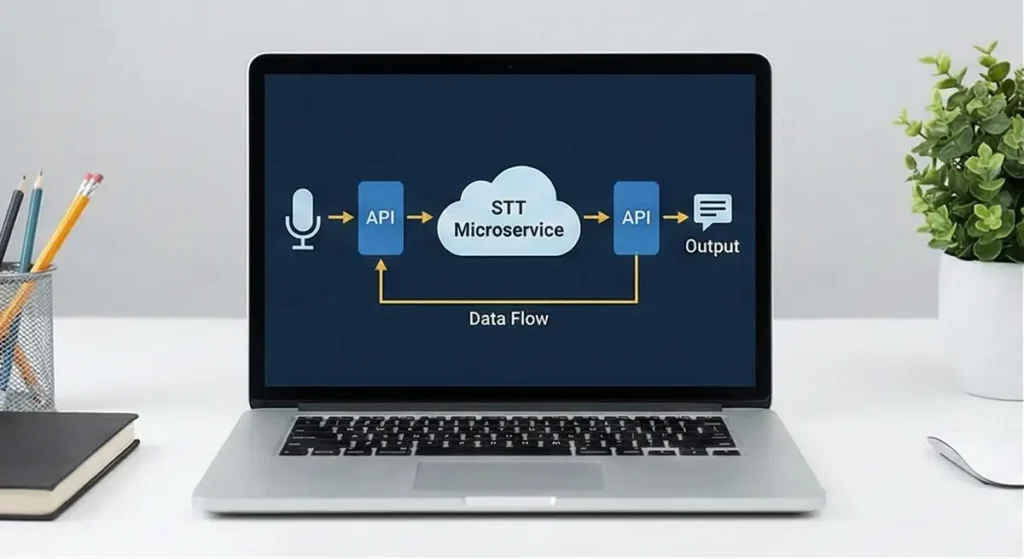
Empowering Real-Time Voice Intelligence with a Standalone STT Microservice
A Scalable, Plug-and-Play Speech-to-Text Platform
Client Overview
PSSPL collaborated with an AI-focused product organization to develop voice-activated, real-time applications in a variety of fields, such as conversational AI platforms, virtual assistants, and appointment scheduling.
A tightly connected Speech-to-Text (STT) component integrated into a single application was the foundation of the client’s initial implementation. Scalability, reusability, and performance under concurrent real-time applications were all constrained as adoption increased. Decoupling STT into a stand-alone, production-grade microservice that could enable real-time streaming at scale and abstract away the complexity of STT providers for development teams was the goal.
Industry
AI / Conversational Platforms / Voice Automation
Location
Global
Company Size
Startup to Mid-Scale
Project Duration
3 Months
Services Provided
- Design of an architecture for a stand-alone STT microservice
- WebSockets-based real-time audio streaming
- Integration with open-source and cloud-based STT engines
- Session security, authorization, and authentication
- Queuing connections and managing concurrency
- Self-service onboarding developer portal
- Setting up usage tracking and monitoring
- Support for production deployment and performance optimization
Technologies used

Node.js

Express.js

Google STT

Whisper

React.js

PostgreSQL

Whisper

Docker

JWT
Challenges
While scaling voice-enabled applications, the client faced multiple architectural and technical challenges.
- STT logic was tightly coupled to a single application
- Difficulty handling multiple concurrent WebSocket clients
- Inconsistent real-time streaming performance under load
- Noise handling and speech detection issues
- Limited flexibility to experiment with or switch STT engines
- Repeated effort required to integrate STT into new projects
- Lack of centralized access control, usage monitoring, and governance
The biggest problem was ensuring high-accuracy, low-latency transcribing at scale while maintaining ease of integration for downstream teams.
Key Challenges We Addressed
PSSPL’s AI and platform engineering team delivered a robust STT solution featuring:
- Standalone STT Architecture: A fully decoupled microservice reusable across multiple applications
- Real-Time Streaming Performance: Optimized WebSocket handling for low-latency transcription
- Multi-Client Scalability: Concurrent session handling with intelligent queuing
- Provider Abstraction: Unified interface across multiple STT engines
- Secure Access Control: Token-based authentication and session authorization
- Developer Enablement: Self-service portal and simplified APIs
This approach transformed STT from an internal dependency into a shared enterprise platform capability.
The way we approach voice-enabled products has been completely transformed by this STT microservice. Faster innovation, cleaner architectures, and consistent performance across applications were made possible by abstracting real-time speech recognition into a stand-alone platform.

Gaurang Joshi
Project Manager, PSSPL
How PSSPL Helped
PSSPL designed and implemented a production-ready Speech-to-Text microservice that serves as a foundational building block for real-time voice applications.
Standardized methods (connect, writeToStream, stopStream) hide provider-specific complexity
Event-driven streaming with speech detection and transcript callbacks
API key/secret pairs with JWT-based session authorization
Uses approved APIs to safely publish created content to all linked platforms without requiring user input.
Google STT for production reliability; Whisper variants for internal benchmarking
Application creation, key management, documentation, and usage visibility
As a result, teams can integrate real-time STT without worrying about audio streaming, scaling, or vendor lock-in.
Ready to Build Scalable Voice Applications?
Implementation Journey

Discovery
In order to comprehend real-time voice use cases, concurrency expectations, latency targets, and reuse needs across various applications, workshops were held.

Design
Streaming logic, STT providers, authentication, and client integration were all clearly separated in a modular, event-driven architecture.

Development
The core service was developed using WebSockets and Node.js. Whisper engines were introduced for internal testing once Google STT streaming was merged for production. Queue management and secure token-based access were put into place.

Deployment
For production readiness, the microservice was containerized using Docker and deployed utilizing best practices for security, monitoring, and logging.

Collaboration
Alignment on latency benchmarks, transcription accuracy, and developer experience enhancements was guaranteed by frequent sprint reviews.
Key Outcomes
Reusable STT Platform
One service powering multiple real-time applications
Low-Latency Transcription
Stable streaming performance under concurrent load
Faster Integration
Development teams onboard STT in minutes, not weeks
Faster Integration
Queue-based connection management during peak usage
Vendor Flexibility
Easy benchmarking and future engine replacement
Scalable Foundation
Ready for multilingual support and advanced analytics
Project Highlights
Ready to Build Your Own AI-Powered Voice Platform?
Contact Us Now!