
AI Agents for Content Generation: Capabilities, Key Components, Use Cases and Trends
Summarize and save time
In today’s digital times, we are witnessing that content is playing a huge role in improving the brand visibility, building trust with customers, and the overall growth of the website. It has become crucial for businesses, as viewers today consume personalised content faster, boosting the digital marketing efforts of your organisation. By introducing AI agents for content generation, there is a shift in how creative content is generated and distributed. It can streamline workflows to improve creativity, becoming a very useful tool for all writers, copywriters, marketers, and content creators.
However, AI agents for content generation are not replacing writers; they are, in fact, freeing them up to focus on building a strategy that sells. Approximately 51% of marketers are utilising AI for content production, and an impressive 80% intend to enhance their use of AI in the upcoming 12 months.
Organisations hiring AI agent development services are transforming their content operations from manual processes into scalable, autonomous systems.
As a decision maker, you might wonder why to hire these services if generative AI systems are available in the market at a much cheaper rate. The truth is, standard generative AI can only process daily text and 2D image tasks, while custom agents can perform complex tasks, generating high-fidelity results such as AI text-to-video, real-time audio translation, and extended video synthesis.
When businesses hire AI agent development services, they work by empowering their AI agents with advanced ML algorithms and NLP capabilities. These intelligent learning methods and languages help the agent to generate various kinds of content, including blog posts, social media updates, reports, and stories.
These AI agents process a huge amount of data and the context to produce content that fits the reader. They can generate creative and high-quality content in seconds and in large amounts, helping businesses to build a steady and powerful online presence. When the content is personalised, it will capture the attention of a large audience and improve engagement.
What are AI Agents and their Functions in Content Generation?
An AI agent is a system that independently completes tasks by creating workflows with available tools.
AI agents can perform a wide range of functions that go beyond natural language processing, including issue-solving, decision-making, interacting with external environments and performing actions.
They are capable of solving challenging tasks across organisational applications, including IT automation, code generation, conversational assistance, and software design. They employ sophisticated natural language processing methods found in large language models (LLMs) to understand and reply to user inputs in a systematic manner and decide when to utilise external tools.
- AI agents leverage the following techniques to function effectively:
- Machine Learning: AI agents can learn from data and improve their performance over time.
- Knowledge Representation: Helps agents to save and store key information.
- Automated Planning: Enable the AI agent to build strategies that will help achieve its goals.
- Natural Language Processing (NLP): Enables AI agents to understand the user input and respond to it effectively.
To solve challenging tasks across different business contexts, AI agents can be deployed in various applications. Have a look at the examples, customer service chatbots, code-generation tools, and conversational assistants that assist user manage their day-to-day activities.
Core Functions of AI Agents in Content Generation
AI agents work through well-laid-out processes that allow them to function independently.
AI agents are also known as LLM agents because large language models are at their core. They work through a well-laid-out process that ensures their function operates independently. Let’s have a look at them:
1. Perceiving the Environment
The AI agent collects information about their surroundings through different sensory inputs. Gathers key data from user inputs, databases, sensors, and documents. For instance, a self-driving car uses cameras and radar to identify objects. Chatbots process voice commands or text.
2. Processing and Reasoning
Once the data is collected, with advanced reasoning systems, AI agents analyse information and decide what step to take next. Most of the AI agents follow a think-act-observe loop that solves complex issues with a strategic process.
- Conditional logic: Basic agents that operate using clear “if this happens, then do that” rules.
- ReAct (Reason + Act): Agents that think through steps as they act, leaving a visible trail of their reasoning.
- ReWOO (Reasoning Without Observation): Agents that plan by dividing a task into smaller, manageable steps before starting.
- Self-reflection: Agents that improve by reviewing outcomes and verbalising what they learned.
3. Taking Action
The AI agents then conduct their selected task through actuators after making the right decisions. They can either answer queries, control devices, or run automated tasks. For example, you are sitting comfortably on your couch, and with just a single voice command, ” turn off the AC,” they will follow the command automatically.
4. Continuous Learning from Feedback
AI agents get better at offering accurate responses over time. With constant feedback, they identify mistakes in their own output and leverage that information to improve their models. The agent learns which action is deriving the most accurate response, through reinforcement learning, helping it to outperform next time.
5. Using Tools and Memory
AI agents also use a memory system and tools to generate more accurate answers. They can also use APIs, web searches, or work with different agents to collect information beyond the data that they have been trained on.
There are four types of memory system they work on:
- Short-term memory: Keeps a record of recent task details.
- Long-term memory: Stores key information for future use.
- Episodic memory: Keeps a folder of important events that took place in the past.
- Procedural memory: Stores learned skills and procedures.
AI Agents: How Do They Work?
Any complex task can be simplified and automated through AI agents. They follow a structured workflow:
- Define goals: Once the AI agent receives key instructions from the users, it starts by planning tasks that align with these goals, dividing them into smaller, actionable steps.
- Acquire information: To achieve success in the assigned task, AI agents collect necessary information from different sources, including the internet, interacting with other AI agents or using machine learning models to collect useful data.
- Execute tasks: Whatever information has been collected by the AI agent is implemented methodically. The AI agent will evaluate its own performance by the feedback they receive, and inspect its logs to ensure it meets the set goals.
Optimise your Operations with PSSPL
Building AI agents that align with the needs of your industry, reducing manual effort, improving customer experiences, and seamlessly integrating with existing systems.
Key Components of an AI Agent
AI agents are built from different key components that support autonomous behaviour by working together. Let’s understand what makes AI agents so flexible, responsive, and intelligent.
The Brain of an AI Agent
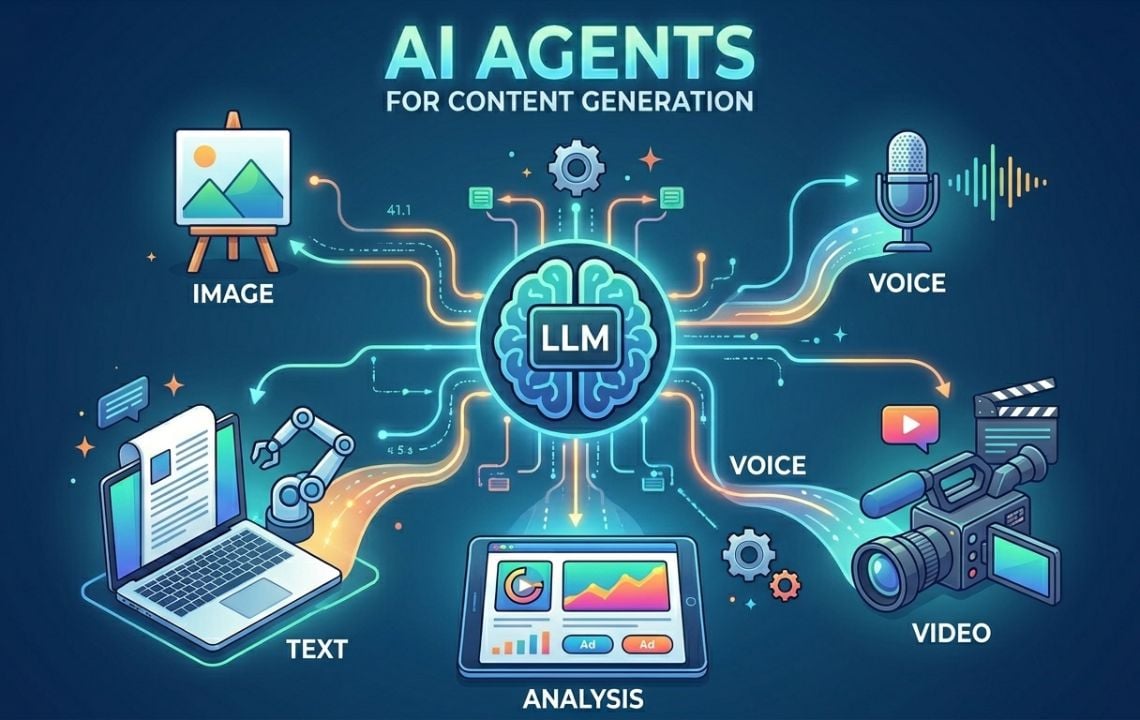
The main brain of an AI agent in content generation revolves around a Large Language Model (LLM). This core is responsible for defining the objectives, integrating relevant tools, and managing the agent’s memory. AI developers customise prompts that shape the persona of the AI agent, so that the goals of your business can be achieved successfully.
With that, sophisticated algorithms and neural networks allow the agent to process a huge amount of data, ensuring it generates contextually appropriate and coherent content.
Empowering the agent with LLMs capabilities to adapt writing style, tone, and content structure to fulfil the specific requirements for generating different types of content. The content variation includes informative and detailed articles, engaging social media posts, technical documents, case studies, video scripts, and more.
Planning and Task Decomposition
The planning agents not only react to inputs; they actually develop a step-by-step plan before taking any step. This planning plays a key part in various use cases, including route delivery optimisation, automated scheduling, and autonomous robots.
After understanding the issue, the AI agent breaks it into smaller and manageable tasks. The agent selects the best approach using trained models, fixed rules, and a logical approach.
It identifies the task that depends on others. When multiple agents work together, the process of planning becomes more complex because they need to share resources, coordinate actions, or negotiate. A strategic plan handles surprises very well, without failing in changing conditions.
Memory
The memory module acts as the brain of the AI agent, enabling it to recall all the key information. It also makes sure that it can learn from past interactions and maintain context over time. The memory module is typically divided into two parts: short-term and long-term memory.
Short-term memory: Session-based context is stored in the short-term memory, empowering an AI assistant to remember recent messages in a conversation and helping to maintain relevance.
Long-term memory: The long-term memory module includes organised knowledge, numerical representations and past data, which is used by the agent while making decisions that are informed and accurate.
The memory module plays a crucial role in improving personalisation in AI agents and other applications such as customer support bots, recommendation engines and virtual assistants. An AI agent without a memory module will make its users frustrated, by asking them to repeat their information again and again, generating responses that aren’t relevant to the previous ones, and functioning statelessly.
Action and Tool Calling
The action module works by transforming the agent’s decisions into actions in real life. So that it can interact with users, digital systems or even physical environments. The reasoning and planning modules select an appropriate response, and then the action module executes the essential steps.
Most of the time, agent workflows need to use outside tools, data sources, APIs, or automation systems to complete tasks. “Tool calling” is how agents connect with external resources, calling APIs, running functions, or using services. Basically, tool calling enables a large language model to connect to structured tools and live data, giving it capabilities and information beyond what it learned during training.
Use Cases and Applications of AI Agents for Content Generation
Today’s businesses understand the importance and influence of content for effective engagement and communication. Producing content that’s creative, easy to understand, high-quality, and can grab the attention of readers is a time-consuming task as well as resource-demanding. AI agents are transforming this process, reshaping how content is ideated, created, and optimised.
1. Natural Language Generation (NLG)
AI agents are using advanced algorithms and machine learning models that have been trained on extensive datasets. This empowers the AI agents to generate content that sounds like a human, contrary to the content generated by generic bots.
As content generated by generic bots fails to capture the attention of users, offering them content that sounds robotic and is hardly relevant. AI agents can generate content that’s contextually appropriate, context-aware, and coherent.
Key capabilities of an AI agent for content generation:
- Adaptive to various kinds of writing styles, tone, and patterns, including formal, technical, casual, etc.
- Content generation in different languages.
- Various formats of content pieces, such as blogs, articles, stories, poems, and scripts in seconds.
- Processing and responding to specific prompts or guidelines.
2. Personalised Content Creation
AI agents can process a huge amount of user data, through which they are able to create personalised content experiences for specific users/ targeted audience. Unlike the traditional techniques, such as mail merge.
Key capabilities of an AI agent for content generation:
- Based on the real-time user interactions, the AI agents can adapt content dynamically.
- By analysing the browsing history, purchase behaviours, and engagement patterns of users, AI agents can help in capturing leads.
- Identify what a particular set of users prefers to consume, then generate content based on the specific user segments.
3. SEO Optimisation
AI agents can transform SEO optimisation from a manual, time-consuming process into a data-rich, automated process.
Key capabilities include:
- Bring new opportunities for internal and external linking.
- Analysing the structure of the writer’s content and gaining key suggestions for better visibility on Google.
- Identifying content gaps and opportunities in the market.
- Offer useful and actionable on-page optimisation improvements, including meta tags, content structure, and headers.
4. Content Translation
Traditional translation software used to work by matching words and phrases against bilingual dictionaries. The traditional ways are now transformed with Neural Machine Translation (NMT).
Instead of translating word by word, NMT models read entire sentences and paragraphs as a whole, learning the relationships between words, the flow of ideas, and the patterns of natural language from hundreds of millions of examples. The result is output that reads the way a human would actually write it.
Key qualities of AI agents:
- Translation of text accurately, not changing the style and tone.
- Adoption on idiomatic expressions in content for any cultural differences.
- Translating the required content while ensuring the technical or industry-specific terminology stays the same.
- Conversion of audio and video content, including subtitle generation.
5. Article and Blog Post Writing
Yes, AI agents can act as content writers and generate articles and blog posts on various kinds of topics. However, human writers still have the upper hand, because to rank on google its essential to follow certain criteria and guidelines.
Key qualities of AI agents:
- Conduct heavy research on various topics and compile useful information.
- Generating content in a proper format of H1, H2, H3, title case, etc.
- Crafting engaging and detailed conclusions as well as introductions.
- Generating content that aligns with the brand’s voice and target audience.
- Adding relevant numerical data and quotes wherever they are needed.
6. Social Media Content Creation
AI agents can act as social media managers who plan and craft various kinds of content that have the ability to trend online. AI agents can also generate various kinds of graphic and audio/video content within minutes with accurate prompts. Helping social media managers with ideation and the generation of content in less time.
Key capabilities of an AI agent for content generation:
- Analyse trending topics on the internet through huge data processing and finding relevant keywords and hashtags.
- Generation of content that is customised as per different social media platforms, including Twitter, Instagram, LinkedIn, Facebook, etc.
- Generation of a variety of content pieces such as memes, polls, infographics, etc.
- AI agents can also track the performance of your post, offer key insights on which one is performing well and which is not.
6. Scriptwriting
AI agents can also bring creativity like humans into content generated by them, providing an inspirational and structured storytelling and scriptwriting.
Key capabilities of AI agents for content generation in Scriptwriting:
- AI agents can generate versatile scripts for various characters.
- They can rate your script based on your preferred pacing and structure.
- Generate plot twists and outlines based on a given storyline.
- Analyse existing scripts and content to identify popular patterns.
7. Competitor Analysis
We came across different kinds of content each day, or each minute. Some of them have a great impact on us, while others just fade away. AI agents can figure out what this content has in common that helps them outperform others through competitor content analysis.
Key capabilities of AI agents for content generation in competitor analysis:
- Scan, analyse competitors’ top-ranking online content.
- Analyses what SEO strategies are used by competitors and digs into the top ranking keywords.
- Keep a track of competitors’ content pieces for any useful changes that happen over time.
- Spot useful themes and topics in competitor content.
- Suggest different types of content after analysing current trends.
How can PSSPL help you in Building AI Agents for Content Generation?
When you hire PSSPL for AI agent development services, you will witness a significant increase in your online presence with a strong brand voice that not only brings organic traffic but also quality and right leads. Businesses can witness that their AI agent development services can:
- Increase the production of content
- Enhance the quality of your content
- Cost-effective creation
- Data-driven insights
- Maintain a consistent brand voice
PSSPL holds deep AI expertise in building AI solutions that align with the unique requirements of your business. Their customised solutions focus on reflecting the voice and style of your brand. They ensure a smooth integration of AI agents into your current workflow for optimised efficiency.
With a proven track record of delivering intelligent, scalable, and seamlessly integrated AI solutions, PSSPL is the partner that transforms your content operations from a cost centre into a growth engine.
Wrap It Up: The Future of Content Generation is Agentic
The content landscape is evolving at an unprecedented pace, and businesses that embrace AI agents for content generation today will be the ones leading their industries tomorrow. From natural language generation and personalised content creation to SEO optimisation, multilingual translation, and competitor analysis, AI agents are not just tools; they are intelligent collaborators that scale your content operations without scaling your headcount.
What sets AI agents apart from standard generative AI is their ability to reason, plan, remember, and act autonomously across complex, multi-step workflows. Whether your goal is to publish more consistently, reach a global audience, or outperform competitors in search rankings, a custom-built AI agent delivers precision and performance that off-the-shelf solutions simply cannot match.
As organisations shift from reactive content production to proactive, data-driven content ecosystems, the decision to invest in AI agent development services is no longer a competitive advantage; it is a business necessity. The brands winning online are the ones automating intelligently, personalising at scale, and freeing their creative teams to focus on strategy and storytelling.
The question is no longer whether to adopt AI agents for content generation; it is who will build them right for your business.
I have written several pieces of technical and SEO content across different SaaS and product companies, and the ones which have been successful possess one common characteristic: they have something valuable to say to a technical reader while still being optimized for ranking. Writing an informative blog post? Easy part. Getting the search intent right, making sure that the technical information is accurate, and aligning each post with its place in the buyer journey? That's where I put all my efforts.