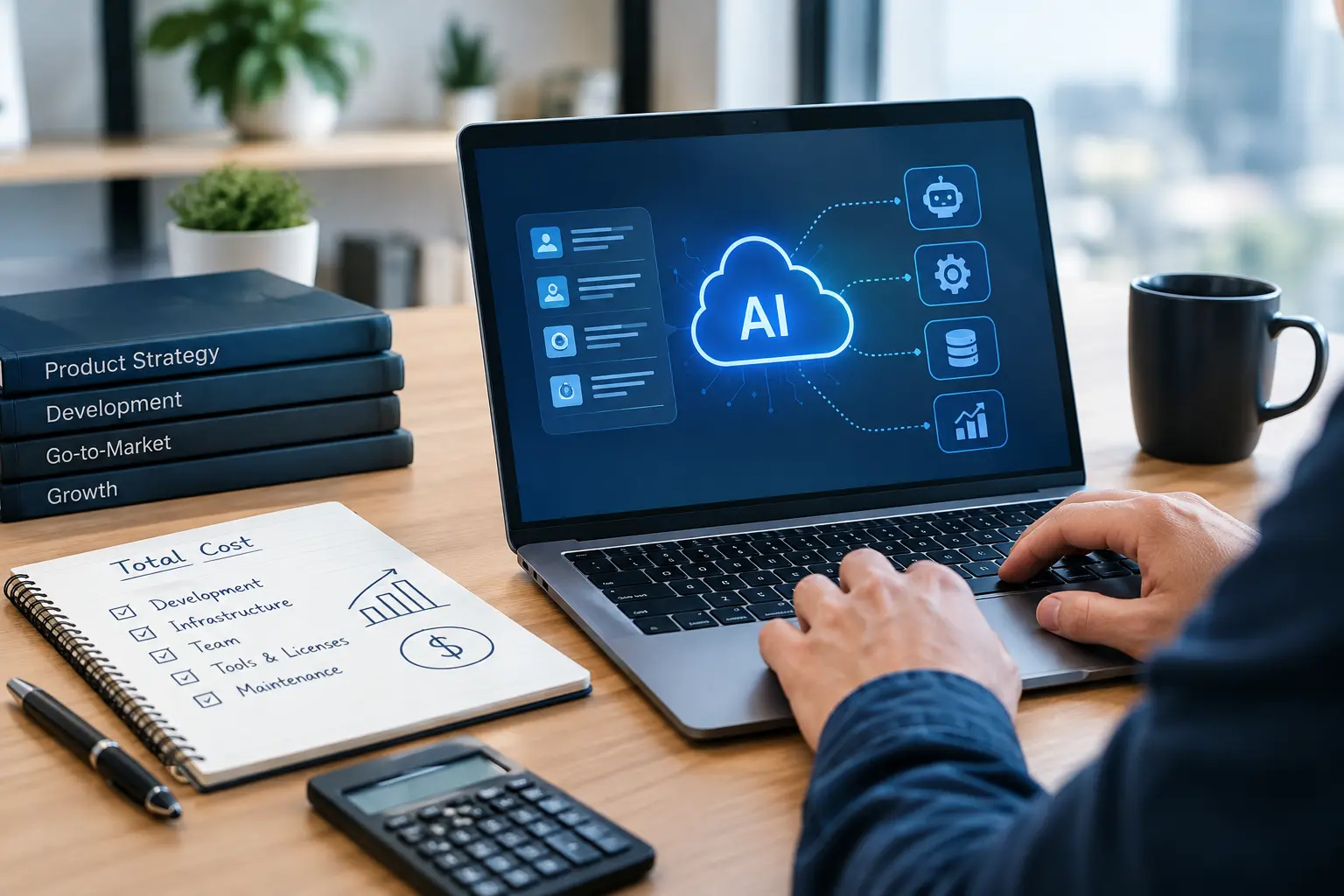
How AI Is Transforming Product Development: From Idea to Market, Faster Than Ever
Summarize and save time
Computers can now learn, solve problems, and make judgments much like people thanks to a technology called artificial intelligence. Product owners have begun experimenting with the use of AI in product development from its early adoption in product design about 2010. AI-powered solutions have revolutionized how businesses promote software product creation and facilitate a data-driven approach to product development during the past ten years.
From early ideation and requirement discovery to coding, quality assurance, deployment, and continuous improvement, PSSPL sees AI as a useful enabler that helps teams at every stage of the software product lifecycle. AI was integrated into the development processes by our software engineering teams. We have successfully produced hundreds of items over the course of more than 25 years. We saw a change in the SDLC when we began incorporating AI into the entire product development process, from conception to implementation.
As a business case, let us guide you through this educational blog.
What AI Brings to the Product Development Lifecycle?
To assure outcome-oriented delivery, the software product development lifecycle is divided into several levels, stages, and phases. AI in the product development lifecycle can empower procedures and, to some extent, expedite the execution of each phase’s activities for greater productivity and efficiency, accelerating the introduction of new services and goods into the market. Let’s examine the potential effects of AI and Gen AI capabilities on several software development lifecycle (SDLC) domains.
Product Development Strategy
You may accomplish three key goals by incorporating AI into your strategy: being customer-centric, putting in place a strategic deployment procedure, and assuring effective product management. The idea of data-driven digital product engineering is made possible by AI.
A subset of artificial intelligence called generative AI examines enormous volumes of data from numerous sources to help in feature listing, product idea generation, and other tasks. In order to estimate market trends, user adoption rates, and possible product performance, it also provides predictive modeling.
As a result, AI gives you the ability to make data-driven, market-based decisions, optimize product features and functionalities, examine competition data, and match product vision and mission with changing market trends.
Software Requirement Gathering
Software product development teams can gather insights and find patterns across a variety of elements, including previous projects, customer input, and market trends, and forecast project results thanks to AI’s capacity to analyze enormous data sets. NLP can be utilized for support tickets, feedback, and identifying information in unstructured databases.
AI-enabled solutions can also assist business analysts in producing thorough requirement documentation that is understandable to both the software development team and the client. If we continue, generative AI can reduce uncertainty and expedite documentation by transforming users’ initial contributions into structured requirements drafts.
Product Architecture Design
AI technologies use machine learning models to evaluate previous and current digital product development architecture designs and suggest the best patterns and tactics.
Developers can define the structured solution of a software project that not only satisfies technical and operational requirements but also optimizes attributes like security, performance, and manageability thanks to its ability to further predict the impact of factors like cost, time, performance, and security.
UI/UX prototypes and mockups are produced using AI-driven product development architecture design in accordance with stakeholder-defined design requirements.
Project Management
AI for product development provides a variety of useful tools and solutions for starting a project, developing it, deploying it, and overseeing it throughout its existence. It makes it possible for teams, managers, and product stakeholders to follow project progress with precise metrics and automate business analysis.
By improving resource allocation and making proactive adjustments based on ML models, AI improves project management. The processes of creating and optimizing project deadlines, proactively managing risks, concentrating on project progress, and raising the probability of project success are all automated by AI-powered applications like Microsoft Project, Asana, Jira, and others.
The next generation of Gen AI-powered assistants can anticipate obstacles, automatically summarize project updates, and recommend actions to be taken in real time. Eighty percent of project management tasks will be eliminated by AI by 2030, according to research.
Intelligent Coding & Development
By offering code completions, suggesting refactoring to better code structure, and automating bug fixes, an AI-powered code editor with sophisticated capabilities assists developers.
By tackling common mistakes, improvements, and bugs, generative AI for code generation frees up engineers’ time to concentrate on more imaginative problem-solving.
Productivity, code quality, and overall software delivery all rise as a result. By automating up to 70% of coding activities, AI can increase developer productivity.
AI in Ensuring Product Quality
AI in product development makes testing more dependable, effective, and efficient by automating the entire process. Software and testing solutions driven by AI are designed to improve the testing process.
AI is automating tedious chores and manual testing methods in software product development and modernization, freeing up testers to concentrate on intricate testing scenarios.
AI also has a significant impact on product software fault prediction, which improves the accuracy and efficiency of testing. In order to improve coverage beyond human techniques, generative AI can automatically create large test cases and synthetic datasets.
Advantages of AI in Product Development Lifecycle
Businesses’ approaches to product creation are changing as a result of the incorporation of AI technologies and their expanded capabilities, such as generative AI, from better accuracy and bug detection to tailored consumer experiences.
The software development AI industry is anticipated to grow to $1286 million by 2030 due to the substantial advantages of AI. Let’s examine the main advantages:
Better Quality
By incorporating AI into the product creation process, the final product is of higher quality. How? AI can find issues early in the development process, something that was previously done during testing. Proactive resolution is aided by this.
Furthermore, generative AI in product development (SDLC) makes it feasible to create every potential test case for the product, covering a wide range and guaranteeing dependable software delivery. AI support aids developers in optimizations and enhancements, resulting in better code, best practices, and coding standards throughout the project.
Enhanced Innovation
AI is a potent pillar that propels innovation in product creation. By producing ideas after evaluating enormous volumes of data from many sources for ground-breaking products or features that can give a company a competitive edge in the market, AI’s generative skills help to promote an atmosphere of creativity.
Rapid prototyping cycles enable the team to swiftly develop and test several new concepts or prototypes, pushing the boundaries of innovation. Thus, utilizing AI in software development allows businesses to push the limits of product innovation, take measured risks, and investigate new avenues.
Improved Decision Making
AI in the product development lifecycle produces intelligent, data-driven decision-making. Project metrics, on-demand software trends, client requirement charts, and other critical elements of project stages can be examined using AI and ML algorithms by the software product development services provider.
While GenAI-powered forecasting offers better insight into possible outcomes, facilitating more efficient resource allocation, reducing risks, and guaranteeing product success in the marketplace, it directs project development toward strategic decisions.
Enhanced Productivity
AI and product development work together to drive and improve team members’ and interconnected operations’ productivity on a larger scale. Code generation for simple and repetitive modules, testing, documentation creation, and prototyping design are just a few of the time-consuming and repetitive operations that are automated in software product development.
Developers, testers, and BAs may concentrate on challenging, creative work with the help of generative AI tools and platforms like GitHub Copilot and OpenAI Codex, which help with code snippet creation, document drafting, and early design acceleration.
The coding process can be greatly accelerated by AI technologies, which can also automatically correct issues early in the development cycle, cutting down on debugging time. AI integration improves communication amongst multiple teams, streamlines the development process, and decreases inefficiencies. It results in higher levels of productivity and job satisfaction.
Faster Time-to-Market
AI speeds up the entire process by automating and streamlining the software product development lifecycle. Faster time to market is made possible by this, and it has become essential in the competition to stand out in a crowded market.
In order to expedite delivery and guarantee high-quality goods, generative AI models can help with code generation, automate product testing, improve project management, and streamline deployment.
Decreased Development Costs
Using AI in product development can have a big influence on a number of investment-related factors. It assists significant development organizations with analysis and optimization, pinpointing places to control future costs, expedite development, and guarantee optimal resource utilization.
Rework expenses are decreased by higher quality and lower error/bug ratios. By steering the project in the right direction, improved requirement collection lowers the possibility of misunderstandings and saves money.
Ready to accelerate your product development with AI?
At PSSPL, we help businesses apply AI strategically across ideation, development, testing, and delivery—ensuring faster time-to-market without compromising quality.
How Can the Risks of AI in Software Product Development Be Reduced?
Data Quality and Bias Mitigation
The utilization of AI to its fullest extent during the product-development stage might be significantly reduced by the existence of biased and low-quality data, leading to biased and unreliable outputs. The quality of the software development process will be lowered as a result of the analysis, which is based on such data, becoming unreliable.
Solution: Establish an infrastructure to preserve high-quality data, carry out different pre-processing and purification procedures on the data, and implement fairness metrics and data auditing as extra security measures.
Privacy and Security
Since the training of AI models necessitates access to sensitive data, integrating AI into the product development life cycle may raise security and privacy issues.
Solution: Secure the data pipelines and investigate privacy-invasive methods to guarantee that the data used is not exposed to the outside world in order to prevent unwanted access or modification with the AI model.
Explainability and Transparency
When AI is used in product creation, explainability and transparency present significant obstacles. Since the majority of AI and ML models and algorithms are effectively “black boxes,” the lack of transparency may cause problems during the development process.
Solution: Make use of interpretable AI models, apply Explainable AI (XAI) methods, maintain thorough documentation, and participate in the stringent testing procedure.
Degradation of Performance and Model Drift
An AI model has a significant chance of being erroneous and irrelevant if it isn’t updated frequently with fresh data and progressively advanced through the product development cycle.
Solution: Create feedback loops to identify and correct drift early in the development cycle, retrain models using the most recent datasets, and continuously monitor the model’s performance.
An excessive dependence on AI and a decrease in human oversight
In product development, an over-reliance on AI-generated outputs can impair human judgment and result in flawed designs, poor choices, or missed edge cases.
Solution: Ensure that final approvals and crucial choices are still under human control, maintain human-in-the-loop procedures, and clearly establish decision boundaries for the use of AI.
How to Use Gen AI Effectively in Your Product Development Project?
These days, generative AI chatbots like ChatGPT, Gemini, and Llama can hold conversations that mimic human communication. Additionally, these generative AI models are capable of tasks that are beyond the capability of humans.
It’s crucial to realize that their usefulness comes from their capacity to create predictability from probabilistic behavior. You can successfully include generative AI into your product development process by following these steps.
Determine Use Cases with High Value
A strategic filter is the first step in integrating GenAI. According to research, GenAI has the best return on investment in four domains: knowledge synthesis, coding, customer engagement, and creative development. If your use case doesn’t solve a cold-start issue or lessen cognitive strain, it becomes novelty rather than value.
When evaluating AI use cases through a Jobs-to-Be-Done (JTBD) lens, it is important to balance business impact with technical feasibility using an Impact-vs-Feasibility approach. Use cases that offer high impact and high feasibility should be prioritized for the MVP stage, such as document summarization or text-to-SQL conversion, as they deliver quick value with manageable risk.
Opportunities that promise high impact but lower feasibility, like autonomous negotiation agents, may require deeper R&D investment and should be planned as strategic, longer-term initiatives.
Use cases with low impact but high feasibility, such as tone correction or content polishing, work well as supportive add-ons that enhance user experience without driving core differentiation. Finally, initiatives that are low impact and low feasibility, including open-ended GPT-style creativity in regulated environments, should generally be avoided due to high risk and limited business return.
Before finalizing any AI use case, teams should ask a critical question: does this workflow require deterministic, predictable output? If the answer is yes, generative AI should act as a supporting layer—assisting with recommendations or automation—rather than owning core business logic. This approach ensures reliability, compliance, and long-term scalability while still benefiting from AI-driven efficiency.
Evaluate Architecture, Data, and Readiness
GenAI models don’t have states. They cannot produce dependable or contextual outcomes in your product development cycle without core architecture.
Checklist for Data Readiness: ETL for Unstructured Data Make that the systems are able to process HTML, PDFs, and conversations into clear semantic units.
Preparedness of Vector Infra: Select and set up a vector database (Weaviate, Milvus, or Pinecone) and complete your chunking plan.
Adherence: Create PII-redaction layers in advance, particularly for industries that are subject to regulations.
Use RAG to transition from a database-centric architecture to a context-centric one. To improve accuracy and reduce hallucination rates, your system must retrieve the correct data before providing it to the model.
Looking to build smarter, faster products with AI?
Our AI development services help you streamline your software lifecycle, reduce delivery timelines, and launch scalable, market-ready solutions.
Select the Appropriate GenAI Tools & Models
Rather than being a feature-level decision, choosing GenAI models and tools is an architectural one. How GenAI contributes throughout your software development lifecycle—from testing to production scale—determines the ideal mix.
Model Landscape
For complicated reasoning and early-stage development, proprietary LLMs (GPT-4o, Claude 3.5 Sonnet) are ideal.
The best models for scale, privacy, customization, and cost-effectiveness are open-weights models (Llama 3, Mistral).
Architecture of the System
- Instead, depending on a single, big model, use compound AI systems.
- For extraction, validation, routing, and classification, use smaller, quicker models.
- Only assign complicated thinking, planning, and synthesis to larger models as necessary.
- System stability, latency, and cost effectiveness are all enhanced by this tiered approach.
Build & Integrate GenAI into the Development Process
At this point, GenAI transcends testing and develops into a superior part of the product architecture. When GenAI is seamlessly integrated into current development processes, it produces genuine value. GenAI should support teams throughout planning, development, and collaboration tasks rather than altering how they operate.
The Integration Method
- To increase accuracy and relevance, use hybrid retrieval by fusing standard keyword search with semantic search.
- To limit reasoning behavior, response format, and contextual boundaries, use clearly defined system prompts.
- Create backup plans to deal with low-confidence outputs, insufficient data, or retrieval problems.
- While maintaining predictability, observability, and safety inside the larger system, a well-integrated AI module improves user experience and decision-making.
Test for Safety, Quality, and Dependability
In contrast to deterministic software, GenAI outputs are context-dependent and probabilistic, meaning that over time, the same input may provide various results. Therefore, testing needs to assess reasoning quality, factual foundation, consistency, safety, and bias in addition to functional correctness.
To achieve dependable behavior in production situations, effective GenAI testing necessitates ongoing, LLMOps-driven evaluation employing real user prompts, automated scoring, human-in-the-loop evaluations, and guardrail validation.
Implement, Track, and Continue to Improve (Treat GenAI as a live system.)
GenAI integration necessitates a continuous cycle of improvement rather than a one-time effort. As products change, its efficacy must be regularly assessed to make sure it provides genuine business value.
What companies ought to monitor
- Increased productivity and speed of development
- Effects on consumer feedback and product quality
- GenAI use cases’ ongoing relevance
- Businesses make sure GenAI continues to promote product growth and innovation by refining its use over time.
Thus, Product development is becoming a dynamic, data-driven engine with faster, smarter, and better results thanks to artificial intelligence. AI helps teams work more productively while upholding high standards, whether you’re developing code, defining product strategy, or guaranteeing quality.
Integrating AI into product development is now a practical requirement for companies trying to maintain their competitiveness rather than a forward-thinking experiment.
I have managed SEO and digital campaigns in several industries, but the industries that have really benefited have one thing in common; the traffic we are driving is the right traffic, and each rupee spent relates to an actual business goal. It is easy to rank for a keyword and get clicks, but the challenge comes in when we need to ensure that these visits convert, and the team knows from which medium the visit came. It is here where most "set and forget" campaigns fail, and it is here where we concentrate most of our efforts.