
AI Chatbot Development Cost in 2026: What Businesses Actually Pay (And why)
Summarize and save time
Quick Summary: In 2026, AI chatbot development cost varies depending on the model chosen – starting from a minimum of $8,000 for the rule-based model up to $250,000 for an enterprise-level agentic AI chatbot. However, for a mid-level business entity, the cost of developing a complete AI chatbot lies between $25,000 and $90,000. These figures are determined by the following five criteria: type of chatbot, AI model, number of interfaced systems, compliance, and training requirements.
When asking the vendors “how much does it really cost to develop an AI chatbot?” you have noticed how all of them offer you their own price. This is not about the attempt by agencies to hide pricing, but the fact that the term “chatbot” covers a five-question FAQ chat and a reasoning system able to do updates in your CRM system, make a refund and escalate a ticket without any human involvement. They are completely different things and trying to put them in one box is an error which leads to failure of budget discussions in most cases.
At PSSPL, we get some version of this question every week, usually from teams who’ve already read three other quotes and still can’t tell what they’re actually paying for. So instead of another generic “it depends” answer, here’s the real breakdown — what drives AI chatbot development cost, what gets missed in early estimates, and how to plan a budget that doesn’t blow up six months in.
What Actually Decides Your AI Chatbot Development Cost?
Before you can compare quotes, you need to know what’s being priced. Five variables do most of the work here.
Chatbot complexity and intelligence level
A bot that follows a decision tree (“Track order → enter order ID → show status”) is inexpensive as there is no need for AI as only logical sequence of actions should be programmed into it.
Chatbot capable of understanding the intent behind user’s question, maintaining conversation context and fetching answers from your knowledge base via RAG (retrieval-augmented generation) requires additional model tuning, training and many hours of engineering work. This difference alone makes your bot 5-10 times more expensive.
The AI model you build on wiring your chatbot to an existing model
GPT-4-class, Claude, or Gemini — is quicker and cheaper than developing a new one from scratch. Custom or fine-tuned models give you more control over tone, quality and data security of your chatbot, yet require more initial investments in data preparation and model evaluation. Majority of companies do not require full customization of AI model but only its proper tuning.
Integrations
Every system with which the bot will have to integrate — from CRM, ERP, helpdesk, to payment gateways, and inventory systems — takes engineering effort. A question answering bot is significantly cheaper than one that is capable of actually doing something: checking inventory, providing a refund, scheduling an appointment, or updating a ticket.
Compliance & security
If you are working in the healthcare industry, in finance, or any other domain where sensitive information is collected, you are not only developing a chatbot but a chatbot that will withstand auditing. The cost of HIPAA, GDPR, SOC 2, or Indian DPDP compliance adds up to 15-25% of development effort.
Ongoing training and maintenance
This is the part most budgets forget. A chatbot isn’t a one-time build. It needs monitoring, retraining as your products or policies change, and regular tuning based on real conversations. Budget roughly 10-15% of your build cost annually for this — it’s not optional if you want the bot to stay useful.
AI Chatbot Development Cost by Type
Here’s a realistic range based on what we typically see across projects. Treat this as a planning reference, not a quote.
| Chatbot Type | Typical Cost Range | What It's Good For |
|---|---|---|
| Rule-based / scripted bot | $8,000 – $20,000 | Simple FAQs, basic lead capture |
| AI-powered NLP chatbot | $25,000 – $70,000 | Customer support, intent detection, CRM-linked queries |
| RAG-powered knowledge chatbot | $35,000 – $120,000 | Internal knowledge bases, product manuals, enterprise support |
| Transactional chatbot | $30,000 – $90,000 | Bookings, orders, payments through conversation |
| Agentic AI chatbot (multi-step, tool-using) | $90,000 – $250,000+ | Autonomous workflows: updating records, chaining actions, cross-system tasks |
| SaaS chatbot platform (subscription) | $50 – $4,000/month | Fast deployment, limited customization, good for testing an idea |
A quick check: If any AI Chatbot development company gives you quotes of less than $15,000 for an “AI chatbot,” you should check what is actually being trained. More likely than not, it will be a flow with a chat interface on top – nothing wrong with that, but it is a different product from a trained assistant.
Also Read: Types of AI Chatbots: How to Select the Right One for Your Business
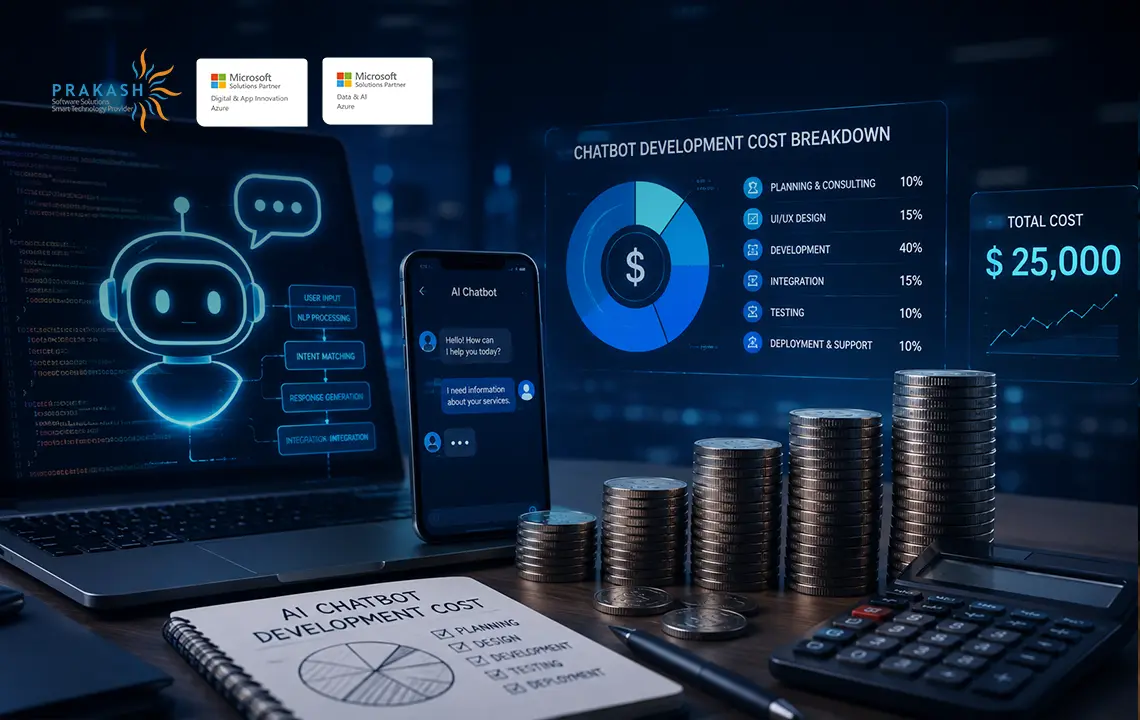
Where the Budget Actually Goes: Cost by Development Stage?
It is beneficial for one to understand how the project goes through each stage since it is here that questions like “why is it so expensive” get their answers.
- Discovery and Planning (10-15%) – use cases, conversation flow mapping, determining success metrics. This stage is often skipped which makes projects go off budget.
- Conversation and UX design (10-15%) – conversation itself, how the bot reacts on user input, fallbacks, and branding.
- AI/NLP model development (25-35%) – this is usually the largest single component of the project. Here training and testing take place.
- Back-end & integration (20-30%) — integrating the solution with CRM/ERP/ticketing solutions as well as developing middleware to connect everything together.
- Testing & QA (10-15%) — conversation testing, edge case testing, load testing.
- Deployment & maintenance (ongoing) — hosting, monitoring, retraining.
Notice where the biggest chunk of money will go: training on AI integration and backend integration, not the chatbot interface. If the budget estimate is highly weighted towards “design,” be careful!
The Hidden Costs Nobody Mentions Upfront
This is the area that is often not addressed by cost guides, and this is generally why actual costs exceed initial quotes by about 20-40%.
Data cleaning: The effectiveness of your chatbot will be dependent on the quality of the data it learns from. Disorganized, out-of-date, and inconsistent FAQs, product literature, and previous support queries must be cleaned up first before any training begins.
API and usage-based fees: These services typically use a model based on usage to calculate costs, meaning you need to budget for more than just development. An unexpectedly successful chatbot will run up your monthly operational cost quickly.
Integrating legacy systems: Legacy systems lacking good APIs will require building custom middleware from scratch. It is quietly one of the costliest items in enterprise projects.
Scaling architecture: Should you need to provide support for your chatbot during peak times, across multiple geographic locations, and availability, you will be paying for load balancing, redundancy, and multi-region hosting — not just a server.
Monitoring after launch: Someone has to verify which answers fail, why users drop out during conversations, and which areas should be retrained. It is a recurring expense, not a deliverable.
Plan for the above right from the beginning, and they become manageable. However, discover them midway through the project, and you get the feeling of scope creep, even though they might not be.
What’s Actually Included in Professional AI Chatbot Development Services
When you’re comparing AI chatbot development services, it will be useful for you to have an idea about what a proper engagement entails, beyond “we’ll build you a bot”:
- Discovery sessions for analyzing the real-world use cases against your business objectives, rather than making wish lists of features
- Model selection, which means deciding whether you need off-the-shelf, fine-tuned, or hybrid models
- Conversation design & prompt engineering
- Architecture for integration (CRM, ERP, payments, ticketing, or industry specific systems)
- Security and compliance as appropriate
- Testing through actual conversations, not just happy path demos
- Deployment to the channels that your users actually use (website, WhatsApp, Slack, mobile app)
- Monitoring and analysis after deployment and retraining cycles
A provider that bypasses the discovery process and rushes into the “Let’s connect it to GPT” phase is likely just creating a general solution for you, rather than one tailored to fit your business needs. The importance of this cannot be overstated in relation to your costs.
How to Keep AI Chatbot Development Cost Under Control?
- Start with an MVP: Choose a couple of use cases with big impact – such as order tracking, appointment booking, tier 1 support – and release those early on.
- Use existing models where you can: Tuning up a GPT or an open-source solution will be far less expensive than creating a model from scratch and faster to market.
- Phase your integrations: Connect the critical two or three systems first. Then add the remaining ones once you validate usage of your bot.
- Build compliance in from the start: It’s easier to build security and audit logging in the early stages than to implement these elements as an afterthought.
- Pursue an iterative approach: Small iterations with testing will catch costly mistakes early on.
- Match your team to the job: Offshore or hybrid (on-shore planning and off-shore execution using the services of a partner having experience in AI/NLP) could be effective to reduce costs without compromising quality if and only if the partner is really knowledgeable in AI/NLP.
Typical Timelines
- Simple chatbot: 4-8 weeks
- Mid-complexity AI chatbot (NLP + integrations): 3-5 months
- Enterprise-grade chatbot (voice, multilingual, agentic workflows): 6-12 months
It should be noted that timeframes and prices go hand in hand — a chatbot that touches more systems and needs more training data will take longer, almost by definition.
Why Businesses Work with PSSPL for AI Chatbot Development?
Cost planning will only work if those building the chatbot understand where the cost will be incurred, and that depends on the level of experience with enterprise delivery in creating such an estimate.
PSSPL (Prakash Software Solutions Pvt. Ltd.) has been in enterprise software delivery for 25+ years, shipping 500+ projects globally with a team of 250+ engineers and data scientists.
We’re a Microsoft Solutions Partner for both Data & AI and Digital & App Innovation, hold ISO 27001:2022 certification for information security, and run delivery under CMMI Level 3 practices — which matters more than it sounds, because it’s the difference between operate under CMMI Level 3 process improvement approach, as it is the distinction between “we will wing the scope” and a project that has actual sprints and reports.
We created our own AI Chatbot called PIRI which we use to solve a majority of regular client questions – reducing our response time by 4x while we work on the more complicated questions that require human intervention.
This is how we implement our solution for clients too – automate the repetitive 80% of the tasks, while involving people in other 20%. Our typical ROI for our AI projects is 3.2x and we have been able to achieve process automation in 70%. This might not always be true but this is how a project should aim.
We work on any project of an AI chatbot by taking the same approach: define the top 2 or 3 features that the bot should definitely have and implement them well, then scale out – but not by implementing all the features in v1 hoping that the budget will suffice.
Experience in building our AI chatbots comes from our use of pre-trained LLMs (GPT-4o, Claude, Llama 3), RAG pipelines, and fine-tuning, which enables us to choose the model according to your specific dataset and use case, not what you have in the stack.
Integration of the bot into CRM, ERP, ticketing, payment systems happens by following the API-first approach, which simplifies future modifications; if your business is working in a regulated industry, the compliance (HIPAA, GDPR, SOC 2 standards) is already provided from day one.
If you want a realistic number before collecting vendor quotes, that’s a conversation worth having early. We start with a free discovery session and follow up with a written estimate — no scope, no guessed number.
Frequently Asked Questions
The above five variables covered earlier in the blog do most of the work: how complex the chatbot needs to be (a scripted dialogue vs reasoning AI), AI engine or framework behind it, number of integrations, regulatory compliance requirements such as HIPPA and GDPR, and frequency of training after launch.
There are two additional variables that affect the cost, but to a lesser extent: the channels the bot will work in (web widget – the most cost-effective option; WhatsApp, mobile, and voice channels will raise complexity), and location of your dev team, because hourly rates may differ significantly across regions. Any change in just one variable will immediately affect the cost – and that’s the reason why two seemingly similar chatbots may have a vastly different cost.
There are several stages that all projects involve, although they may vary in terms of structure: discovery and planning, conversation/user interface/user experience design, machine learning and NLP models (these typically make up the biggest share and account for 25-35 percent of the project costs), backend development and integration, testing and QA, and then launch and maintenance. If you are offered a price quote moving directly from “design” to “launch” without mentioning any model optimization, then it might be useful to clarify the specifics of the process.
US-based development typically runs $90-180/hour, compared to $25-60/hour in India or $40-80/hour in Eastern Europe. In terms of full project cost, a mid-complexity AI chatbot built in the US usually lands between $60,000 and $150,000, while a basic support bot can start closer to $20,000-$40,000. Enterprise-grade systems with custom LLM training, multilingual support, or agentic workflows commonly cross $200,000-$300,000+. This is also why many US companies use a hybrid model — strategy and product ownership in-house, engineering with an experienced offshore or nearshore partner — to bring that number down without cutting into quality.
For a genuinely custom assistant — one trained on your own data, using RAG or fine-tuning rather than an out-of-the-box template — plan for roughly $35,000 to $120,000, depending on how many systems it needs to talk to and how much your industry's compliance requirements add to the build. On top of that, budget another 10-15% of the build cost per year for retraining and maintenance; a custom assistant isn't a one-time purchase, it's a system that needs upkeep to stay accurate.
"Affordable" usually comes from smart scoping and the right delivery model, not from a specific type of vendor. Offshore and hybrid development teams — particularly in India, which runs 28-40% cheaper than US or Western European rates for comparable work — can bring real cost savings without sacrificing quality, provided the team has genuine AI/NLP depth and not just general app development experience. Prakash Software Solutions Pvt. Ltd., for instance, combines 25+ years of enterprise delivery with Microsoft Solutions Partner status for Data & AI, which is the kind of track record worth checking for before picking a "budget" vendor — the cheapest quote upfront isn't affordable if it needs to be rebuilt in a year.
Start with a simple formula: (development hours × hourly rate) + AI model/API fees + integration costs + a maintenance allowance. For most small businesses, that lands the first version somewhere between $8,000 and $40,000, especially if you scope it as an MVP — one or two use cases (like order status or appointment booking) rather than trying to automate everything at once.
Using an existing LLM instead of training a custom model, and connecting only your one or two most important systems first, keeps this number from creeping upward.
Pre-built SaaS platforms (Intercom, Tidio, Drift, Landbot, Chatbase, and similar) typically run $50 to $5,000 a month and can be live in days — a good fit for standard FAQ handling or testing whether a chatbot even moves the needle for your business.
Custom development costs more upfront (commonly $25,000-$250,000+, depending on complexity) but gives you deep integration with your own systems, full data ownership, and workflows a template genuinely can't replicate. Most businesses use SaaS to validate the idea, then move to custom once they know exactly what they need.
If budget is the most critical factor, then a Software as a Service solution (Intercom, Tidio, Drift, Landbot, Chatbase) provides the quickest way to go live with the least initial outlay. Open source frameworks such as Rasa or Dialogflow will lower the license fees, but the effort will be required to customize the solution by the in-house team (or contractors).
Pre-trained language models (LLMs) such as GPT-4, Claude, or Gemini would cost less initially than building an AI model from scratch, since you're paying for API usage rather than months of model development.
There are four types that capture nearly all the business: fixed price (flat rate quote for defined scope – for small well-specified projects), time and material/hourly (charged according to actual time consumed, used in custom enterprise builds that change in scope), subscription/SaaS (flat rate monthly fee, priced typically $50-$5,000/month depending on volume or features offered) and usage-based pricing (per conversation or API call, frequently used in addition to one of the above for the costs of LLM and speech-to-text). In reality, most projects use two types of models, a fixed or hourly build price plus usage-based fees.
When considering enterprise-level projects, the same drivers come into play, but they become more significant due to deeper integration into legacy systems, which do not always provide good APIs; compliance and security requirements (which alone could amount to 15-25% extra budget); infrastructure to accommodate scalability and high availability across multiple regions; and the expense of data preparation and cleansing prior to any training efforts.
The addition of multilingual or voice capabilities adds even more time and budget to the project. This is why budgets for enterprise AI chatbots usually start at $90,000, going up to $300,000-$400,000+, with backend development and AI model training being the biggest parts of the budget.
I have developed a good number of computer vision, speech, and LLM projects over the years, and let's be honest about the important ones: whether the model is reliable where it is expected to work – at the edge, on-device, in the pipeline, and whether people can trust what the model produces. Training the model, beating a benchmark – that is not my biggest problem. My biggest problem is getting the model fast and reliable in CoreML or ONNX, and making sure that everything else doesn't fall after we move it to production. Almost all prototypes die on this stage, so I focus my efforts here.