


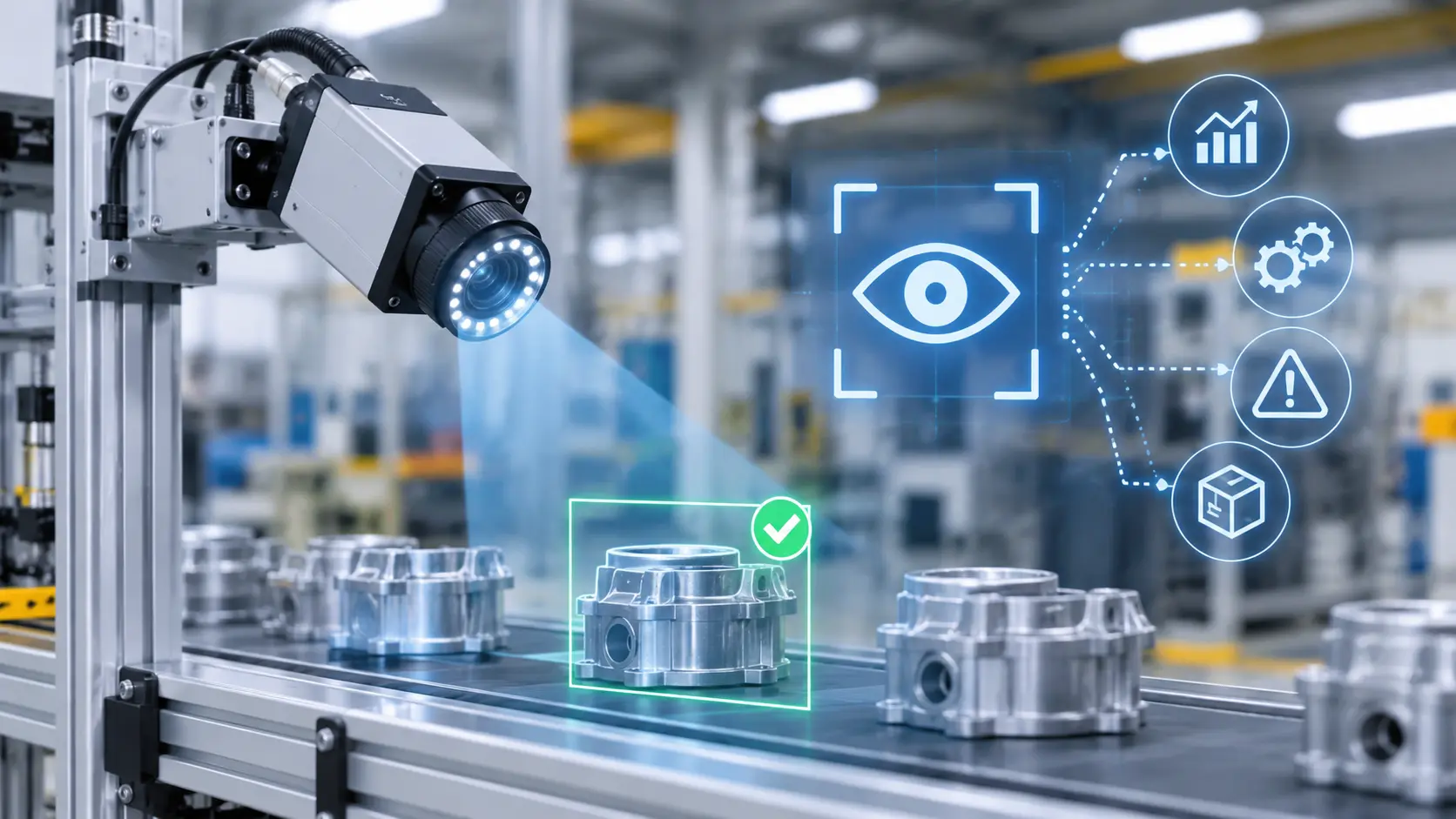
Computer Vision Development Cost: A Practical Guide to Budgeting Your AI Vision Project
Summarize and save time
Computer vision is an advancement in the AI development market that is increasingly used among startups, SMBs, and large-scale enterprises to detect defects, monitor safety, analyze inventory, process documents, automate visual inspection, and support informed decision-making.
Computer vision development has gained prominence and is no longer a sore sight, yet many organizations struggle with one consistent challenge: ‘what will be the computer vision development cost’?
The real answer to this question varies based on a range of factors that are distinct based on the nature of business and industry. The cost of computer vision development goes beyond simply building an AI model. It includes the cost of data collection, image annotation, model training, cloud computing, hardware and system integration, testing, deployment, and ongoing monitoring. Initially, a computer vision project might look straightforward, but the expenses can add on with add-on requirements like real-time video processing, seamless integration with existing data infrastructure, warehouse management, and ERP systems.
This blog is a guide to the factors that drive computer vision costs, what typical projects cost, which approaches are most cost-effective, and how to budget realistically for a production-ready system. It also explains how you can benefit from hiring AI developers via leading AI app development companies like Prakash Software Solutions Pvt. Ltd. (PSSPL). Analyze what benefits your computer vision development project can have when you partner with our Microsoft-certified AI and computer vision developers. Experience the value of our custom and enterprise-grade AI solutions driven by cutting-edge technologies, tools, and systems.
Recent Statistics: Computer Vision Market Growth
The adoption of computer vision development is rapidly growing globally, especially across manufacturing, retail, logistics, healthcare, automotive, and security industries. The following statistics reflect this rising demand, indicating why businesses are growing their investment in AI and why accurate budgeting matters:
- According to Grand View Research, the global computer vision market is projected to grow at a CAGR of 1%, from USD 28.2 billion in 2026 to USD 101.5 billion by 2033.
- Manufacturing accounted for 49% of global computer vision market revenue in 2025, driven largely by automated inspection.
- According to IHL research cited by Sci-Tech Today, 35% of retail sales winners planned computer vision deployment within 12 months.
Businesses are increasingly using computer vision AI for improving quality control, reducing manual inspections, automating business operations, and gaining real-time data insights.
What is Computer Vision Development?
The process of building software that understands and interprets visual data is referred to as computer vision development. Besides, analyzing and translating textual data and figures, these AI-assisted computer vision models can analyze images, videos, and live camera feeds for tracking real-time movements, detecting objects, classifying scenes, recognizing text, and identifying anomalies.
Common computer vision capabilities include:
- Facial recognition
- Image segmentation
- Optical character recognition (OCR)
- Object detection and classification
- Object counting
- Video analytics
- Document processing and inspecting visual quality.
Computer vision development is not simply about training business models; it’s a lot more. It includes collecting relevant and accurate data, labelling it correctly, choosing the right model architecture, seamlessly integrating the models with existing data infrastructure and systems, and providing post-deployment maintenance support.
How to Determine Computer Vision Cost?
Each project has different types of data availability, accuracy level, hardware, and software needs, and integration requirements. Based on the project’s purpose, there are varied budgets for computer vision models. The biggest factors that drive this cost include:
Categories of Computer Vision Tasks
Uncomplicated tasks like image classification or reading text are less expensive compared to complex tasks like detecting small defects, object tracking across video frames, or image segmentation based on pixels. This requires an evaluation of more data, testing, and engineering, which is why it can strain your budget.
Accuracy Requirements
If you want higher accuracy in the operations of the computer vision models, it requires more relevant data, more testing, better models, and more human review. This is especially true in cases when the system must detect rare defects or involve high-level decision-making.
Data Availability and Annotation
One of the highest hidden costs that you must consider when computing computer vision development cost is data availability. If the existing data is already updated, sorted, structured, and labelled, the cost will be lower. But if you need to separately collect images, manually label them, and annotate the rare defects, the cost will be higher.
Real-time Processing
If you need a computer vision system that can analyze large data sets and respond in milliseconds, it requires optimized models and advanced hardware. Therefore, real-time computer vision raises the cost quickly compared to batch-based processing of uploaded images.
System Integration
Computer vision rarely operates in isolation; it needs to seamlessly connect with ERP, CRM, POS, warehouse management, and alerting systems. Integration thus accounts for a substantial portion of the total computer vision cost.
Number of Locations
If a system is designed and deployed for one specific site, then the cost will be less compared to a system that is deployed across multiple factories, warehouses, stores, or regions. This is because, with a new site addition, there is a need to set up a separate camera, adjust lighting, and test the additional model’s suitability.
Computer Vision Development Cost Based on Project Type
When it comes to computer vision projects, they are generally classified into 3 broad categories: MVP, proof of concept, and production system. The computer vision development cost of these projects varies based on scope, data requirements, and level of integration complexity.
| Type of Project | Typical Scope | Estimated Development Cost (USD) | Typical Timeline |
|---|---|---|---|
| MVP |
|
$25,000 to $75,000 | 10 to 16 weeks |
| Proof of Concept |
|
$10,000 to $30,000 | 4 to 8 weeks |
| Production System |
|
$75,000 to $250,000+ | 4 to 9 months |
| Enterprise-Scale Platform |
|
$250,000 to $500,000+ | 6 to 12 months or more |
Important Consideration: These figures, timelines, and scope are estimates to help you plan, but don't consider them fixed quotes and restrict your budget to these approximations.
Cost Breakdown
Do you know one of the prominent reasons why computer vision development projects fail?
Most businesses make the mistake of getting blindsided by the cost of model development alone; they underestimate the work required around it. That’s where the real gap lies between the estimated and real budget. To avoid this scenario, here are a few components you must consider when planning a computer vision cost budget:
Discovery and Planning
Inclusions:
- Technical architecture
- Evaluating feasibility
- Identifying use cases
Typical Budget Share: 5% to 10%
Data Preparation
Inclusions:
- Image collection
- Labeling
- Preparing dataset
- Quality checks
Typical Budget Share: 15% to 30%
Model Development and Training
Inclusions:
- Model choice
- Training
- Tuning
- Evaluation
Typical Budget Share: 25% to 40%
Backend and System Integration
Inclusions:
- APIs
- Dashboards
- Integration with ERP, CRM, POS
- Alerts
Typical Budget Share: 10% to 20%
Hardware and Edge Deployment
Inclusions:
- Edge devices
- Cameras
- Networking
- Installation
Typical Budget Share: Variable
Testing and Validation
Inclusions:
- Edge-case testing
- Accuracy testing
- Performance validation
Typical Budget Share: 10% to 15%
MLOps and Ongoing Monitoring
Inclusions:
- Post-launch support
- Model monitoring
- Retraining
- Drift detection
Typical Budget Share: 5% to 10%
Not to Miss:
One significant yet overlooked cost aspect is that of data annotation. The more complex the label segmentation is, the higher the computer vision development cost will be. For instance, if 10,000 images need to be labelled, and each of them has 5 bounding boxes, a total of 50,000 annotations are needed. If the cost per bounding box is $0.10, the basic labelling cost before each quality review will be around $5,000.
How to Reduce Computer Vision Development Cost?
One of the pro tips you can consider to realistically account for computer vision development cost is to start small and with high-impact use cases. By doing so, you are not compromising the business value, your project budget, or the overall output quality.
Here are some proven ways to reduce the computer vision cost:
Begin with a Proof of Concept
Before you commit to a full-scale production build, deployment, and integration, start small. This means testing the solution on a limited dataset, which can also mean a pilot development phase.
A proof of concept is a way to validate the real-time effectiveness and usefulness of the ideated solution. It helps you in early review of technical feasibility, identifying data gaps, and any potential red flags.
Rely on Pretrained Models
Don’t opt to build a model from scratch or custom-built unless you have validated the results in a real-time environment. If retraining or refining an existing model can serve the purpose, it can prove to be cheaper, faster, and more practically rewarding.
Focus on Image Quality
Instead of unnecessarily adding complexities to the computer vision models, a smart approach can be to focus on the quality of visual assets. This includes image quality with better camera resolution, consistent lighting, and a stable camera placement. Focusing on this component not only helps to keep costs in check but also improves overall model accuracy and effectiveness.
Label Strategically
Before validating the model, don’t spend unnecessarily on labelling thousands of easy images. Begin with a few hundred high-quality images that correctly represent the difficult scenarios.
Keep Human Review in the Loop
AI automation doesn’t mean you discard the intelligence and review of human agents. The purpose is not to replace or eliminate human review, but to simplify the process a little, leaving more room for high-priority cases for your team and reducing delays.
A human reviewer in the loop is especially required in the early stages of model development. This reduces the risk of incorrect automated decisions and provides real-time, evidence-backed feedback for model refinement.
Plan for Retraining
Computer vision models can’t be restrictive to feedback and iterations. Models can lose accuracy over time if changes are introduced in lighting, products, camera angles, or even operating conditions. These types of monitoring and periodic retraining costs should be accounted for when budgeting your computer vision development costs.
How PSSPL Serves as the Right Computer Vision Development Partner?
Choosing the right technology is not all it takes when considering computer vision costs. You need to be very smart in choosing your computer vision development partner, because it’s a long-term and fruitful partnership offering you experienced AI developers and an operational environment where the solution will actually add value.
Here are a few key aspects and questions that will help you shortlist the right partner for your computer vision development project:
| Evaluation Criteria | Questions to Ask |
|---|---|
| Real-time experience in similar computer vision projects | How many labeled images do they think will be needed? |
| Expertise in data engineering, model training, evaluation, annotation, and deployment | How are rare exceptions or difficult use cases handled? |
| Experience with cloud and edge deployment | What approach do they recommend: API, custom model, or fine-tuning an existing model? |
| Clear approach for testing and accuracy validation | What accuracy metrics do they use? |
| MLOps and post-launch support | How is the system tested and validated in a real-world environment? |
| Transparent pricing with clear deliverables | Who owns the data, code, model, and documentation? |
| Strong security and compliance policies | What will ongoing support and model retraining cost? |
Based on these evaluation metrics, one of the highly regarded AI app development companies with 26+ years of experience is Prakash Software Solutions Pvt. Ltd. (PSSPL). At PSSPL, we are a team of 250+ certified and competent AI developers, data engineers, and computer vision experts. Combining our hands-on software engineering excellence with state-of-the-art technology, we design, develop, implement, deploy, and integrate enterprise-grade AI solutions.
Our custom solutions provide end-to-end development assistance from conceptualizing, designing, to implementation, integration, and ongoing monitoring. As partners with OpenAI, Microsoft Solutions, and Anthropic Claude, we ensure we build and adopt solutions using leading AI technologies. Our competent professionals have experience serving 500+ global clients across 40+ countries with 1,000+ successfully delivered projects.
The computer vision capabilities at PSSPL that guarantee measurable business value include:
- Use case discovery and feasibility assessment
- Custom computer vision model development
- Document intelligence, object detection, segmentation, and image classification
- Video analytics and real-time processing
- Edge AI and camera integration
- Seamless integration with ERP, CRM, POS, and third-party systems
- Model monitoring, security, governance, retraining, and compliance support
At PSSPL, we offer a comprehensive range of AI development services, where we don’t base our approach on a predetermined model but customize it around your end goal and budget. Our consultants evaluate the existing workflows, hardware requirements, data maturity, integration, and feature needs before recommending the action plan.
Ready to Build a Computer Vision Model that Delivers Measurable ROI?
Hire AI developers from PSSPL who assist in assessing feasibility, preparing data, building custom computer vision models, and deploying scalable solutions that integrate seamlessly and deliver measurable ROI.
Frequently Asked Questions (FAQs)
Here are a few top-rated factors that have a lasting and direct impact on computer vision cost:
- Accuracy requirements
- Data annotation
- Edge deployment
- Real-time processing
- Hardware choice
- System integration needs
If it's a basic proof of concept, the computer vision development cost typically starts at $10,000 and goes up to $250,000 or more for a production-grade enterprise system. The overall cost will vary based on the factors discussed in the above sections of the blog.
Edge hardware can be useful if your computer vision development project requires low latency, real-time processing, or privacy-sensitive video analytics. Cloud-based computer vision is simpler and more cost-effective in case of occasional image uploads.
Depending on the data readiness, model requirements, integration needs, and deployment scope, the timeline varies. A proof of concept can take 4 to 8 weeks, an MVP can take 10 to 16 weeks, and a production system can take 4 to 9 months or more.
If you are considering developing custom, secure, practical, scalable, and reliable computer vision AI models, hiring AI developers from PSSPL can be a wise move. This is because the PSSPL team of developers supports end-to-end computer vision development without separating strategy from implementation.
PSSPL doesn't provide generic off-the-shelf models; they customize the offering after thorough use-case discovery and data analysis to facilitate custom model development, seamless integration, deployment, and post-launch support.
Plan for Complete Computer Vision Cost
In a nutshell, the computer vision development cost is not only about building the AI model, but it constitutes the cost of all related components, including data preparation, annotation, retraining, integration, testing, deployment, and ongoing maintenance.
Plan a phase-wise, complete full development lifecycle from the beginning with AI app development companies like Prakash Software Solutions. Our custom integrated development approach supports the development of a computer vision system that improves accuracy, keeps development costs in control, reduces manual labor, and assures measurable business value.
Being involved in building a significant amount of generative AI applications I can say that the success of these apps lies in one thing — their model is integrated into a user’s workflow and people trust their results. Building some LangChain agents or ML models in a notebook? Piece of cake. The real deal is to build something useful in production, to ground it so that it won't start hallucinating and doing stuff for no reason. This is where most demonstrations fail silently, and this is what we concentrate on the most.