


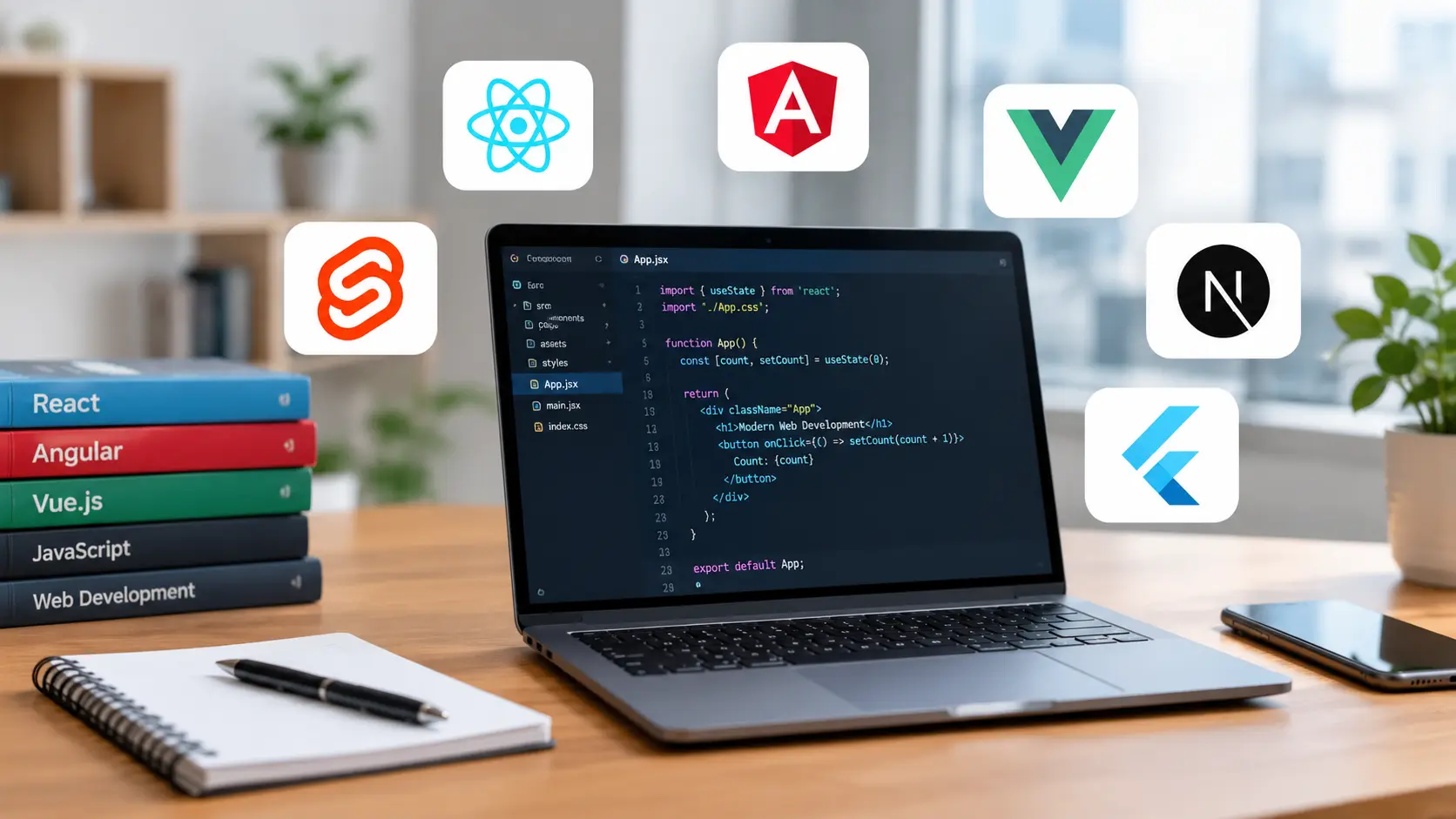
Best Frontend Frameworks – A Complete Guide for Modern Web Development
Summarize and save time
Attractive websites no longer last in the market with a growing demand and audience base. Websites are no longer digital assets for businesses, but they are meant to multiply the revenue stream by retaining loyal customers. This is why having an attractive design, color scheme, writing clear HTML code, or adding interactive buttons is not enough.
Modern-day users expect fast loading times, responsive and personalized layouts, improved user experience, smooth navigation, and reliable performance across all devices and screen resolutions. Modern websites can meet these expectations with a strong and reliable frontend foundation. That is why the demand for frontend frameworks in modern web development is growing.
Frontend frameworks provide developers with access to reusable structures, tools, and patterns for designing user interfaces. Developers don’t need to spend the time and energy to individually write every interaction, page update, and form validation rule from scratch. They can utilize the frontend framework to ensure faster and consistent application development as the business scales.
The challenge is to choose the right frontend framework from the list of most popular frontend frameworks, including React, Angular, Vue.js, Next.js, Solid, Nuxt, and others. The right choice depends on numerous factors ranging from project scope and complexity to performance needs, development timeline, long-term maintenance needs, business goals, and available skills.
Key Takeaways
- Frontend frameworks assist modern-day businesses in building interactive, responsive, and maintainable web applications in less time by utilizing reusable components and structured development patterns.
- According to the State of JavaScript 2025 survey, React, Vue, Angular, Preact, and Svelte are among the most popular frontend frameworks.
- There is no one best frontend framework for any project. The right choice depends on the identification of the scope, team expertise, performance needs, SEO goals, and long-term business scalability.
- Before committing to full-scale development, a small proof of concept is a better choice to validate your choice of framework.
What are Frontend Frameworks?
Frontend frameworks refer to a collection of tools, libraries, conventions, and reusable components that assist developers in building the visible interfaces of a website or application. The frontend is what the users see and interact with, which is why it lays out the groundwork for their choice and experience. It includes forms, dashboards, navigation menus, buttons, search filters, animations, responsive layouts, etc.
Frontend frameworks help in organizing these elements into manageable pieces, and most modern frontend frameworks utilize a component-based approach. In this approach, a component refers to a self-contained interface piece that is defined by its unique design, behavior, and logic. The benefit of designing a component is that instead of rebuilding it from scratch repeatedly, the developer can design one component and apply it throughout the site. One of the top-rated examples of a framework using this approach is React.
Additionally, frontend frameworks also make managing the application state easier and simpler, which keeps changing with each user interaction. In the absence of a structured framework, managing these changes can become challenging as the application grows. With the right frontend framework, you can update the appropriate part of the interface with zero rebuilding.
Significance of Frontend Frameworks
Static pages no longer serve the needs of the online audience in the fast-paced digital context that modern-day businesses operate in. Users now need interactive digital experiences with websites functioning like software applications, providing instant feedback, seamless user navigation, personalized content, and mobile-friendly user performance.
Modern frontend frameworks support these expectations in more ways than one as listed below:
Agile Development
Best frontend frameworks help reduce the hassle of repetitive coding, as developers can utilize ready-made structures to route, handle forms, integrate APIs, manage interface components, and manage state. This shortens the development timeline and makes it easy to release new features.
Consistent User Experience
Frontend frameworks provide shared components and standardized user patterns that help design consistent applications and deliver a uniform user experience. Buttons have similar appearance and functionality across pages, forms follow the same user behavior, and error messages are rendered in the same style. Users don’t have to relearn the interface design and how it works on each page because consistency improves usability.
Improved Performance
Working with the best frontend framework provides tools that assist developers in optimizing page load behavior, managing assets, improving rendering performance, and reducing unnecessary page updates. The performance also depends on how the framework is implemented, because even if the right framework is chosen, a poorly designed application would function slowly.
Better Maintenance
A well-structured frontend application becomes easier to maintain and update. Instead of updating dozens of individual pages separately, the design team can change the primary button styling, and developers can then update the reusable button component. This is a benefit for businesses with fast-scaling products having multiple teams, frequent releases, and large codebases.
Large Ecosystem
The most popular frontend frameworks have extensive user communities, documentation, plugins, development tools, and a repository of learning resources. This reduces the risk for businesses to find and hire frontend developers, as they are easier to hire; common challenges already have known solutions, and tools are regularly updated.
Key Factors for Choosing a Frontend Framework
The answer to ‘what is the best frontend framework’ has no definite answer, because several factors influence this decision. Besides the product being built, the best choice relies on the following factors:
Team Expertise
The value of a framework is only ensured when the team can use it effectively. Having an in-house team with the expertise to use a particular framework makes it difficult for them to adopt a completely new framework. It adds to the onboarding time and delivery risk. Additionally, depending on the project type and technical requirements, the choice of framework varies.
Project Type
Based on the type of project, the choice of framework will be different. For a simple marketing website, there will be a requirement for a real-time analytics dashboard. But for a complex and content-heavy website, prioritizing SEO visibility and page speed will be the focus areas. Based on these priorities, the frontend framework is then selected.
Scalability
Building a prototype can be done easily with any framework, but the real challenge is ensuring that the architecture remains maintainable. This is especially crucial in cases when the application has a growing user base, more feature additions, integrations, and a large development team.
SEO Requirements
Search engine optimization is key for modern-day businesses in the digital age, and even more important for public-facing websites. Therefore, always choose frontend frameworks that support server-side rendering, static generation, and hybrid rendering to help search engines access and understand your page content reliably.
Performance Needs
Modern-day applications need to load quickly because of the reduced attention span of users. The load speed also matters, especially on low-powered devices and unreliable networks. Moreover, real-time updates and highly interactive user interfaces are also the need of the hour.
As a result, the frontend framework needs to be carefully selected based on its rendering options, bundle size, caching, server-side rendering, and asset optimization ability.
Community and Ecosystem
A healthy ecosystem facilitates easy development by providing UI libraries, state-management options, testing tools, seamless integrations, and community support.
Long-term Support
Framework maturity is another factor to be considered in your choice of framework. Don’t fall for a tool just because it’s trendy, because a poorly supported tool with limited migration, stability, and developer availability creates maintenance challenges in the future.
Best Frontend Frameworks to Consider
Let’s look at the best frontend frameworks that are highly regarded in 2026:
(1) React
React is one of the best frontend frameworks and a flexible choice for modern interface development. It’s commonly described as a JavaScript library used for designing dynamic web applications. React is widely used as the foundation for frontend development stacks with reusable components that facilitate developers in building complex interfaces from smaller pieces.
From designing simple embedded interface elements to large single-page applications, mobile apps, eCommerce platforms, and dashboards, React supports almost everything. Designed for gradual adoption, your team can easily add React to the existing website or use it as the core of your new application being developed.
Key Strengths of React include:
- A strong ecosystem of supporting libraries and tools.
- Extensive developer community with broad talent availability.
- Reusable component-based development.
- Flexibly integrates with existing applications.
- Works well for highly interactive applications.
Potential Drawbacks of React include:
- Although React offers flexibility, teams often must choose additional tools for routing, testing, state management, data fetching, and styling.
- In the absence of clear architectural standards, different developers structure code in different ways.
Common Use Cases of React include:
- SaaS dashboards
- Designing customer portals
- ECommerce storefronts
- Social platforms
- Booking systems
- Enterprise applications and websites
(2) Angular
Angular is a structured and complete web framework used for reliable and scalable enterprise application development. With a broad suite of tools and APIs available, Angular includes a larger range of features compared to React that developers don’t need to add separately.
With strong support from Google, this frontend framework has built-in patterns for routing, forms, HTTP communication, dependency injection, testing, and application architecture.
Key Strengths of Angular include:
- A complete framework with strong structure for large-scale applications.
- TypeScript-first development approach.
- Suitable for complex enterprise application development with supporting reusable components and modular architecture.
- Strong support for testing and maintenance.
Potential Drawbacks of Angular include:
- Angular has a steep learning curve, which is why developers need to have a thorough understanding of complex modules, dependency injection, services, and TypeScript patterns.
- For a small landing page project or a prototype, Angular might be more structured than needed.
Common Use Cases of Angular include:
- Financial platforms
- Enterprise portals
- Large dashboards
- Internal business systems
- Healthcare applications
- Customer service tools
- Workflow-heavy applications
(3) Vue
Vue is an approachable, balanced, and popular JavaScript framework for user interface development. Built on standard HTML, CSS, and JavaScript, this component-based model is easily approachable by developers with an understanding of the core web technologies and specifics.
Declarative rendering and reactivity are emphasized by Vue. Declarative rendering refers to developers explaining what the interface should look like based on its current state. Reactivity means the framework tracks the changes made in data and updates the relevant parts of the user interface with that data efficiently.
Key Strengths of Vue include:
- Strong reactivity system with good developer experience.
- Clear template syntax and component structure.
- Easy learning curve for developers.
- Flexible for small and large-scale projects.
Potential Drawbacks of Vue include:
- Despite the strong ecosystem of Vue, it’s smaller in comparison to React’s ecosystem in global markets.
- Finding Vue developers can become difficult compared to React developers, especially in remote locations.
Common Use Cases of Vue include:
- Portals
- Dashboards
- eCommerce experienced
- Admin panels
- Content platforms
- Interactive website features
(4) Svelte
Svelte, a lightweight frontend framework, takes a different approach from traditional frontend frameworks. Svelte doesn’t do most of its work in the browser during runtime; instead, it compiles the components during the build process. This reduces the amount of JavaScript that users receive and support faster, lightweight application development.
Svelte is one of the most popular frontend frameworks for its simple syntax and developer-friendly design. There’s no boilerplate like other frameworks, and it allows developers to write components using familiar HTML, CSS, and JavaScript patterns.
Key Strengths of Svelte include:
- Simple and readable component syntax.
- Lightweight output and strong performance with less boilerplate for common tasks.
- Fast development experience, serving as a good option for performance-conscious applications.
Potential Drawbacks of Svelte include:
- Svelte has a smaller ecosystem and developer community compared to React, Angular, and Vue.
Common Use Cases of Svelte include:
- Product interface and interactive website development
- Data visualization
- Lightweight application development
- Prototyping
(5) Next.js
Next.js is a leading React framework that extends React by providing conventions and capabilities for server-side rendering, routing, image optimization, static site generation, and production deployment. For several teams, React alone doesn’t suffice for complete production websites. This is where Next.js can serve the purpose by providing a reliable method for handling pages, optimization, and backend integration.
Key Strengths of Next.js include:
- Useful for SEO-focused websites, providing static generation and server-side rendering support.
- Built on React, so it offers familiarity for the React community of developers.
- Supports hybrid rendering strategies with support for full-stack application development.
Potential Drawbacks of Next.js include:
- js introduces several concepts beyond basic React. This includes server components, caching, rendering strategies, and routing conventions. To avoid performance and maintenance issues, it therefore becomes important for developers to understand these concepts.
Common Use Cases of Next.js include:
- Product platforms
- Corporate website development
- eCommerce stores
- Marketing websites
- Documentation portals
- SaaS products
(6) Nuxt
Nuxt is a framework that is built on Vue with additional tools for routing, static generation, SEO, server-side rendering, and production-ready application architecture. This can be a strong choice for teams that prefer experience in Vue development but need the advanced capabilities of a full application framework.
Key Strengths of Nuxt include:
- Useful for SEO-friendly applications.
- Supports server-side rendering and static generation.
- Good fit for content-heavy and performance-focused websites.
- Supports modern full-stack development workflows.
Potential Drawbacks of Nuxt include:
- Nuxt is well-suited for teams that are already comfortable with Vue, but for organizations that rely on React expertise, Next.js can be a better fit.
Common Use Cases of Nuxt include:
- Publishing platforms
- Online stores
- Blogs
- Marketing sites
- Customer portals
(7) Preact
Preact is a lightweight alternative to React that is compatible with most of the React ecosystem. With a similar component-based development model, Preact aims to reduce the application size delivered to users. Preact is valuable for teams that want a React-like developer experience but want to reduce the frontend overhead.
Key Strengths of Preact include:
- Familiar development approach for React developers.
- Compatible with the majority of the React tools and patterns.
- Small size in comparison to several frontend solutions.
- Well-suited for lightweight applications and embedded experiences.
Potential Drawbacks of Preact include:
- Although Preact has React compatibility, it might not work identically with every React-specific library or feature.
Common Use Cases of Preact include:
- Mobile-first web experiences
- Landing pages
- Progressive web application development
- Embedded widgets
- Lightweight user interface
How to Choose the Right Framework for Your Project?
Choosing the best frontend framework is about picking up a framework that assists your team in delivering a secure, fast, maintainable, and user-friendly product experience with unnecessary complexities. The following guidelines might help you choose the right frontend framework based on your project needs:
-
React is well-suited for:
- Flexible architecture
- Large ecosystem
- Strong availability of developers to hire
- Designing highly interactive user experiences
-
js is well-suited for:
- Search engine optimization
- Server-side rendering
- Content management
- Fast page delivery
-
Angular is well-suited for:
- Complex enterprise application development with large teams
- Detailed workflows
- Lengthy project timelines
- Strict architectural needs
-
Vue is well-suited for:
- Smooth learning curve
- Clear syntax
- Balanced development experience
-
Nuxt is well-suited for:
- Strong SEO is required
- Server-side rendering
- Content-focused performance
-
Svelte is well-suited for:
- Performance
- Simplicity
- Reduced frontend overhead
-
Preact is well-suited for:
- Application size
- Rendering efficiency
- Interactive performance is of value
Frequently Asked Questions (FAQs)
Frontend frameworks refer to the development tools that are used for building user-facing parts of the website and web applications. They include reusable components, structured coding patterns, and features used for managing interactive interfaces.
There cannot be a single answer to this question, as the definition of the best frontend framework depends on the project. For instance, if flexibility is a priority, React is a preferred framework. If you are looking to develop large enterprise applications, then Angular can be the right pick, and so on.
React is technically a JavaScript library used to build user interfaces. It's often listed among the best frontend frameworks because it is frequently used as the foundation of full-scale web application development.
Vue is often regarded as a beginner-friendly framework with its readable syntax and slow learning curve. React is another strong option for beginners with an extensive community, multiple tutorials available, and increasing demand in the job market.
To choose among the most popular frontend frameworks, here's what you can evaluate:
- Performance needs
- Complexity of the application
- SEO
- Team expertise
- Development timeline
- Future maintenance needs
Yes, startups can benefit from using frontend frameworks because it helps speed up development, easily scale the product as the user base and features grow, and supports reusable UI components.
For SEO-focused websites, Next.js and Nuxt are top-rated choices. This is because they provide server-side rendering and static site generation support.
Final Thoughts
In a nutshell, the most popular frontend frameworks are not just technical tools. They have a major influence on the speed of product launch, ease of maintaining code, the quality of user experience, and the scalability of the digital platform over time.
The best frontend frameworks listed above all have distinct advantages and limitations. Don’t choose a framework based on the list of features or community size, but make your choice based on how well it aligns with your project goals, performance needs, team skills, and future plans.
One wrong choice can prove to be costly in the long run, but one thoughtful choice can save you the costly redesigns and technical challenges later. Consider the present as well as the long-term benefits when you choose a frontend framework from the start of the project.
I have written several pieces of technical and SEO content across different SaaS and product companies, and the ones which have been successful possess one common characteristic: they have something valuable to say to a technical reader while still being optimized for ranking. Writing an informative blog post? Easy part. Getting the search intent right, making sure that the technical information is accurate, and aligning each post with its place in the buyer journey? That's where I put all my efforts.