
AI Agents for Procurement Transforming Sourcing, Purchasing, and Supplier Management
Summarize and save time
Businesses are no longer operating as per traditional procurement methods. With the advancements of AI being observed in every business domain, procurement is no exception. There are several challenges in the traditional procurement channels that need to be addressed, such as high costs, less supplier visibility, slow sourcing cycles, compliance issues, and so on.
This is why companies are automating and modernizing their procurement processes to digitize purchase orders, invoices, supplier records, and approvals. Despite this advancement, there are several procurement processes that still require human intervention for searching for the required information, comparing options, document review, coordination across disconnected systems, etc. This type of human assistance can result in potential delays and expenses. As a result, the use of AI agents in procurement is gaining popularity.
AI procurement agents understand the business objective, gather and analyze data from multiple systems, suggest recommended actions, and coordinate the multi-step workflows with minimal or no human intervention. This level of AI automation is required in the present-day procurement channels where AI agents don’t simply answer a pre-defined set of questions, but also assist with:
- Researching suppliers
- Classifying spend
- Reviewing contracts
- Identifying potential risks
- Creating purchase requisitions
- Escalating exceptions to human agents when needed
Therefore, the opportunity for AI agents in procurement is no longer restricted to the procurement modules alone. These agents help to build intelligent workflows that connect seamlessly to the ERP systems, supplier portals, procurement platforms, contracts, invoices, and internal knowledge repositories. Several reputed companies like Prakash Software Solutions Pvt. Ltd. offer AI agent development services as part of their production-ready AI solutions. Our experts utilize cutting-edge technologies to deliver enterprise-grade AI agent solutions that streamline the procurement processes with intelligent automation to deliver measurable ROI.
Recent Market Growth of AI Agents in Procurement
AI adoption in procurement is rapidly growing with the development of AI agents, but several organizations are still struggling with production deployment. There is a gap between experimentation and enterprise-scale implementation, and AI development companies like PSSPL help address this gap.
At PSSPL, we outline a practical AI strategy roadmap after thorough evaluation of data readiness, integration, and governance support. Let’s look at the market figures indicating the demand for AI agents for procurement:
- Generative AI adoption in procurement has nearly doubled from 50% to 94%, making procurement the leading enterprise function for AI adoption.
- According to the Hackett Group, 49% of procurement teams have run generative AI pilots, but only 4% have made it to large-scale AI deployment. This indicates that organizations still need help moving from proof of concept to production.
- A 2025 ProcureCon CPO report found that 90% of procurement leaders have considered or are already using AI agents.
- Gartner forecasts that supply chain management software with agentic AI will grow from under $2 billion in 2025 to $53 billion by 2030, reflecting a rapid investment in autonomous procurement.
What Is an AI Agent for Procurement?
An AI agent for procurement refers to an intelligent software system that can pursue a predefined procurement goal based on data interpretation, reasoning, utilizing connected tools, and completing tasks with the required level of human oversight. Basic chatbots simply respond to prompts, but an AI agent is designed to act within a specific workflow.
For instance, in case of an AI chatbot a procurement professional can at max ask about the current amount spent with a specific supplier. The chatbot will retrieve and present the answer. But when it’s an AI agent, it can answer broader questions, such as:
- Pricing and delivery timelines
- A comparison of approved suppliers in the region
- Verifying the contract terms
- Preparing a purchase recommendation
- And so, on
The goal of implementing AI in procurement solutions is not to replace procurement professionals, but to remove repetitive work and back-and-forth coordination from the process. This gives the procurement team more time to focus on broader supply strategy, negotiations, risk management, etc.
If you are looking for end-to-end assistance from use case discovery to custom development, integration, deployment, and maintenance, the AI app development services from the PSSPL team of experts can be the best choice.
How AI Agents in Procurement Differ from Traditional Automation?
Just like AI chatbots, traditional procurement automation is rule-based. The predefined paths guide the complete actions and responses. There is a rule for each type of instance that occurs in the pipeline. For instance, route the purchase request to a manager if it exceeds a certain amount, or if an invoice doesn't match a purchase order, send it for human review.
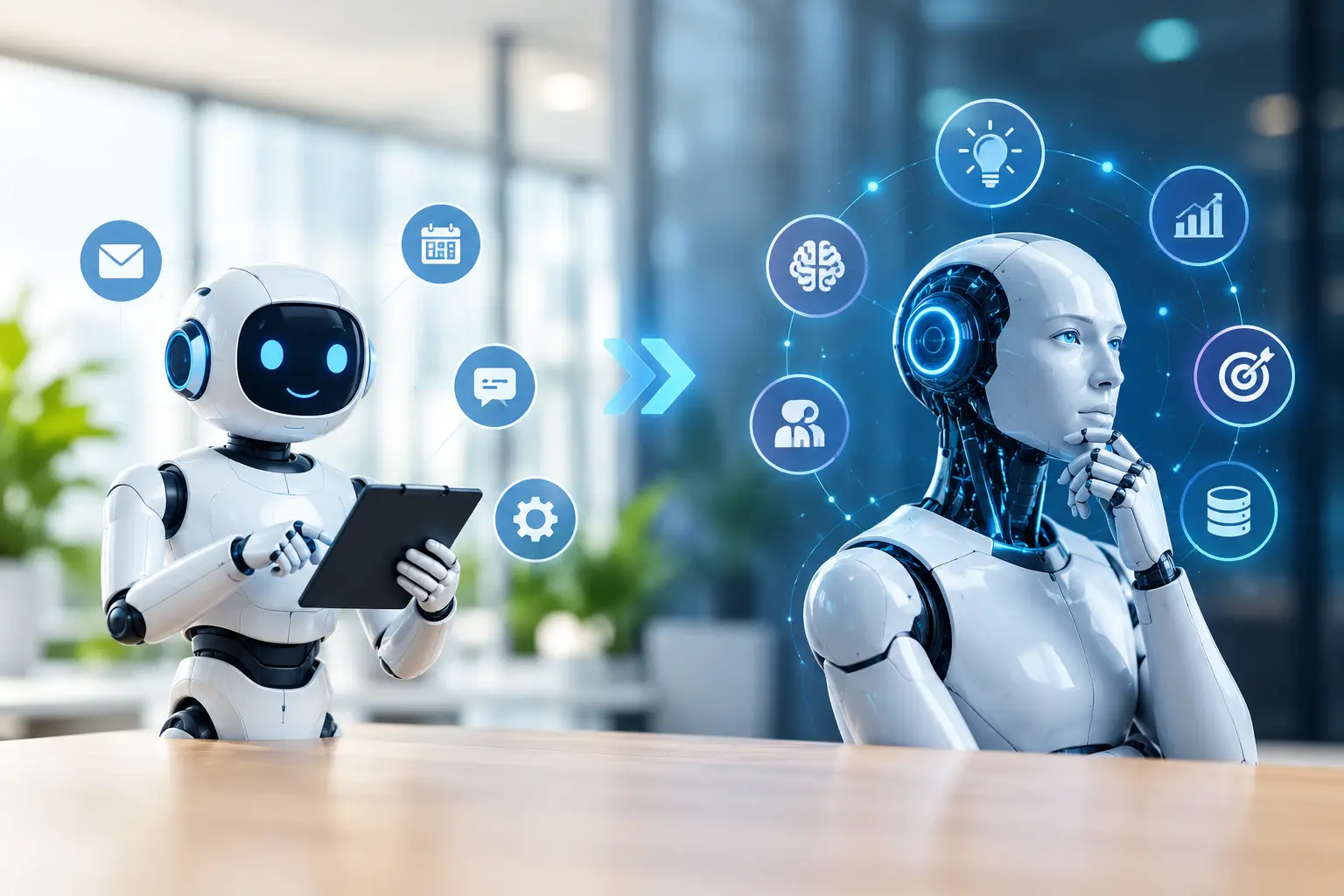
On the other hand, AI agents in procurement go beyond these pre-defined sets of rules. They can comprehend and put unstructured information to use, adapt to the context, and recommend the next course of action after coordinating across multiple systems.
| Point of Difference | Traditional Automation | AI Agents in Procurement |
|---|---|---|
| Type of workflow | Fixed rules with pre-defined steps | Goal-oriented and adaptive workflows |
| Data handling | Structured forms and fields | Structured as well as unstructured data |
| Support in decision-making | Via alerts and approvals | Context-related recommendation and actions |
| System interaction | Mostly limited to a single system | Multi-system integration across ERP, CRM, and supplier portals |
| Exception handling | Manual escalation | Suggested resolutions via intelligent automation. Escalated manually only in high-impact cases |
| Role of human agent | Approval and processing | Strategizing, negotiating, and exception management |
| Learning and improvement | Limited scope | Scope of improvement is based on feedback and performance metrics |
The procurement industry is rarely stable or linear. Several factors keep fluctuating, including but not limited to supplier information, pricing, documents, market trends, and frequent exceptions. As compared to traditional automation, AI agents for procurement are valuable because they can manage this complexity with consistent and traceable outcomes.
Types of AI Agents in Procurement
Every AI agent functions in a distinct way, and understanding the main types of AI agents in procurement helps you to choose the right level of access, autonomy, and governance for these agents.
Here are the most popular types of AI agents in procurement:
(1) Reactive Agents
As the name suggests, these agents respond to specific requests or events. These agents are also useful in employee self-service and procurement helpdesk automation. In the procurement environment, these agents can respond to questions like:
- What is the status of a particular order?
- Which suppliers are approved for office supplies?
(2) LLM-powered Assistants
Large Language Model-powered AI assistants can interpret natural language, summarize documents, retrieve information, communicate, and answer questions utilizing an internal knowledge base. In procurement tasks, these assistants can summarize supplier agreements, extract important contract clauses, draft emails, and so on.
(3) Rule-based Agents
Rule-based agents are a practical and favorable choice for high-volume and monotonous processes because they function on a pre-defined set of clear rules and tried-and-tested business logic. The common value addition of these agents includes automation of purchase requests, validating the budget, automated renewal reminders, etc.
(4) Task-specific Agents
Task-specific agents dedicatedly work for a single procurement function and have a greater degree of reliability. With a clear scope and performance metrics, these agents can be the best starting point. Examples include:
- Invoice-processing agent
- Supplier-risk monitoring agent
- Contract-review agent
- and several others.
(5) Multi-agent Systems
A multi-agent system oversees the functioning of several specialized agents. Each agent performs a unique task, and the orchestration layer coordinates the overall workflow. For instance, one sourcing request can trigger multiple agents to ensure contract compliance, approve the route, choose the right supplier, and so on.
(6) Autonomous Agents
Autonomous agents function independently with zero human intervention to complete routine tasks. These tasks can include processing invoices, reordering high-demand items, updating supplier records, etc.
Pro-Tip: Make sure to state the level of autonomy for these agents to ensure reliable performance.
(7) Human-in-the-loop Agents
Human-in-the-loop agents perform research, analysis, and provide recommendations, but they can’t do it independently. These agents require human approval and review before taking any action. This type of AI agent is well-suited for high-value purchases, supplier choice, and high-stakes decisions involving compliance or reputational clauses.
Looking to Build an AI Agent for Procurement Around Your Existing Systems?
Partner with the PSSPL team of AI experts and design a secure AI agent for procurement that seamlessly connects your procurement data, supplier portals, ERP systems, and approval workflows. From use-case identification to deployment and support, get end-to-end assistance to turn AI concepts into production-ready solutions.
Benefits of AI agents in Procurement Solutions
The adoption of AI agents in procurement solutions is scaling forth because they help reduce manual efforts, improve decision-making quality, and provide greater degree of control over procurement processes. Several benefits that make them a valuable investment include:
Low Processing Cost
AI agents in procurement automate the majority of the routine and repetitive administrative tasks, such as requisitions, invoice processing, routine purchases, etc. This reduces the overall administrative workload and processing cost.
Fast Sourcing Cycle
Sourcing and finalizing suppliers is done in half the time taken earlier. This is because the AI agents can gather supplier information, compare responses, and provide recommendations in less time using intelligent automation.
Improved Policy and Contract Compliance
Abiding by the policy and contract regulations and compliance is not a concern with AI agents. They ensure that purchases are validated against the set budgets, preferred suppliers, and contract terms. Contracts are also maintained from time to time with timely renewals, updates in pricing terms, and clauses to address challenges.
Better Spend Visibility
The AI classification and analysis of AI agents provide a clear view of the spending patterns and saving opportunities. This helps to provide a better balance and visibility for the overall spend.
Improved Employee Experience
Self-service agents provide automated and prompt answers to common procurement questions, reducing the wait time.
Challenges and Risks of AI agents in Procurement
Although AI agents bring unparalleled advantage and potential, they also pose several challenges. Procurement decisions have an impact on cost, supplier relations, compliance, and overall operational continuity. It's important to address these risks before scaling automation to avoid any disruptions or reputational damage.
Some of the common challenges involved in implementing AI agents in procurement include:
| Challenge | Description | How to Address It |
|---|---|---|
| Poor Data Quality | The reliability and quality of the output rendered by AI agents rely on the accuracy and quality of the data. Outdated pricing, fragmented data, duplicate records, incomplete contracts, inconsistent supplier information, etc., can result in poor output. | Before deploying AI agents in procurement solutions, assess the supplier's data, transaction history, contract terms, and system integration. |
| Integrating Legacy Systems | Many procurement teams use a combination of ERP systems, procurement platforms, supplier portals, and spreadsheets, which makes integration a common challenge when implementing AI agents. | Ensure secure data exchange between these systems; otherwise, the AI agent will have limited visibility and ability to act. |
| Unclear Rules for Approval | Without clearly defined access controls, the level of autonomy of AI agents in procurement is not restricted. | Define what agents can do independently and which actions mandate human approval and review. |
| Data Privacy and Security | Procurement data deals with sensitive information including supplier pricing quotes, contracts, personal identification information, financial records, and other confidential details. | To prevent a breach of confidentiality, define data access, encryption protocols, and deployment restrictions. |
| Model Errors and Guesswork | Generative AI produces confident but incorrect outputs at times. In procurement, this can result in incorrect contract summaries, inaccurate comparison of suppliers, or inappropriate purchase recommendations. | Human review, data retrieval from approved sources, and use-case-specific evaluations become mandatory. |
| Bias in Supplier Evaluation | If the historical data includes biased supplier selection practices, it is highly likely that the AI agent will reciprocate the same pattern. | Procurement leaders must clearly define fair evaluation criteria and thoroughly review the agent's recommendations for unintentional bias. |
A Practical Implementation Roadmap of AI Agents for Procurement
To ensure a successful, seamless, and valuable implementation of AI agents, it requires a proper implementation roadmap. Choosing the AI model or purchasing a tool doesn’t suffice. At PSSPL, we follow a practical development approach that connects business outcomes with your business goals, budget, data readiness, governance, and overall deployment.
Here are a few steps that can help you ensure the right implementation of AI agents for procurement:
(1) Use Case Discovery
Before you design an AI agent, begin by identifying the high-value use cases for it. Don’t overcomplicate by trying to automate the source-to-pay process in one go. You must begin with a review of contracts, classifying overall spend and matching invoices, automating procurement help, and so on. The whole idea is to design a pilot model of the AI agent and then make a full-scale rollout once the results are rewarding.
(2) Assessing Data Readiness
Make sure your legacy systems and existing data can comply with the requirements of the AI agents in procurement. Identify missing data, integration gaps, inconsistent records, access restrictions, and other specifics to evaluate the overall readiness. This requires a thorough review of the invoices, contract terms, purchase orders, product catalogs, ERP and CRM platforms, etc.
(3) Defining Guardrails and Architecture
Define clear rules that state the autonomy of the AI agents. This includes defining the overall spend limit, escalation paths, restricted categories, audit requirements, and human escalation scenarios.
At this stage, it’s all important to choose if the agent will utilize an existing procurement platform or if there’s a need to build a custom agent and adopt a hybrid approach altogether. Evaluate the workflow complexity, integration requirements, and data sensitivity before arriving at a conclusion.
(4) Pilot Development
Test your idea of the AI agent on a limited category or supplier group by developing a controlled pilot. This is the stage where you can test the feasibility and viability of the AI agent without implementing it across the procurement process. Identify the roadblocks and improvements needed before the full-scale launch in the real world.
(5) Performance Evaluation
Set the performance criteria from the start to compare the performance of AI agents against these benchmarks. This can include error rate, processing cost, compliance, cycle time, supplier response time, adoption rate, cost savings, and so on. The end goal is to improve the overall procurement process and not just ensure the AI agent’s accuracy.
(6) Deployment
Before full deployment, it’s important to constantly evaluate and monitor the security, compliance, and performance of the AI agent. The procurement team should know what the agent did, why it did it, what the outcomes of this action were, and what level of human approvals were required.
(7) Scalability and Maintenance
If the first defined use case is stable and viable, expand the AI agent in procurement to additional categories and workflows. Gradually, you can connect several agents into a centralized and well-coordinated procurement system.
How PSSPL Helps Build AI Agents for Procurement?
Our team of 250+ AI engineers at Prakash Software Solutions Pvt. Ltd. (PSSPL) moves beyond AI experimentation by designing and implementing enterprise-grade AI agents. We combine AI consulting with our software engineering expertise and advanced AI technologies to provide a comprehensive range of AI agent development services.
At PSSPL, our team designs agents to implement AI in procurement solutions such that they can work alongside real systems, real data, and real operational constraints. We follow a customized development approach that begins with an identification of your business goals and challenges and is designed to align with your specific requirements. We don’t go by the books and follow a predefined set of rules or use a predetermined model. Our AI consultants evaluate your business workflows, processes, AI readiness and architecture, compliance requirements, data infrastructure, and skills gap thoroughly. Based on this evaluation, we then recommend the implementation roadmap for successful deployment of the AI agents in procurement.
Here are the AI capabilities you can expect from the PSSPL team of experts:
- Use case identification and feasibility
- Custom AI agent architecture, development, and deployment
- Generative AI, document intelligence, and RAG
- Seamless integration with ERP, CRM, and supplier portals
- Natural language processing for invoices, emails, contracts, and important supplier documents.
- Security, governance, and post-launch support
- End-to-end development services from strategizing to implementation
Frequently Asked Questions (FAQs)
There can never be one right AI procurement software option because it varies based on the procurement maturity, ERP environment, data quality, and integration needs. Therefore, the right solution is one that ensures a secure and seamless connection of the AI agent with the existing systems and platforms, ensuring measurable value with human escalation where needed.
There are several companies that are leading the list of agentic AI for supply chains. The choice depends on your requirements for an AI agent in procurement and budget. One reputed AI development company regarded for its custom end-to-end development partnership is Prakash Software Solutions Pvt. Ltd. (PSSPL). This company helps startups and enterprises to build AI agents for procurement tailored to their systems, business rules, and data.
AI agents can provide support in supplier negotiations by drafting negotiation briefs, summarizing the contract terms, comparing different supplier offers, and so on. But the final negotiations must be escalated manually, especially for high-value contracts.
The main types of AI agents used in procurement include:
- Rule-based agents
- Reactive agents
- Multi-agent systems
- LLM-powered assistants
- Task-specific agents
- Autonomous agents
- Human-in-the-loop agents
AI agents are not there to replace procurement professionals, but they are there to change and update the procurement roles. They can automate a range of routine tasks that simplify the work of procurement teams and leave them more time to focus on high-priority tasks.
Common task automation includes:
- Data entry
- Invoice processing
- Researching suppliers
- Negotiation
- Risk management
Clean, structured, updated, well-documented, and governed data is required to deploy AI in procurement solutions. Common data requirements include:
- Purchase orders
- Invoices
- Contracts
- Catalogs
- Spend history
- Inventory data
- Information on supplier performance
- Etc.
Future of AI Agents in Procurement
AI agents in procurement have a promising future ahead, with likely advancement from copilots to multi-agent systems that are thoroughly governed. Slowly and gradually, there will be a time when organizations allow these agents to take independent actions in managing routine transactions within strict audit boundaries.
You don’t necessarily need to automate the fastest, but you need to automate smartly to take advantage of AI agents in procurement. Partner with reputed AI development companies like Prakash Software Solutions Pvt. Ltd. (PSSPL) and combine their AI excellence with updated data, secure integrations, and strict governance to build intelligent AI agents for procurement. We will be your long-term partner, not only helping to automate procurement but also assisting you to build a resilient procurement function that delivers measurable business value.
Start Your AI Procurement Journey Today with PSSPL
A clear roadmap, an identification of the right procurement use case, and secure AI agent development is all it takes to kickstart your AI procurement journey.
Book a free consultation with the PSSPL team of AI experts and scale your ideas from conception to production with confidence. Let us evaluate your data readiness and design a reliable and scalable AI agent for procurement.
I have managed SEO and digital campaigns in several industries, but the industries that have really benefited have one thing in common; the traffic we are driving is the right traffic, and each rupee spent relates to an actual business goal. It is easy to rank for a keyword and get clicks, but the challenge comes in when we need to ensure that these visits convert, and the team knows from which medium the visit came. It is here where most "set and forget" campaigns fail, and it is here where we concentrate most of our efforts.