

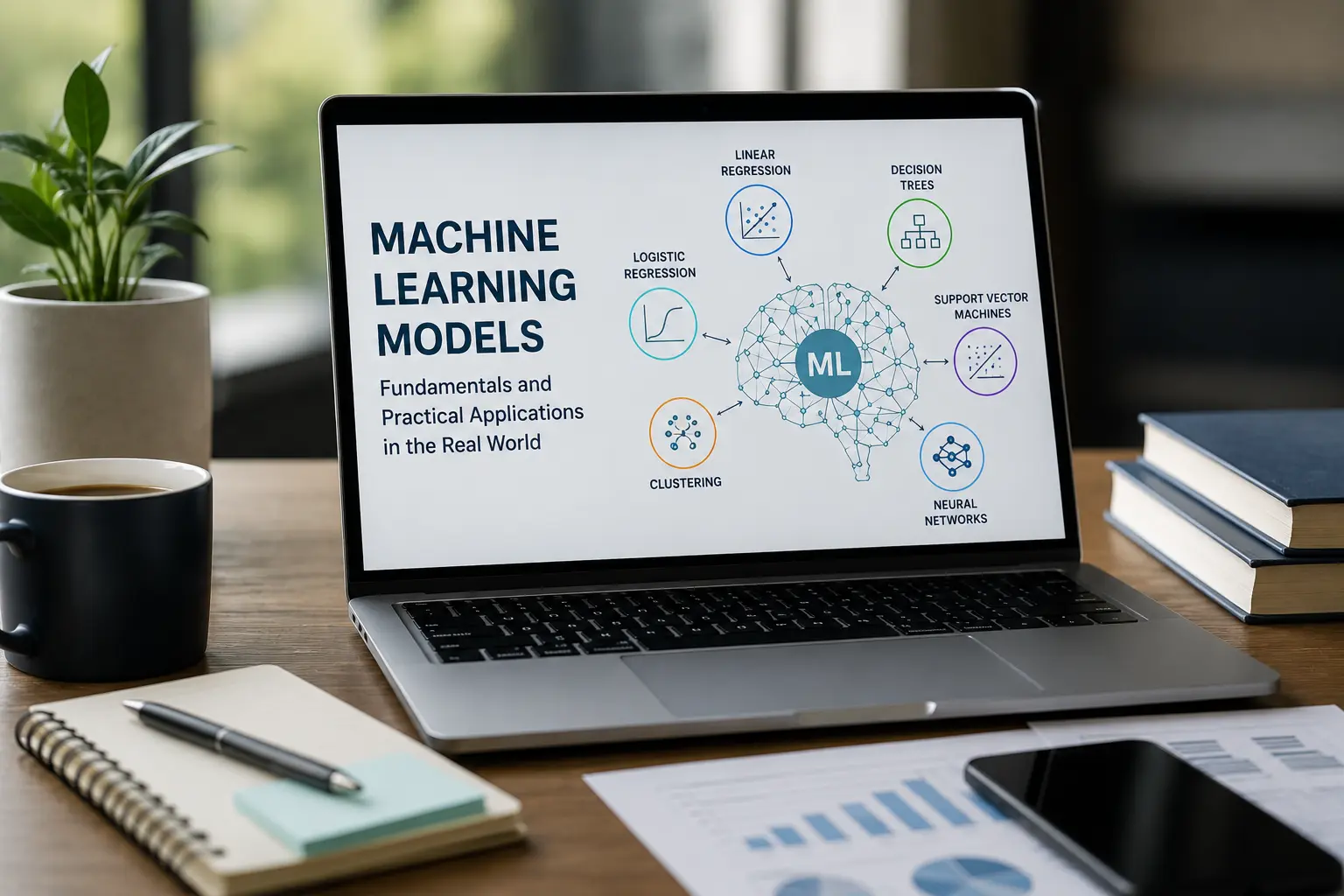
What are Machine Learning Models? Their Fundamentals and Practical Applications in the Real World
Summarize and save time
Quick Summary
Our blog on “What are Machine Learning Models? Their Fundamentals and Practical Applications in the Real World” aims to explain types of machine learning models, covering supervised, unsupervised, semi-supervised, reinforcement, and self-supervised learning, along with popular models such as regression, classification, clustering, and dimensionality reduction. We also guide our readers on choosing the right model based on data type and their business objectives.
Our blog provides real-world examples such as voice recognition, self-driving cars, fraud detection, image recognition, and customer support. At the end, we highlight how PSSPL’s machine learning deployment services bring lasting value to businesses with proper deployment and regular maintenance.
Artificial Intelligence is dominating the globe. The quicker organisations come to this realisation, the more effectively they will advance by investing in AI and Machine Learning technologies. These technologies are helping businesses of all sizes to gain a competitive edge by utilising data to make informed decisions and automating complicated tasks.
The global machine learning market size was valued at USD 47.99 billion in 2025 and is projected to reach USD 65.28 billion by 2026. This technology is expected to see rapid growth across sectors such as healthcare, manufacturing, public services, retail, transport, and more.
Machine learning models depend on data and algorithms; for many organisations, adopting them can be daunting and complex. Businesses need to understand the different types of machine learning models and how they are used, especially when they want to use AI to its full potential.
In our blog, we will explain to you briefly about these models, covering the key types of machine learning models and showing live examples of how businesses are using them.
Machine Learning Model: What is it?
In simple terms, a machine learning model is a program that identifies patterns or makes decisions from a previously unseen dataset. For example, in natural language processing, machine learning models can understand what the user is trying to say even without seeing the exact sentence before.
In image recognition, a model can learn to identify various objects such as cats or cars in pictures. The model goes through a process known as “training.” In which a huge amount of data is studied, and the algorithm adjusts itself to identify patterns that are relevant to the task at hand, be it understanding any language or spotting images.
Once the training is completed, you’re left with the machine learning model itself, which is built from specific rules and data structures that are now capable of performing the task they are trained for.
What are Machine Learning Data Models?
Machine learning data models make predictions and identify patterns by using algorithms that are trained on data. They empower businesses by automating decision-making, detecting anomalies, providing personalised services, and forecasting trends to boost efficiency across diverse industries such as retail, healthcare, finance, and manufacturing.
Three core components that make up a machine learning model:
(1) Training: The training process consists of teaching the model using information. Since different models have different machine learning use cases, it’s crucial to understand how each one actually “learns” from that information.
(2) Data: The raw inputs feed the entire training process, and the model learns from the same data.
(3) Algorithm: People often think that “algorithm” and “model” are the same, but the reality differs from this common misconception; the algorithm comes first, which is the method that is used to process the data. After the data runs through the algorithm, the result derived is known as a model.
The real challenge is making sense of huge amounts of data and then accurately predicting outcomes from it. In today’s digital age, businesses work with terabytes of information, so they need a solution that’s both robust and dependable to make this process manageable.
Machine learning models work by looking out for patterns in data, testing their findings, and then learning from them. Over time, this learning allows the model to identify patterns and leverage them to make predictions. Machine learning holds great potential for business across industries, from healthcare to finance, retail, and hospitality – transforming how they work.
5 Types of Machine Learning Models
Machine learning algorithms fall into 5 broad categories: supervised learning, unsupervised learning, semi-supervised learning, self-supervised learning, and reinforcement learning. Each type of model has an algorithm, training data, and a learning mechanism that enables it to get better and more accurate at making predictions and taking decisions over time.
1. Supervised Machine Learning
Supervised machine learning works simply; it trains a model on data where the answer is already known. For example, it contains both the inputs and the correct output, and it learns from that. Take the example of building a model that predicts tornadoes. The inputs would be things such as data, location, temperature, and wind patterns, while the output would be whether a tornado actually occurred on those days. Supervised machine learning is mostly used for image recognition, fraud detection, and risk assessments.
2. Unsupervised Learning
In unsupervised machine learning, the computer is provided with the data but not the right answers in advance. It looks for patterns, similarities, and groups on its own instead of learning from labelled examples. A popular example would be: think of it as giving a child a box of mixed toys and asking them to sort them out by colour, size, shapes without telling them the rules.
3. Semi-Supervised Learning
In semi-supervised learning, a small amount of labelled data is used with a huge amount of unlabeled data, which improves the performance of the model. With semi-supervised learning, businesses can reduce dependency on costly manual labelling by exploiting unlabeled data. In simpler words, semi-supervised learning is a mix where the teacher provides some concepts in class, and the students practice with homework assignments based on those concepts.
4. Reinforcement Learning
Reinforcement learning is very different from other approaches; they don’t learn from a fixed set of training data; the algorithm learns by doing. It works like trial and error, where the model keeps interacting with its environment, testing actions, and adjusting based on the results it derives. As time passes, the continuous back-and-forth with the environment helps the algorithm figure out the action to take.
5. Self-Supervised Machine Learning
Self-supervised learning (SSL) takes a different approach; instead of needing large sets of manually labelled data, the model learns directly from raw, unlabeled data. It does this by leveraging one part of the data to predict or make sense of another part, creating its own labels along the way. With this intelligent trick, an unsupervised problem is transformed into something closer to supervised learning.
Turn Machine Learning Ideas Into Real-World Solutions
There is a huge gap between a trained model and a working one; close the gap with PSSPL.

Popular Machine Learning Models
Machine learning models can be classified into two categories: supervised and unsupervised. Let’s explore how other models can fit into these two categories.
Regression Model
A regression model predicts an output value using one or more independent variables. In short, it helps you understand the relationship between a variable you are trying to predict and the variables that influence it. It differs from classification; the output here is continuous, meaning it can be any number along a range rather than a fixed category. The common types of regression models include:
Decision Tree: Just like the name suggests, a decision tree has a tree-like structure that’s made up of root, internal nodes, and leaf nodes, each connected by branches.
Random Forest: This builds on decision trees by creating many at once, each trained on a slightly different sample of the data. At every step of building a tree, it randomly picks a subset of variables to consider; this randomness helps make the overall prediction more accurate and trustworthy.
Neural Network: By leveraging layers of connected “nodes” modelled loosely after the human brain to process information. Data enters through an input layer and passes through one or more hidden layers.
Classification
In classification, the output is discrete; here are some of the most common types of classification:
Logistic Regression: Don’t get confused by the similarity in the names; logistic regression works differently from linear regression. It doesn’t predict a continuous number; it estimates the probability of an outcome that falls in a limited number of categories, like (yes/no).
Support Vector Machine: This method finds the best possible boundary, known as a hyperplane, separating different groups of data points in a multi-dimensional space.
Naive Bayes: There is a statistical rule known as Bayes’ theorem; this model calculates the probability of different outcomes to make classifications. It’s mostly used for tasks such as filtering spam emails, analysing sentiment in text, or powering recommendation systems.
Decision Tree, Random Forest, and Neural Network: All three elements work in the same way as they do in regression, except here they’re used to predict a category instead of a continuous number.
Clustering
The grouping of data points is known as clustering; it’s often used for customer segmentation, fraud detection, and document classification. The common clustering techniques include:
K-Means Clustering: K-means clustering is a type of unsupervised learning, used to find groups which have not been explicitly labelled in the data. This is a simple and commonly used method, which requires you to define the number of clusters beforehand.
Hierarchical Clustering: Hierarchical clustering is an unsupervised machine learning method that groups data into a tree of nested clusters. The tree stands for the relationships between the objects and shows how these objects are clustered at each level.
Mean Shift Clustering: Mean shift clustering groups data based on its unique characteristics; this type of unsupervised learning learns directly from the data it is fed.
Density-Based Clustering: The way in which a computer finds groups in data itself is known as density-based clustering. It asks the clusters, “Are there enough points close together within this distance?” If the answer is yes, then it forms a cluster; if the answer is no, then it leaves the points as noise.
Dimensionality Reduction
With dimensionality reduction, the dataset can be smaller and simpler, reducing the number of features while keeping the key information intact. Enabling models to work faster, use less memory, and avoid being confused by useless or repeated data.
For example, editing a long document into a shorter version without losing the main idea; in machine learning, the “long document” is your feature set, and dimensionality reduction keeps the important part while reducing the extra data. The two common types include feature elimination and feature extraction.
Different machine learning models work to solve different problems, so engineers should choose the model based on the task, data, and accuracy needs. When you understand the model types, you can easily pick the one that fits best instead of using some random method.
What are the Key Components of Machine Learning?
Machine learning can be divided into five key components for learning, just the way we divide our tasks into smaller portions. The key components of Machine learning are:
Representation:
We humans can process knowledge in different ways; machines can do the same. Representation refers to how specific information is described for the machine to learn and understand. Making it easier for machine learning to reason, learn, and make effective decisions based on specific goals.
Data Storage:
Users can store and retrieve huge amounts of data so that both humans and computers can leverage the stored data. This data can be stored, retrieved, and used for advanced learning.
Abstraction:
Creating foundational concepts and extracting knowledge from the stored data involves applying the knowledge to both types of models.
Generalisation:
The new and unknown data is handled by generalisations that were identified in the data used in training the model. Understand the quality of your model and find out if it’s aligning or not.
Evaluation:
The last step in the learning process is known as evaluation, providing feedback to the user about the type of knowledge it has learned and how effectively it has been applied, to improve the model and the learning process.
How to Choose the Right Machine Learning Model?
Businesses have different objectives, goals, and pain points and selecting the best model that aligns with your goals can be a challenging task. We will help you solve the question: How to choose the right machine learning model?”
So, developers need to keep the following factors in mind, such as the dataset, task, and the nature of the model. Selection of the model can be done based on the data type availability, such as video, text, speech, images, and numerical data.
Also, the type of task they want to accomplish. Developers need to ask themselves a question: “Why do you need the model?” “Is it a high need, for example, for industries such as finance or healthcare?
A Comparison Table to Choose the Right Machine Learning Model:
| Model Type | Primary Strength | Weakness | Best For |
|---|---|---|---|
| Parametric | High explainability, fast | Unable to capture complex patterns, high bias | Easy tasks, baseline models, and cases where features matter. |
| Tree-Based | Good performance on tabular data | Can overfit if not properly ensembled | Structured/tabular data, especially when you want a balance of performance and explainability. |
| Instance-Based | Conceptually easy, no training needed | Slow at prediction time and sensitive to irrelevant features | Fast baselines and cases where similarity metrics work well. |
| Neural Networks | Highest performance on complex, unstructured data | Low explainability and high data/computation needs | Image recognition, NLP, and other complex non-linear problems. |
At the end, there is no single best machine learning model; you have to choose the one that aligns with your business goals.
Applications of Machine Learning Models
Businesses hiring machine learning model deployment services are witnessing a huge transformation in the way they work; it’s not only best for streamlining daily tasks. But it also automates complex workflows and helps businesses make predictions based on the historical data for powerful decision-making. Let’s see the applications of machine learning models:
1. Voice Recognition
With speech recognition, businesses can enable the conversion of spoken words into text. Popular virtual assistant applications (Alexa and Siri) depend on natural language processing (NLP) and neural networks to process and respond to spoken commands accurately. This technology boosts user experiences, especially in a hands-free environment.
2. Driving Cars
Self-driving cars, one of the prime examples of real-time decision-making enabled by machine learning. Autonomous vehicles are enabled with sensors and cameras that, combined with reinforcement learning, help in navigating roads, avoiding obstacles, and adapting to constantly changing conditions. These cars depend fully on machine learning models to improve their performance.
3. Financial Transaction
In the USA, about 60% of credit card holders have been subjected to cyber fraud, as per security.org. This issue can be reduced with machine learning model deployment and classification algorithms that spot activities that appear suspicious and flag them for future investigation.
4. Image Recognition
In industries such as healthcare, security, and social media, the use of image recognition is very prominent. This technology enables systems to analyse visual data such as medical images, detect diseases or spot objects and faces in the image. This technology is powered by deep neural networks.
5. Customer Service
Machine learning has the capability to not only assess the words of a user but also their intent by the tone they use through voice-based queries. Chatbots are good at handling text-based queries, but machine learning-enabled virtual agents tend to offer more personalised and immediate attention to their users. With ML, businesses can also monitor social media and other activities for customer responses and reviews. They also help businesses forecast and decrease customer churn.
Grow your Business with PSSPL’s Machine Learning Deployment Services
Machine learning models are no longer just a buzzword; they have become the backbone of how modern businesses run, make decisions, and stay ahead in a highly competitive world.
From supervised and unsupervised learning to reinforcement and self-supervised approaches, each model type offers a unique purpose, and choosing the right one depends entirely on your data, your goals, and the issues you are trying to solve.
Our blog described how machine learning is already transforming industries, powering everything from voice assistants and self-driving cars to fraud detection and personalised customer services.
The real question now is: building a well-trained model is only half the job; the real value comes from successful deployment, monitoring, and maintenance in a live environment. This is the point where most businesses struggle, and here’s how PSSPL is built to close that gap.
Why Prakash Software Solutions Pvt. Ltd. is the Right Partner for Machine Learning Deployment?
At PSSPL, we understand that a model sitting in a lab isn’t delivering any value; it needs to work reliably in the real world. That’s why our machine learning deployment services are built around the qualities that matter most:
Deep Technical Expertise:
Our team brings hands-on experience deploying models into real production environments, not just prototypes, with strong command over MLOps practices and major frameworks like TensorFlow, PyTorch, and cloud platforms including AWS, Azure, and GCP.
Scalable Architecture:
We design systems using containerization and orchestration tools like Docker and Kubernetes, ensuring your models can handle growing data volumes and user demand without breaking down.
Continuous Monitoring & Maintenance:
We don’t just deploy and disappear. We track model performance over time, catch model drift early, and keep your models retrained and up to date.
Security & Compliance First:
Whether you’re in healthcare, finance, or any regulated industry, we prioritise data privacy, secure API design, and compliance with standards like GDPR and HIPAA.
Seamless Integration:
Our models are built to fit into your existing systems, not disrupt them, with clean APIs and pipelines that connect smoothly with your current tech stack.
Transparent Communication:
We keep you informed with clear reporting and honest conversations about what your model can realistically achieve, no jargon, no overpromising.
Speed Without Shortcuts:
Using automated CI/CD pipelines, we move quickly from development to deployment while maintaining quality at every step.
Reliable Post-Deployment Support:
We stay by your side after launch, offering responsive troubleshooting and a long-term partnership rather than a one-time handoff.
Cost Transparency:
With upfront pricing and optimised infrastructure, you get maximum value without hidden surprises.
Industry-Specific Understanding:
Our team brings sector-specific knowledge, so the solutions we build are relevant to the real challenges your industry faces.
FAQ About Machine Learning Models
A computer program that identifies hidden patterns and makes predictions using data rather than strict hard-coded rules is known as a machine learning model. It's important for business because it automates complex tasks, provides deep insights, and adapts and improves over time. It has transitioned from a specialised tool into a fundamental engine driving modern AI breakthroughs.
The main types of machine learning models are grouped into supervised learning, unsupervised learning, and reinforcement learning.
People often use these two terms interchangeably, but they're not the same thing. An algorithm is the method or set of instructions used to process data; think of it as the "recipe." A model, on the other hand, is what you get after that algorithm has been trained on data; it's the finished "dish." In short, the algorithm comes first, and once it learns from data, the result is called a model.
A machine learning model works by learning from data instead of following fixed, hardcoded rules. During a process called "training," the model is shown large amounts of data, and it studies this data to spot patterns relevant to its task, whether that's recognising images, understanding language, or predicting outcomes. Once training is complete, the model can use what it has learned to make predictions or decisions on new, unseen data.
Machine learning is being used across almost every major industry, including healthcare, finance, retail, manufacturing, transportation, and public services.
Being involved in building a significant amount of generative AI applications I can say that the success of these apps lies in one thing — their model is integrated into a user’s workflow and people trust their results. Building some LangChain agents or ML models in a notebook? Piece of cake. The real deal is to build something useful in production, to ground it so that it won't start hallucinating and doing stuff for no reason. This is where most demonstrations fail silently, and this is what we concentrate on the most.