

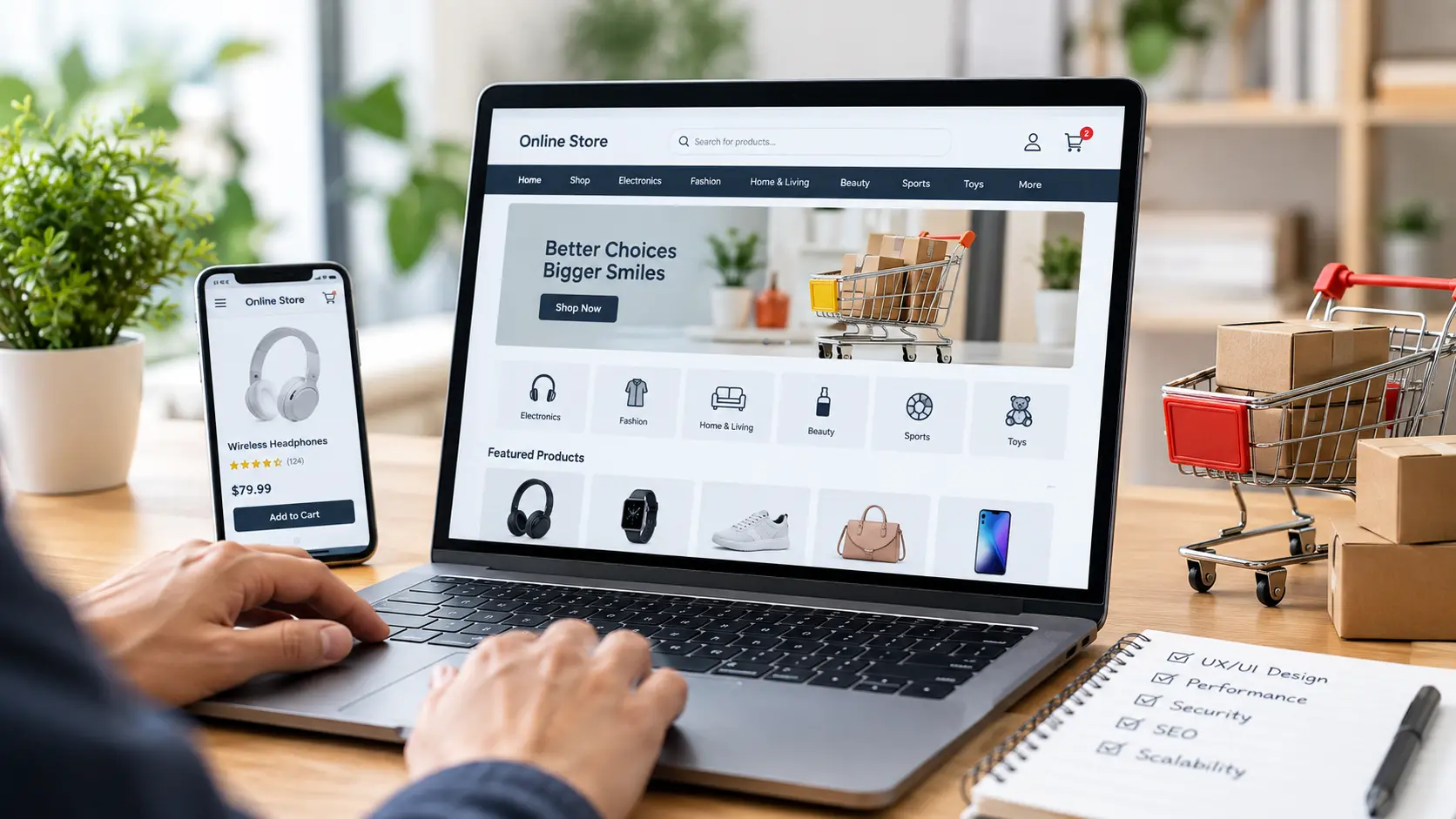
A Detailed Guide to Modern E-Commerce Web Development: Latest Trends, Approaches, and Best Practices
Summarize and save time
Discover the latest trends in the development of custom e-commerce websites, including various approaches and best practices for creating high-performing online stores in contemporary e-commerce web development.
“Websites can break an e-commerce business” Starting this blog with a controversial but true statement. Businesses that think the e-commerce website development process is something of less importance are making a big mistake; all their hard work can end up working against them. In this blog, we will explain how. As per a popular prediction on the internet, 95% of all purchases will take place online through e-commerce by 2040, and with online sales projected to surpass $5,887B by 2029, this is expected to be normalised by then.
Even today, you either have an e-commerce store or don’t exist, and on top of that, your site needs to offer exceptional online experiences to its visitors. Even minor mistakes can dramatically impact your business. For example, even a one-second delay in page load time can trigger your visitors to leave your site and jump to another.
Beyond that, the rise of AI and automation has brought another drastic change to the e-commerce industry; to keep your business competitive in the digital market, you need a state-of-the-art website. In today’s world, the expectations of consumers are very different from what they were in the past; they need instant access to commerce sites and platforms.
Market leaders such as Amazon, Pinduoduo, and Taobao all have one thing in common: their online stores are fast and easy to use. One of the biggest challenges is keeping the technology at the centre of your online store up to date with modern trends and frameworks that are emerging regularly. Though it can be beneficial for developers and clients, it also brings great responsibility and raises questions such as: ” Which tools are best for your online store?”
PSSPL’s excellent e-commerce website development services help businesses of all types build a digital store that attracts customers and increases their profits. They focus on creating a user-friendly experience that makes it easy for your customers to shop and explore more.
Can I Build an E-Commerce Website Without Coding?
The short answer is yes, you can build an e-commerce website without coding, but it’s just one part of the story. A retail website can be built without coding; you can utilise website builders and e-commerce platforms that offer drag-and-drop functionality.
It’s best used for a small-scale business with simple needs. Businesses wanting advanced customisations or unique features need a fully functional online store with custom design and processes.
Top No-Code e-Commerce Platforms:
- Shopify
- Wix e-Commerce
- Squarespace
- Hostinger AI/GoDaddy Airo
- WooCommerce
Custom e-Commerce Development vs. Ready-Made Platforms
Businesses can gain complete freedom and control by building a fully custom eCommerce website. The only downside is that it usually takes more time and carries bigger risks. On the other hand, leveraging an existing platform is more scalable, follows proven best practices, and often costs less over the long run. The prices might seem higher in the beginning, but it’s worth.
How to decide which one is better? Let’s take a look at the bigger picture:
- What are your business goals?
- What is your budget?
- How fast do you need to launch?
- What will you need in the future?
Also, keep your needs in mind: how much you want your site to grow, how uniquely you want it to look and work, and how easy or hard it will be to maintain later. Here is a simple table that compares the main pros and cons of both options so you can see the differences quickly:
| Type | Pros | Cons |
|---|---|---|
| Platforms |
|
|
| Custom Web Development |
|
|
What is the Cost of eCommerce Website Development?
The cost of website design and development in the USA starts from a few hundred dollars for a simple landing page and then depends on the features, platform, and level of customisation. The cost of a simple website is lower because it usually includes fewer pages, a simple design, contact forms, and basic SEO setup.
| Website Type | Lowest Practical Cost | Best For |
|---|---|---|
| Simple Landing Page | $300 – $800 | Ads, offers, single service promotion |
| Basic Business Website | $700 – $1,500 | Local businesses, consultants, small service providers. |
| Basic Business Website | $700 – $1,500 | Local businesses, consultants, small service providers. |
| Starter WordPress Website | $800 - $2,000 | Blogs, company websites, service websites |
| Starter Odoo Website | $1,200 – $3,000 | Businesses needing a website + basic CRM setup |
| Small Business Website | $1,500 – $3,500 | Businesses that require a professional website |
| Basic e-commerce Website | $2,000 – $5,000 | Small-scale businesses, online stores with limited products. |
| Custom Business Website | $3,000 – $7,000 | Businesses seeking tailored designs and improved performance. |
| Custom Web App/Portal | $8,000 – $15,000+ | Dashboards, portals, login systems, advanced features. |

Key Features of an eCommerce Website
Every e-commerce website is unique, but there are certain features that successful sites have in common; these include:
1. User-Friendly UI/UX
A website that is attractive yet easy to navigate plays a crucial role in keeping people interested and turning them into customers. If any user finds it difficult to find products or understand the services of your business, then they will leave without taking any action. Here’s what goes into building that smooth experience:
- Intuitive navigation and site structure.
- Clear calls-to-action (CTAs)
- Easy-to-use search and filtering options
- Streamlined checkout process
2. Secure Payment Gateways
In modern times, where the risk of cyberattacks is becoming more and more common, people care most about keeping their payment information safe while shopping online.
If a website uses trusted and popular payment options such as PayPal, Stripe, and Apple Pay. When the payment gateways are well-known, buyers feel safe and make purchases more confidently. On the other hand, if a website offers great products or services but feels unfamiliar or unsafe at checkout, customers worry and abandon their carts.
Secure payment gateways don’t just protect customers; they protect the business too. To reduce the risk of fraud, scams, and chargebacks, keeping both the business and its customers safe helps build long-term trust in your brand.
3. Product Search and Filtering
Customers are more likely to make a purchase when they can quickly and easily find what they have been looking for. If someone has to do a lot of research through pages and pages of your products just to find their desired item, they will just give up and leave altogether.
This is why an intelligent, strategic, and well-designed search system is so important to make the shopping experience for users faster and more convenient. Adding the following features will make this experience even smoother:
- Predictive search
- Category filters
- Personalized suggestions
4. Optimised for Mobile
Did you know that more than half of all internet traffic today comes from mobile phones? That means many potential customers prefer to shop on their phones rather than laptops or computers. Mobile optimisation is a must; here’s what that involves:
- Responsive design that adapts to different screen sizes.
- Fast loading times on mobile networks
- Easy-to-use mobile navigation and checkout
- Mobile-specific features
5. Analytics Integrations
Businesses need to access real data, rather than just making guesses, to find out how their website is performing. By connecting tools like Google Analytics, along with custom dashboards built for specific business needs, it becomes easy to track and monitor key data such as how users behave on the site, which products sell best, and how effective the website is overall at turning visitors into customers. Businesses that leverage the data effectively can:
- Improve conversion rates
- Increase customer retention
- Drive revenue growth
Stages of the Development Process
Before you educate yourself about different software development approaches, it’s very crucial to understand the main stages of the development process. Let’s learn more about a common IT company workflow.

Stage 1: Get to Know Your Client
Once the Custom eCommerce website development company receives a message from a potential client, they sit with their sales team and discuss the needs or the Scope of Work documentation if they are already aware of their ultimate goals. The sales manager fills out a brief with the details of the desired outcome, the Definition of Done, the timeline, the budget, essential requirements and possible bottlenecks.
Stage 2: Project Research
In the discovery phase, the team looks closely into what the potential client actually needs, and they start working out a possible solution that aligns with the needs.
In this phase, they find out which services will help the business solve its challenge; they also offer AI development services. As part of their SaaS development services, they will also figure out the technology stack that needs to be used, such as which programming languages, frameworks, and AI tools.
Stage 3: Wireframes and Prototypes
One of the most distinctive features of a leading Custom eCommerce website development company is that they always provide a draft of a future web page, also known as a wireframe. This wireframe of your website contains all the blocks, giving a rough impression of your page’s grid. Businesses can make changes or give suggestions, if any, avoiding any future confusion.
Stage 4: UI Design
Once the wireframes are finished and approved, the next step is moving to the design phase. This is when the web developers add life to your website.
Depending on the identity and core values of your brand, they add colours, logos, fonts, and other visually appealing elements. The developers also ensure that your website looks good and works smoothly for users who browse on a desktop computer, a tablet, or a mobile phone.
Stage 5: Back-End Development
When you hire the best Custom eCommerce website development services, the team of developers will focus on building a strong back-end architecture on three fundamental components: servers, databases, and application logic.
They will have in-depth knowledge of various technology stacks like Node.js, Python, Java, PHP, and Ruby on Rails, and more, that maintain the performance, scalability and maintainability of your website.
Stage 6: Front-End Development
The front-end and back-end development depend completely on the pace of your project. Front-end development involves all the visual features and ensures everything is pixel-perfect and that your website is cross-browser compatible.
Stage 7: QA
AI development services, SaaS development services, or custom eCommerce website development services all have one thing in common: they have a solid QA team, and they treat this process very seriously.
They check the performance of the website, and even a small issue is treated with great attention. The team of professional QA experts conduct testing in the following stages: integration testing, functional testing, UI testing, and manual smoke testing.
Stage 8: Launch & Post-Launch Support
After receiving approval from the QA team, the e-commerce website developers show the client how to manage the website, add content, and more. Not only that, but they also offer maintenance and support services after launch so that your site keeps performing effectively.
On Choosing the Right Technology Stack
For your ecommerce store development, choosing the right technology stack is equal to choosing the foundation of a house. Every business wants something that will support its growth and adapt to evolving needs. A reliable technology stack plays a crucial role in keeping your site running smoothly and growing as your business expands.
Technology Stack
Front-end -Technologies
React, Angular, Vue.js
Back-end Technologies
PHP, Laravel, Django, Node.js, Ruby on Rails
Hosting Solutions
AWS (Amazon Web Services), Google Cloud Platform (GCP), Microsoft Azure, VPS
eCommerce Platforms
Shopify, WooCommerce, Magento, OpenCart, PrestaShop, BigCommerce, Bagisto
Open-Source Vs. SaaS Platforms: Pros and Cons
Choosing the right eCommerce platform is like choosing a strong backbone for your online retail store. So you need to decide wisely between an open-source or SaaS platform to create a feature-rich store.
Open-Source eCommerce Platforms: Enable full access to the source code, simplifying custom eCommerce development offers freedom to create any functionality along with adding unique features.
Advantages:
- Gain full access to source code
- Complete control
- More scalability
- Flexibility
- Community support
Disadvantages:
- Complexity
- High cost
SaaS eCommerce: SaaS eCommerce is a subscription-based software-as-a-service eCommerce platform that enables its users to build a store instantly with everything in the cloud, with secure protocols. This works on a monthly subscription fee, charging for domain, hosting, development, maintenance, and more.
Advantages:
- Ease of use
- Fast set-up
- Security
- Custom support
Disadvantages:
- Lack of flexibility
- Lack of customisation
- Less scalability
eCommerce Website Design Principles
To generate revenue, custom eCommerce website development services include the following principles when designing your website.

1. User-Friendliness
The most important thing an eCommerce site should have is its ability to navigate. Developers group your products under specific categories, with a menu at the top that displays all those categories.
Intuitive navigation makes it easy for users to find what they need; it can include breadcrumb trails, mega menus for sites with many products, and a shopping cart that is easily accessible on every page. Adding these features will improve user experience and make the entire shopping process smoother.
2. Brand Identity
By using branding colours, images, and design elements that align with your unique brand, developers make it stand out. Prioritising customer experience on every platform, including your website, physical store, and mobile app.
Customers recognise your brand and build trust in it. However, the consistency of a powerful brand is not limited to the appearance of your website; its features, content, and message matter too.
3. Trust and Security
Buyers will make a purchase only when they feel that your site is secure, so always keep privacy paramount. Transactions should be secure, and sensitive user data should be protected. If your site does not give a sense of security, users will shop elsewhere, impacting your revenue and overall business.
On the technical side, robust encryption and scalable hosting are required to ensure the site’s functionality during peak traffic times.
4. Visual Hierarchy to Guide User Actions
The visual hierarchy needs to be well-structured, directing the attention of visitors towards the CTAs so that they can make a purchase effectively. Using bold buttons and contrasting colours helps highlight key actions. Apart from that, all the promotions and purchase options should be prominently positioned.
5. High-Quality Product Images and Videos
When shopping online, customers often scrutinise the visuals of your products closely. Quality images and videos significantly impact this experience, as they provide buyers with a genuine sense of the product, fostering trust and confidence.
Choosing the Right Payment Gateways for Topmost Security
Most preferred choices are PayPal, Stripe, and Apple Pay because they are very easy to use and can work with many different currencies.
However, they don’t work best for every country. For example, Alipay is a top and preferred choice in China, and Razorpay works best in India. They not only process payments smoothly but offers mix of payment options that uplifts the shopping experience. Keep the following things in mind while selecting a payment gateway:
Transaction fees: Every gateway charges a different fee per sale, affecting how much profit you actually get to keep.
Compatibility: Make sure that it works best with your particular website or platform, and see if it offers easy tools (APIs or plugins) along with good developer support.
Safety features: Seek robust encryption, fraud protection, and PCI compliance a security standard that protects card information)
Multiple payment types: It should support credit/debit cards, digital wallets, and other popular payment methods.
International support: It should be capable of handling payments from different countries and currencies.
Payout speed: Check how quickly the money from sales actually reaches your bank account.
Wrap It Up
Building a successful e-commerce website in today’s fast-moving digital world takes much more than just putting products online. From choosing between a no-code platform and custom development to picking the right technology stack, designing a user-friendly interface, and setting up secure payment gateways, every decision plays a part in how well your online store performs and grows.
As we’ve seen throughout this guide, there’s no one-size-fits-all answer. A no-code platform might be the right call for a small business that wants to launch quickly and keep costs low, while a fully custom-built website makes more sense for businesses that need complete control, unique features, and long-term scalability. What matters most is understanding your business goals, your budget, and where you see your store heading in the future.
Beyond the initial build, things like mobile optimisation, smart search and filtering, strong analytics, and a smooth checkout experience all work together to keep customers engaged and coming back. And a careful, well-tested development process, from wireframes to final launch, ensures your site is reliable, secure, and ready to perform under real-world conditions.
At the end of the day, your website isn’t just a digital shopfront; it’s often the first impression customers have of your brand. Investing time and effort into getting it right can make the difference between a visitor who leaves within seconds and a loyal customer who keeps coming back.
Whether you choose a ready-made platform or a custom-built solution, partnering with an experienced e-commerce website development company can help you avoid costly mistakes and build a store that’s truly built to grow with your business.
Frequently Asked Questions
Small businesses seeking e-commerce companies should consider PSSPL, BrainSpur, Transition, Vention, Rave Digital, and Elogic Commerce. These companies are chosen based on their portfolio, website, customer feedback, experience, and prices.
To find the right e-commerce developer, define a clear scope: the platform (Shopify, WooCommerce, or custom) and whether you need a one-time build or ongoing support. Search platform-specific directories like Shopify Experts, WooCommerce partners, freelancers, or trusted agencies. Review their live portfolio sites, check speed and checkout user experience, read references, and assess whether they understand your business goals.
The top e-commerce software solutions in 2026 are Shopify, WooCommerce, BigCommerce, Wix/Squarespace, Adobe Commerce, and Marketplace.
For small businesses starting, Shopify is a reliable option that scales well and has a vast support ecosystem. However, if you want a customised solution, hiring PSSPL would make a huge difference. With 26+ years of experience and 2,500+ successful projects across Shopify, WooCommerce, and Magento, they help businesses choose the right platform.
I have managed SEO and digital campaigns in several industries, but the industries that have really benefited have one thing in common; the traffic we are driving is the right traffic, and each rupee spent relates to an actual business goal. It is easy to rank for a keyword and get clicks, but the challenge comes in when we need to ensure that these visits convert, and the team knows from which medium the visit came. It is here where most "set and forget" campaigns fail, and it is here where we concentrate most of our efforts.