

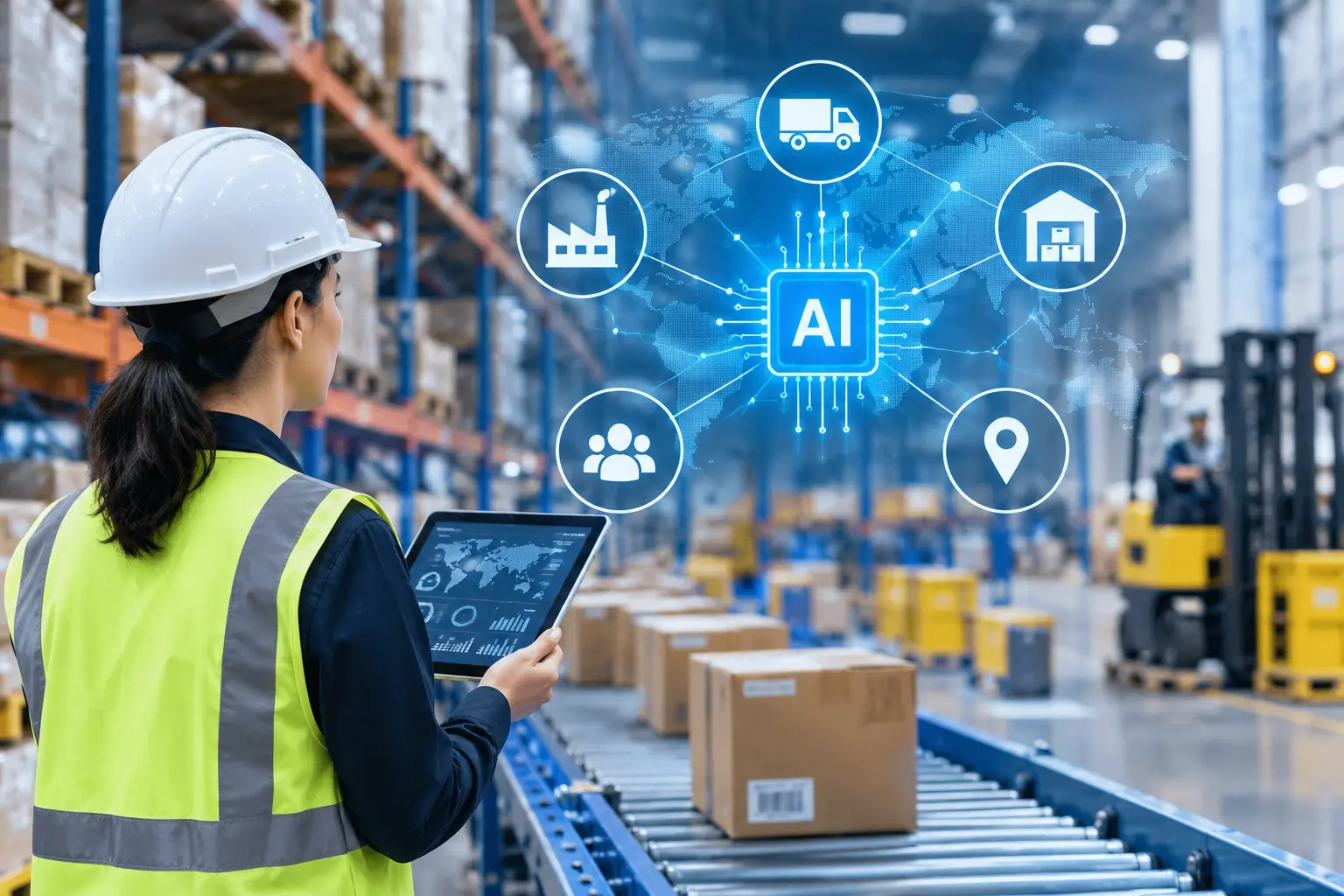
AI in Supply Chain: Use Cases, Benefits and Implementation Guide in 2027
Summarize and save time
Key Takeaways:
- AI is transforming supply chains from reactive to proactive.
- AI supports intelligent warehousing and maintenance.
- With the help of AI, businesses can improve forecasting and inventory management.
- By automating repetitive tasks, AI reduces the overall cost.
- Technology in the supply chain industry does not guarantee success; most AI projects fail due to poor data quality, fragmented systems, unclear processes, and lack of training.
From planning to manufacturing, logistics, and asset management, AI in supply chain management helps optimize processes and improve decision-making.
AI in Supply Chain Management: An Overview
A supply chain is the full journey of a product, from collecting raw materials to making it and delivering it to customers. By leveraging artificial intelligence, this journey can be smoother and faster. Businesses in the supply chain industry must maintain balance across teams, such as those who buy materials, check quality, and handle production.
This is a huge task, which consumes a lot of time and energy. AI in the supply chain can reduce much of this work; it can identify issues earlier, suggest better ways of doing things, and transform huge amounts of supply chain data into useful insights. The best part is that both small- and large-scale businesses can leverage AI to work better, faster, and smarter.
AI in Supply Chain Management: Use Cases
AI in supply chain management is redefining the operational core of supply chains by enabling real-time visibility, proactive decision-making, and adaptive systems. Below, we have mentioned key use cases of AI in supply chain optimization.
(1) Automating Daily Supply Chain Tasks
In the supply chain industry, day-to-day tasks involve moving materials and products from one stage of the supply chain to the next, which requires a huge number of small tasks and messages. This might create various issues; the number one would be managing and keeping track of everything.
For instance, AI tools can manage day-to-day tasks of communication and collaboration. They can respond to questions and queries received from suppliers, confirm that an order has been received, and update everyone on where a delivery is. Saving a lot of time and energy spent doing repetitive work keeps information flowing smoothly and cuts down on delays.
(2) Predictive Maintenance
When AI is combined with IoT-enabled sensors, companies can monitor the condition of critical machinery and infrastructure, tracking variables such as temperature, vibration, pressure, and usage patterns 24/7.
It works by analysing data to identify early warning signs of equipment failure and recommend maintenance before issues escalate. Predictive maintenance empowers the supply chain industry to minimise unplanned downtime, reduce costly repairs, and extend the operational lifespan of assets.
(3) Autonomous Vehicles in Logistics
With the help of AI, moving and delivering goods without the need for human interaction has become easy. Companies are now leveraging self-driving trucks, delivery drones, and small robots that move around warehouses on their own. They help with delivering packages to homes and moving items inside storage buildings.
These machines leverage cameras, laser sensors, GPS maps, and smart AI software to work efficiently. With these advanced tools, they can process the road, pick a route, avoid bumping into obstacles that come in their way, and keep working without the need for a driver. It’s safe and can operate efficiently 24/7, which means delivering more with less human effort or involvement.
(4) Efficient Warehouse Management
Before sending goods to customers, companies store them in a big warehouse, which is why they need a very effective way to manage the entire warehouse intelligently. AI in supply chain optimization helps with:
AI can process a lot of information in less time, such as which product is in demand, how much stock is left, and which items are getting sold out faster. By leveraging this data, it can give an accurate picture of which product will be in demand in the future.
With the help of AI, companies can arrange their warehouse better, as it suggests where the products should be placed. For example, popular items can be kept closer to the packing area, saving space and helping workers find them more quickly.
(5) AI in Supply Chain for Fraud Detection
Shops and retail companies can leverage artificial intelligence to prevent fraud. In today’s digital world, cybercriminals have discovered modern ways to commit fraud. Train AI models to identify whether an order is fake or genuine. It works by processing financial records and looking for strange patterns that humans might miss.
They look for unusual patterns and raise a warning after detecting them. According to statistics, 75% of companies in retail are planning to leverage AI to prevent fraud. This approach will not only safeguard businesses against potential financial losses, but it also enhances security.
Advantages of AI in Supply Chain Management
1. Supplementing Existing Workflows
Agentic AI acts as a digital assistant for office and back-end teams, and it enhances the quality and quantity of the work that gets done. It delivers tasks much faster and also verifies the accuracy of the work that gets done.
For example, this advanced technology helps record route details for billing and calculate employee pay. It processes and reviews 10,000 emails every week and filters out only the useful ones. AI in supply chain management is not intended to take anyone’s job; its purpose is to support employees by automating all the manual and time-consuming tasks, so that they can focus on core work.
2. Tracking and Tracing Freight
Agentic AI also assists team members in validating key data from telematics devices and GPS inputs, speeding up communications and giving customers near-real-time visibility into freight. So, what initially used to take an entire day to get to customers can now be done in seconds.
3. Cost Reduction Through Automation
By leveraging AI in supply chain optimization through robotic process automation (RPA), companies can automate repetitive and time-consuming tasks such as order tracking, invoice processing, and data entry. In the warehouse, AI-guided robots can pick, pack, and sort items with speed and precision, reducing labour costs.
4. Enhanced Customer Experience
In today’s digitally driven world, the attention span of customers is getting shorter, and impressing them is becoming harder day by day.
By leveraging supply chain management, companies can offer personalised experiences to their buyers, such as product recommendations, real-time delivery updates, and AI-enabled chatbots.
AI-enabled chatbots offer 24/7 assistance to their users, slove their simple to complex queries in a way that doesn’t feel robotic, and users can choose their preferred language and medium to interact with these bots.
5. Scalability
Cloud-based AI services offer businesses the flexibility to increase or reduce computing resources whenever needed. This allows them to process huge amounts of data and manage more complex supply chain networks without investing in additional physical infrastructure. Businesses don’t have to worry when more suppliers, warehouses, products, or customers are added; AI supports the heavy data and workload.
6. Smart Decision Making
With real-time insights and predictive analytics, businesses can make decisions that are faster, smarter, and better. With up-to-date information, businesses can respond quickly to constantly changing market conditions, customer demands, and global events.
7. Improved Facility and Workforce Efficiency
With the help of digital twin technology, businesses can test and improve facility layouts via 3D virtual models before making any physical changes. Generative AI tools such as supply chain copilots empower your team to quickly find the information, materials, or resources they require to accomplish their task.
Why Do Most AI Supply Chain Implementation Projects Fail?
Whenever any advanced technology is introduced, everyone wants to adopt it, but very few of them do it in the right way. Just like that, most AI supply chain implementation projects fail not because the technology is new, but because companies deploy models based on broken processes, fragmented data, and untrained teams.
1. Data Governance is the Real Issue, not Model Capability
Due to fragmented data, siloed systems, and undocumented workflows, 95% of GenAI initiatives fail. If your workflow is confusing or built on broken data, adding advanced technology won’t help. The strategic approach is to improve the workflow, clean and organise the data, and then apply AI automation.
2. A Lack of Trust Holds Back Returns on AI
Many businesses invest heavily in AI tools, but the returns they receive are not as high as expected. Almost one in four business leaders say the biggest issue is that people don’t trust AI
If a company is only focusing on AI tools and not investing in training their team, then AI initiatives fail badly. Confidence is earned by educating your team about the advanced tools they will be working on from the earliest trial phase.
3. Scaling from Pilot to Production
Only about 10% of logistics companies have successfully moved generative AI beyond the pilot stage into full-scale use. Research by BCG suggests that the main difference between successful and unsuccessful adopters is not the technology but how supply chain planners leverage it to help with trade-offs and make decisions under pressure. Scaling requires clean and trustworthy data pipelines, trained users, clear success metrics, and robust operational processes.
How to Successfully Implement AI in Supply Chain Management?
A comprehensive, step-by-step guide for integrating artificial intelligence into supply chain management. This guide covers everything from conducting a thorough readiness assessment to ensure your organisation is prepared for AI adoption to developing and executing a targeted training program for your team.
1. Strategy and Roadmap
A successful AI implementation in supply chain management begins with a strategy. Businesses need to assess their current challenges, operational gaps, and long-term goals before investing in AI-driven solutions. Establish a clear AI roadmap, define key supply chain processes, and ensure that AI adoption is aligned with business objectives, goals, and customer expectations.
2. Change Management
A successful change management completely depends on your people, not the technology. Organisations need a clear alignment across teams, preparing them to utilise AI-powered supply chain solutions confidently. Change management should focus more on empowering their teams to build new skills, understand how AI works, and feel comfortable using it in their day-to-day tasks.
3. Tech Stack Enablement
A robust AI infrastructure is necessary for scaling AI across the supply chain and enhancing daily operations. Investing in cloud-based AI platforms, advanced analytics tools, and real-time tracking systems supports fast, data-driven decision-making.
It’s very important to choose the right AI supply chain technology. Machine learning models, IoT devices, and automation tools must connect smoothly with the company’s existing supply chain systems.
4. Data Readiness
The accuracy and overall performance of your AI systems depend on clean, structured, and high-quality data. Preparing real-time supply chain data involves collecting historical sales, demand, and logistics data.
Integrating AI and the supply chain system with ERP, CRM, and warehouse management software. Poor-quality data results in inaccurate forecasts and outcomes, so it’s very important to ensure the integrity of data for AI in supply chain optimization.
5. Identify Valuable Use Cases
Once the AI system is ready, businesses should identify their most valuable use cases and introduce AI-driven solutions in stages. They should focus more on high-impact areas that will help companies prove value before expanding AI across the entire supply chain. Most organisations start with practical applications such as demand forecasting, delivery route optimization, and warehouse automation.
How PSSPL Turns Supply Chain Complexity into a Competitive Advantage?
Supply chains are more complex than ever. Many suppliers, scattered warehouses, disconnected systems, and rising customer expectations make every decision harder. Most AI projects fail not because of the technology, but because of weak data, unclear strategy, and untrained teams. This is where PSSPL makes the difference.
PSSPL treats AI in supply chain management as a business transformation, not a software purchase. It starts with a readiness assessment and a clear roadmap, so every AI initiative is tied to real operational goals and measurable success metrics.
Next comes data readiness. PSSPL helps organisations clean, structure, and connect data from ERP, CRM, and warehouse systems. This creates the reliable foundation that AI in supply chain optimization depends on.
PSSPL also enables the right tech stack, combining cloud platforms, analytics, IoT, and automation tools that plug smoothly into existing systems without costly rebuilds.
Instead of launching everywhere at once, PSSPL identifies high-impact use cases such as demand forecasting, route optimization, and warehouse automation. Starting small lets businesses prove value quickly, build confidence, and then scale from pilot to full production.
People matter as much as technology. PSSPL involves end users from the pilot stage and supports them with training and change management, so teams trust the recommendations they receive and actually use the tools.
The result is a supply chain that spots problems earlier, responds faster, and makes smarter decisions with less manual effort. With the right partner, AI in supply chain turns complexity from a burden into a lasting competitive advantage.
Wrap It Up
AI in supply chain management is no longer a future idea. It is a practical way to cut costs, improve visibility, and make faster decisions. From automating daily tasks and predictive maintenance to smarter warehouses and fraud detection, the use cases are proven and growing.
However, success depends on more than technology. Clean data, a clear roadmap, trained teams, and trust in AI recommendations decide whether a project delivers returns or becomes expensive shelfware. Businesses that start with focused use cases and scale step by step see the strongest results.
Whether you run a small business or a large enterprise, AI in supply chain optimization can help you work faster, smarter, and with greater resilience. Begin with strategy, involve your people, and choose a partner who understands both. Start your AI journey today and turn supply chain complexity into your biggest advantage.
Frequently Asked Questions (FAQs)
The role of AI in logistics is to streamline and automate processes by assessing a huge amount of data. Its applications range from demand forecasting and inventory management to transport planning and decision-making, helping businesses improve productivity, responsiveness, and efficiency.
AI improves supply chain performance by assisting companies in predicting customer needs, using people, materials, and transport more efficiently, and making fewer manual mistakes. Basically, with the use of AI, supply chain businesses can forecast better, use resources better, make fewer errors, respond faster, and provide better customer service.
Industry benchmarks suggest that companies should invest 4-6% of their annual supply-chain revenue in AI during the initial year. This can increase to 8-12% when AI is rolled out across multiple sites.
McKinsey's research shows AI reduces forecast errors by 20-50%, inventory levels by 20-30%, and logistics costs by 5-20% for companies that deploy at scale.
The biggest challenges of implementing AI in supply chains are poor data quality, disconnected legacy systems, high implementation costs, lack of AI skills, employee resistance, and difficulty proving ROI.
Being involved in building a significant amount of generative AI applications I can say that the success of these apps lies in one thing — their model is integrated into a user’s workflow and people trust their results. Building some LangChain agents or ML models in a notebook? Piece of cake. The real deal is to build something useful in production, to ground it so that it won't start hallucinating and doing stuff for no reason. This is where most demonstrations fail silently, and this is what we concentrate on the most.