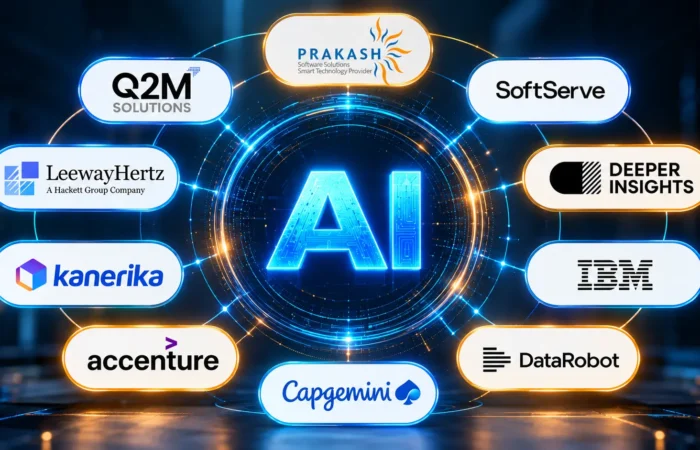
Top 10 AI Consulting Companies to Consider in 2027
Key Takeaways: AI consulting companies assist startups and enterprises in converting AI experiments into measurable business outcomes with the right

Looking for collaboration for your next project? Do not hesitate to contact us to say hello.

AI capabilities
AI by industry
Enterprise AI
Agentic AI
AI That Gets Work Done
Intelligent AI agents that plan, reason and execute workflows.
Computer Vision
See Beyond the Visible
Turn images and video into actionable intelligence.
Smart Glasses & AR
Intelligence in Your Sight
Hands-free guidance and real-time assistance for frontline teams.
SharePoint
Dynamics 365 ERP
Dynamics 365 CRM
MS Teams
Power Platform
Azure & Cloud
Microsoft Dynamics 365
Connect Every Business Function
Unify sales, finance, operations and customer relationships.
Microsoft Power Platform
Turn Ideas Into Action
Build apps, automate workflows and unlock business insights.
Azure & Cloud Solutions
Build Your Cloud Advantage
Modernize applications, data and infrastructure with Azure.
SERVICES
Design
Backend / Open source
Frontend tech
Mobile
Digital Marketing
Build safe, robust AI solutions using Azure OpenAI and Microsoft Foundry. Whether your business demands a GPT application, RAG, AI agents, or AI workflows, our experts will help you create a production-grade solution that best suits your business needs.
Microsoft Solutions Partner (Data & AI) | Anthropic Claude & OpenAI partner | Foundry Agent Service · Foundry IQ | ISO 27001 · Responsible AI

Yes, they are still relevant to this day. Azure OpenAI models are still available via Microsoft Foundry Models. Foundry is the broader platform for building, deploying, managing, and governing AI agents and models.
It’s possible to still create GPT-powered apps on Azure while having access to more than 10,000 models, AI agents, enterprise RAG with Foundry IQ, and flexible deployment options.
PSSPL helps businesses build extensive Azure OpenAI solutions on Microsoft Foundry. These often include RAG copilots, AI agents, governance, monitoring, and cost management, based on their data, identity, network, and compliance needs.
Azure OpenAI services haven’t been replaced. Their models are still available via Microsoft Foundry Models. What changed, announced at Ignite in November 2025, is that Azure AI Foundry became Microsoft Foundry. It now serves as a broader platform for finding, deploying, managing, and governing AI models and agents. Existing Azure OpenAI deployments continue to work.
Azure OpenAI models, including GPT, now sit alongside models from Anthropic, DeepSeek, Meta, Mistral, Cohere, Hugging Face, and other providers. The catalog comprises more than 10,000 models and continues to grow every month.
Microsoft-hosted models are hosted, billed, and supported by Microsoft through Azure, with enterprise SLAs. Partner and community models may have different pricing, support, and terms. The right choice depends on your needs.
Microsoft Foundry brings models, agents, retrieval, orchestration, evaluation, monitoring, and governance into one platform. This makes it easier to build, manage, and scale AI apps.
Azure OpenAI services help businesses create, deploy, and manage AI solutions on Azure and Microsoft Foundry, from initial ideas to production.
Build assistants that help your team find essential information, handle tasks, and work with business data.
Create agents that can leverage tools, follow business rules, and handle multi-step tasks.
Connect AI to your business data so people can ask questions and get relevant, cited answers.
Select and test models from Azure OpenAI, Claude, and other open-model providers on the basis of your needs, cost, and performance.
Develop AI that can meet your voice, documents, images, and transcription needs.
Right from the very start, put the right safeguards, evaluation, network, monitoring, and cost controls in place.
Build secure AI agents that can easily access business knowledge, utilize tools and APIs as per requirement, automate processes, and only involve people when approval is necessary. We build with Foundry Agent Service to create, run, monitor, and govern AI agents.
These copilots provide employees with reliable solutions from business information stored across SharePoint, Azure Blob, SQL, and support content. Our experts leverage RAG, vector search, semantic ranking, and hybrid retrieval to deliver relevant, cited answers while managing permissions, content freshness, and hallucinations.
We build all kinds of voice assistants, multilingual translation tools, call transcription and summaries, meeting intelligence, and voice-enabled field-service copilots. With the help of AI, it becomes easier to extract and comprehend information from many different types of business documents using speech, vision, and content understanding capabilities.
Our experts use AI copilots when it comes to seamless software development, testing, QA, and repetitive business processes. We combine AI agents with tools, approvals, and workflow automation to handle multi-step tasks with less manual effort.
We assess Azure OpenAI, Claude, and suitable open models on the basis of your specific use case. Rather than choosing a model by brand, we compare quality, speed, cost, tool use, safety, regional availability, deployment options, and support. Microsoft Foundry provides tools for comparing models and reviewing their capabilities. We use these insights along with your own workloads to recommend the right model and architecture.
Not every task needs the most powerful model. We can route simple requests to more efficient models while using higher-capability models for complex reasoning and agent tasks. For GPT vs. Claude, the right choice depends on the workload. We test models against your actual tasks and data rather than relying only on general benchmarks.
| What we compare | Why it matters |
|---|---|
| Quality & tool use | Measures accuracy and how reliably the model works with tools and APIs |
| Speed | Important for real-time applications and copilots |
| Cost | Helps select models that fit your usage and budget |
| Safety & governance | Supports responsible and controlled AI usage |
| Region & data zone | Ensures the model is available where your requirements demand |
| Deployment & support | Considers hosting, billing, enterprise support, and service terms |
Our experts design security and accessibility around your business requirements. This includes private networking, Entra ID identity, role-based access, content safety, PII protection, and audit logging.
We manage prompts and versions, assess response quality, monitor performance, trace issues, and run safety checks. This helps measure factors such as hallucinations, latency, quality, and safety instead of relying on assumptions. We also utilize Foundry’s tracing, evaluation, and agent optimization tools as part of delivery.
AI costs vary based on usage, models, and workloads. We create cost controls into the architecture right from the beginning.
Forecast token and request usage and use caching to reduce repeated costs.
Route workloads toward the right model and leverage smaller models where they deliver the required quality.
Choose between standard, provisioned, and batch processing based on workload needs.
Plan for rate limits and failover across models or regions to maintain reliability.
Select standard, provisioned, batch, global, data-zone, or regional deployment options based on workload needs.
Track AI spending by department, application, model, or user journey.
Provide your team secure, permission-based access to crucial company knowledge with cited answers.
Extract, summarize content, and generate content from forms, tickets, contracts, and other similar documents.
These AI agents help call-center teams effectively handle queries, draft responses, and help customers via chat or voice.
They support coding, code review, automated QA, and testing.
Ask questions regarding data in Azure, Fabric, Power BI, and SQL using natural language.
Leverage AI agents to handle multi-step tasks efficiently with tools, rules, and necessary approvals.
Create voice agents for conversations, live translation, and transcription.
Monitor the usage of AI, analyze performance, and manage model costs.
Apply AI solutions to practical use cases across a variety of sectors, for instance, finance, retail, SaaS, manufacturing, and healthcare.
Azure OpenAI development begins with a clear use case, the right data, suitable models, and a plan for security and costs.
Build a working proof of value and test its performance, usually within weeks.
Set up security, responsible AI, LLMOps, private networking, and cost controls.
Roll out to production with monitoring, tracing, and ongoing updates.
Review your existing workloads, deployments, costs, and map them to the right Foundry models and deployment options.
Move your apps to Foundry with minimal disruption. Keep what works and update SDKs or APIs where needed.
Add evaluation, tracing, guardrails, model routing, and cost controls. You can also start using agents and Foundry IQ.
Our experts can help you choose the most suitable approach, map out the architecture, and take it from just an idea to a final product. If your business demands a RAG solution, AI agent, or a broader move to Microsoft Foundry, get in touch today.

Azure OpenAI gives users complete access to OpenAI models through Azure. Microsoft Foundry is a broad platform that allows users to build, manage, deploy, and govern AI agents and models at scale. It also comprises more than 10,000 models, RAG, evaluation, tracing, and governance tools.
Of course. Microsoft Foundry supports models from renowned providers such as OpenAI, Anthropic, Meta, Mistral, DeepSeek, Cohere, Hugging Face, and others. Different models can be used for different tasks on the basis of their performance, capabilities, and cost.
It depends on your business requirements for quality, speed, cost, tool use, safety, and regional availability. We test suitable models against your actual use cases and data, then recommend the best fit.
Our experts combine permission-aware retrieval, hybrid and vector search, access controls, PII protection, and source citations. We also assess responses to reduce the number of inaccurate or unsupported answers.
Adding {{itemName}} to cart
Added {{itemName}} to cart