Build AI Agent: A Practical Guide to Custom AI Agent Development in 2027
Summarize and save time
Modern-day businesses that have adopted AI transformation in everyday business operations are shifting from basic chatbots and scripted automation to intelligent AI systems that can automate processes. There is a rising demand for AI systems that can interpret a request, retrieve relevant data, decide the next course of action, use advanced business tools, and complete tasks autonomously with little or minimal human intervention.
Custom support agents, internal knowledge agents, and sales agents are examples of AI systems that have prominence in the market. Demand for these agents is growing because they can review complaints, leads, or documents independently and decide the next course of action without manual effort. From sending personalized responses to automatically updating the CRM and providing answers with references, AI agents can do everything.
Following this advancement in AI systems, there is a growing interest among businesses in how to build a custom AI agent for specific needs. Despite not having technical expertise or specialists, modern platforms make it possible to design simple workflows. To build AI agents effectively goes beyond simply connecting a large language model to a chat window. There needs to be a well-defined purpose, reliable and relevant data, a carefully chosen tool stack, restricted permissions and access controls, rigorous testing with human oversight, and a plan for long-term improvement and maintenance.
This is where businesses prefer partnering with leading AI development companies like Prakash Software Solutions (PSSPL). At PSSPL, we use state-of-the-art technology to deliver cutting-edge AI systems and solutions that are tailored to your specific business needs, breaking the monotony of generic off-the-shelf solutions. Our experts bring 26+ years of engineering excellence in serving global clients with enterprise-grade AI-powered solutions.
AI Agent Statistics and Market Outlook
Distinct market signals that reflect the growing interest in AI agents include:
- According to Gartner reports, agentic AI could autonomously resolve 80% of the common customer service issues by 2029, reducing operational costs by 30%.
- The agentic AI professional services market is expected to grow from approximately USD 3.36 billion in 2026 to USD 12.24 billion by 2031, indicating a growth of 29.51%.
- McKinsey has estimated that generative AI can contribute between USD 2.6 trillion and USD 4.4 trillion in annual economic value.
What Is an AI Agent?
An AI agent refers to a software system that can understand the information, interpret and reason about it, choose the next course of action, and choose the required tools to complete a task. Instead of traditional automation and predefined scripts, an AI agent can respond to changing inputs and finalize subsequent steps based on the situation.
For instance, if an applicant asks, “Can I work remotely?”, a basic chatbot will provide a generic answer. Whereas an AI agent will search the complete database of HR policies, verify the rules for the candidate’s location, identify whether there is an approval hierarchy for the same, create an approval request, and then specify the next steps. All in all, custom AI agent development focuses on customizability rather than ready-to-ship solutions.
An AI agent typically includes:
- A language model or reasoning model.
- Access to business knowledge and updated data sources.
- Monitoring and evaluation ability.
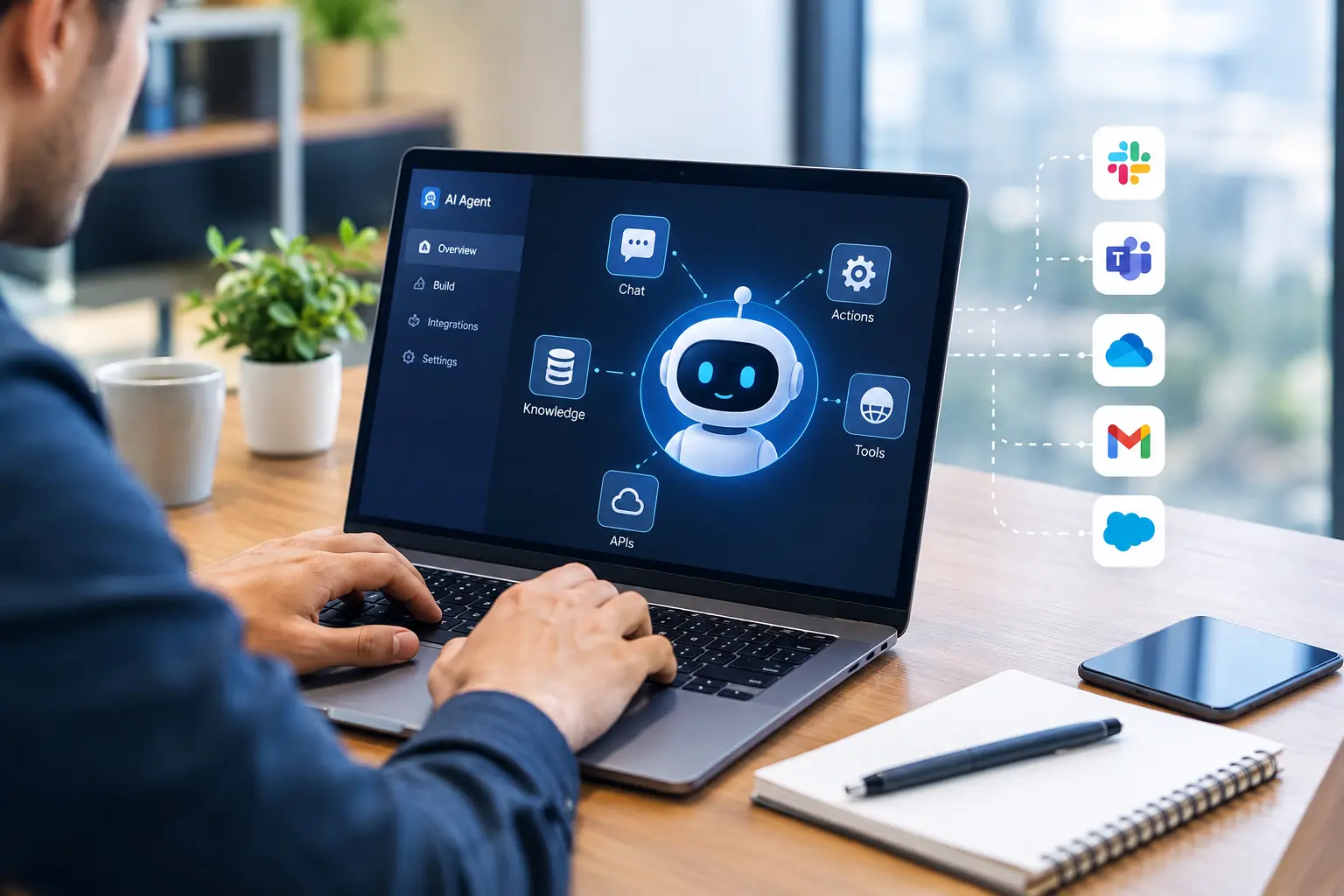
- Tools or APIs to perform actions.
- Instruction that clearly defines its roles, boundaries, and objectives.
- Permission controls and context management.
Pro-Tip: Autonomous reasoning and acting are what set apart a task-oriented agent from a standard conversational interface.
AI Agent Vs. Chatbot Comparison
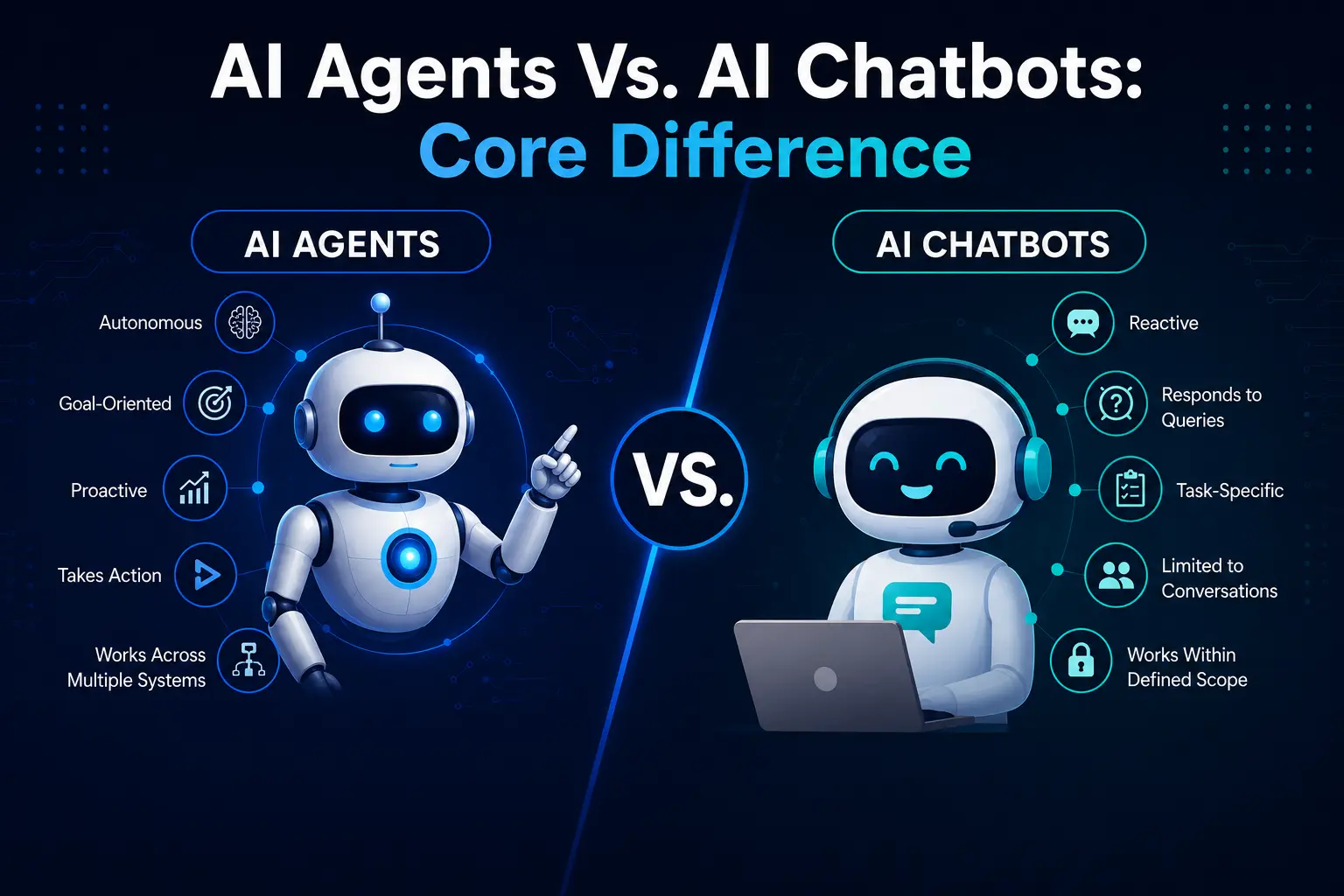
Although chatbot and AI agent are terms that are used interchangeably, they are not identical and do not have the same meaning. While a chatbot typically focuses on conversations, its role typically ends once it sends a response. The answers are either LLM-generated or follow a decision tree.
On the other hand, an AI agent is designed with a goal to accomplish. It makes independent decisions using external tools, triggers workflows, retrieves information, and coordinates with other agents. Let’s look at the distinction in a little in more detail to help you better plan your project:
| Capability | Traditional Chatbot | AI Agent |
|---|---|---|
| Main purpose | Provide instant answers to questions | Complete an ongoing task with minimal human intervention |
| External tools | Limited or absent | Multiple tools, such as databases, CRMs, APIs, ERPs, and many more. |
| Workflow execution | Basic and straightforward | Multi-step |
| Decision-making | Usually scripted based on pre-set rules or a decision tree. | Context-aware and goal-oriented. |
| Best use cases | FAQs and basic user support. | Sales, Operations, Analysis, Service, Automation |
| Human oversight | Optional | Mostly essential, especially for sensitive use cases. |
| Memory | Often limited | Can maintain context and the state of task. |
In short, a chatbot can be sufficient if your requirement is only to answer a set of common questions. If you are looking for a system that can act across multiple applications, then you need to build an AI agent.
What Is an AI Agent Builder?
An AI Agent builder refers to a platform or a toolkit that assists users in designing, configuring, testing, deploying, and maintaining AI agents. These platforms can vary from simple visual tools for business users to developer frameworks that help build complex production systems.
A lot of the AI agent builders provide a combination of:
- Prompt and instructions configuration
- Visual workflow design
- API and application integration
- Memory and context handling
- Testing and simulation
- Conversation management
- Human approval workflows
- Logging and analytics
- Deployment across websites, messaging tools, mobile applications, or internal systems.
Depending on the type of AI agent you are willing to build, the choice of platform also varies. For example, for a marketing team no code AI agents can work for lead qualification, but for a software engineering team, a framework supporting custom code and multi-agent orchestration is required.
Types of AI Agent Builders and Development Platforms
Just as the types of AI agents vary based on the business requirements and industry niche, there are distinct types of development platforms, each serving a different purpose and resolving a unique challenge.
AI agent builders generally fall into different categories, such as:
No-Code AI Agent Platforms
No-code AI agent platforms allow users to build AI agents using visual interfaces, prompts, templates, and prebuilt integrations. These tools facilitate teams in creating quick prototypes while eliminating the initial technical barriers. They are well-suited for simple workflows like:
- Document summarization
- Answering internal policy questions
- Inbound lead qualification
- Follow-up emails
- Scheduling meetings
- Classifying support tickets
Low Code AI Agent Platforms
Low-code AI agent platforms offer visual builders but also have scripting, webhooks, custom API calls, and configurable components. They serve as a middle ground when a standard template doesn’t suffice, but a fully custom application might be a lot. A low-code approach is well-suited for teams that:
- Modify the agent workflow
- Add customized business rules
- Connect proprietary systems
- Introduce approval steps
- Customize the user interface
- Add a structured way of data processing
Useful Read:
To make a better choice between no code AI agents and low code AI agents, the following comparison will help:
| Comparison Factor | No Code AI Agents | Low Code AI Agents |
|---|---|---|
| Setup speed | Very fast | Fast to moderate |
| Required technical skills | Minimal | Basic to intermediate |
| Integrations | Prebuilt connectors | APIs, custom connectors, webhooks |
| Customization | Limited to platform options | Greater degree of customization |
| Suited for | Simple workflows and prototypes | Business workflows with customized rules |
| Scalability | Depends on the provider | Generally, it is more flexible |
| Maintenance | It's usually platform-managed | Shared between team and platform |
| Ideal users | Business teams | Operations and technical teams |
Developer Frameworks
Developer-focused frameworks have a greater degree of control over models, prompts, memory, orchestration, tools, and deployment. Examples of developer frameworks used to build AI agents include LangChain, LangGraph, Microsoft Semantic Kernel, CrewAI, and AutoGen. Developer frameworks are best suited for:
- Advanced retrieval systems
- Multi-agent collaboration
- Custom observability
- Complex decision workflows
- High-volume enterprise workloads
- Private cloud or on-premises deployment
Enterprise AI Platforms
The capabilities of enterprise AI platforms generally include identity, security, governance, integration, analytics, and lifecycle management. Some of the top-regarded AI agent development platforms in this category include:
- Microsoft Copilot Studio
- Google Vertex AI Agent Builder
- Salesforce Agentforce
Open-Source AI Agent Tools
Open-source AI agent tools help reduce the dependency on vendors and promote flexibility. With the need for a greater degree of engineering responsibility, it’s important for businesses to manage security, hosting, updates, monitoring, model connections, and support.
How to Build a Custom AI Agent?
The process to build an AI agent should begin with the identification of the business problem and not the model or platform. Here’s a practical framework that will guide the steps you need to follow to develop a useful and reliable AI agent:
(1) Define the Agent’s Purpose
This must be defined as one clear statement stating what the agent is expected to do in terms of the end goal. Avoid the mention of vague goals, such as ‘build an AI assistant for business’. Make it specific by defining one narrow use case that is easy to test, measure, and improve.
Define:
- Target audience
- Success metrics
- Business process
- Inputs the AI agent will receive
- Situations it must escalate
- Business outcomes to expect
(2) Choose the Right Agent Type
Defining the use case helps determine the right architecture for the AI agent. For instance, a decision agent analyzes structured data and recommends actions. Whereas a multi-agent system divides a complex task among specialized agents.
It’s a smart decision to begin with a single-agent design instead of having multiple specialized agents. Common types of AI agents include:
- Workflow automation agents
- Conversational agents
- Decision-support agents
- Voice agents
- Recommendation agents
- Knowledge-retrieval agents
- Multi-agent systems
- Domain-specific agents
(3) Prepare the Knowledge Sources
The reliability of an AI agent depends on the accuracy and relevance of the information that is fed to it. Based on the role of the AI agent, gather updated and relevant product records, documents, policies, tickets, databases, FAQs, and APIs.
If you have unstructured or unorganized information, using RAG development services is the best option. RAG facilitates AI agents to search a knowledge base and include only relevant information in their responses rather than relying on the model’s general training.
Before connecting the data, always check:
- If the information is current
- If there are duplicate versions of the same
- If any sensitive data needs to be excluded
- If documents are structured for retrieval
- If access permissions are defined
(4) Draft Clear Instructions
Instructions will define the AI agent behavior by explaining:
- The agent’s role
- The objectives
- The intended users
- The sources it uses
- The actions it may perform
- What to do when information is missing
- The actions that need approval
- What to involve human interaction
(5) Add Tools and Integrations
Ensure that the AI agent can seamlessly interact with the existing systems, platforms, and databases. Depending on the use case, it might need access to:
- ERP systems
- CRM platforms
- Calendars
- Helpdesk software
- Payment systems
- Email and messaging tools
- Inventory databases
- Analytics systems
- Internal search systems
(6) Define Memory and Context
To have a history of the entire conversation or task, memory management becomes vital for an AI agent. It can remember details such as:
- The order number of the customer
- The preferred language of the user
- A previously chosen product
- List of already completed steps
- The current status of a workflow
(7) Test the Agent
Testing the AI agent in real-world situations prepares it for normal as well as unexpected scenarios. Create test cases for:
- Ambiguous questions
- Common user requests
- Incorrect user assumptions
- Missing information
- Conflicting documents
- System outages
- API failures
- Sensitive data requests
- Scenarios for escalation to human agent
(8) Run Deployment in Stages
Don’t launch an AI agent across the entire organization in one go or immediately. Proceed step by step with:
- Internal testing
- A small pilot group
- Limited workflows
- Controlled customer access
- Broad deployment after thorough evaluation
(9) Monitor and Improve
When you deploy the AI agent, don’t mistake it for the end of the lifecycle; it’s just the beginning of the AI agent’s journey. Real monitoring begins now, evaluating the:
- Escalation rate
- Task completion rate
- Response quality
- Errors and security events
- User satisfaction
Core Components of a Reliable AI Agent
Several components constitute a production-ready custom AI agent development journey, such as:
-
Model Layer
This layer includes the Large Language Model or other AI models that are responsible for language interpretation, reasoning, classification, summarization, or generation. Certain applications prefer using different models for different tasks to ensure accuracy, speed, and cost.
-
Knowledge Layer
This layer includes all relevant business data in the form of documents, policies, product records, databases, and other sources that the AI agent relies on to provide answers or recommendations.
-
Tool Layer
The tool layer allows the AI agent to take action. This can include search functionalities, APIs, calculators, ticket creation, database queries, email, and workflow triggers.
-
Orchestration Layer
The orchestration layer controls how the AI agent plans and executes the steps. It decides which tools will be used, when to ask a specific question, and when to include a human in the conversation.
-
Governance Layer
This layer includes access controls in the form of audit logs, data protection, permissions, compliance, human oversight, etc.
-
Monitoring Layer
This layer empowers the teams to understand what the AI agent did, what sources it used, where it failed, and how much each task cost.
Common Challenges When Building AI Agents
Despite AI agents being technology-driven, there is always a loophole that results in challenges along the way. Likewise, some common challenges faced in building AI agents include:
-
Poor Data Quality
The reason for unreliable or irrelevant responses from AI agents is often due to outdated, incorrect, or fragmented data. To avoid this issue, data preparation, governance, and validation must be addressed before deploying AI agents.
-
Integration Complexity
Connecting an AI agent to legacy systems, fragmented databases, and custom applications requires significant engineering. API-first design and phase-wise integration can help reduce this disruption.
-
Security and Access Risks
An AI agent with multiple permissions can result in the risk of exposing sensitive data or taking unauthorized actions. This can be overcome by applying least-privilege access, audit trails, approval processes, and strong identity measures.
-
User Adoption
If the behavior of the AI agent is inconsistent or unclear, employees may distrust or avoid using it. In such cases, you can build employee confidence by providing adequate training, documentation, feedback loops, and human oversight.
-
Rising Operating Costs
Retrieval, data storage, tool usage, and model calls can all become expensive at scale. To overcome this challenge, you can track cost per task and choose models based on the significance of each activity.
How PSSPL Helps Businesses Build AI Agents?
PSSPL serves as an end-to-end development partner in the full AI agent lifecycle, from the identification of the right use case to maintaining deployed systems. Our AI engineers are experts in offering custom AI agent development services to leading global startups and enterprises.
We have a client-first approach that includes:
- AI agent strategy and use-case discovery
- Assessing data readiness and infrastructure
- Agent architecture and design
- Custom workflow development
- RAG and enterprise knowledge integration
- Multi-agent and decision-agent system development
- Governance, auditability, and access controls
- Deployment across distinct business channels
- Ongoing monitoring and maintenance
At PSSPL, our team has the expertise to answer your question about how to build a custom AI agent. They have the competence to deliver multiple AI agents, such as workflow agents, domain assistants, recommendation engines, decision agents, and so on.
We have real-world expertise in the successful implementation of AI agents for video analytics, appointment booking, social media automation, and productivity workflows. We know how to build AI agents that go beyond conversation and deliver measurable operational value.
Frequently Asked Questions
Free AI agents refer to those agents that are available with free plans, frameworks, or platforms offering limited usage without any subscription fees. These options can be useful to aid learning and prototype development, but they limit the number of tasks, integrations, users, storage, and model usage.
To build an AI agent that is simple and straightforward can be done in days or weeks. But a production-grade agent with custom integrations, complex features, strict governance, testing, and monitoring needs several development steps, which can take weeks or months based on the level of complexity.
The best AI agent platform varies based on your requirements.
- Microsoft Copilot Studio is well-suited for Microsoft-centric organizations.
- Salesforce Agentforce is well-suited for CRM workflows.
- Google Vertex AI Agent Builder for Google Cloud users.
- Developer frameworks are well-suited for highly customized systems.
Yes, multi-agent systems support specialized agents to collaborate on multiple tasks. For instance, one agent researches information, another analyzes it, and a third one prepares its report.
Choosing among the best AI agent builders requires:
- Thorough evaluation of the use case.
- Deciding the integration and the needed model flexibility.
- Outlining security, scalability, and monitoring policies.
- Mentioning the pricing and deployment options.
Final Thoughts
There is a vast difference between learning to build AI agent systems and building one with detailed planning. Partner with AI development companies like Prakash Software Solutions and let us take control of the end-to-end development lifecycle of AI agents.
We begin with clear use, structured data, clear monitoring instructions, a well-planned tech stack, controlled permissions, and measurable success criteria. From exploring free AI agents to custom AI agent development, we are with you every step of the way to deliver enterprise-grade solutions for quantifiable ROI.
I have written several pieces of technical and SEO content across different SaaS and product companies, and the ones which have been successful possess one common characteristic: they have something valuable to say to a technical reader while still being optimized for ranking. Writing an informative blog post? Easy part. Getting the search intent right, making sure that the technical information is accurate, and aligning each post with its place in the buyer journey? That's where I put all my efforts.