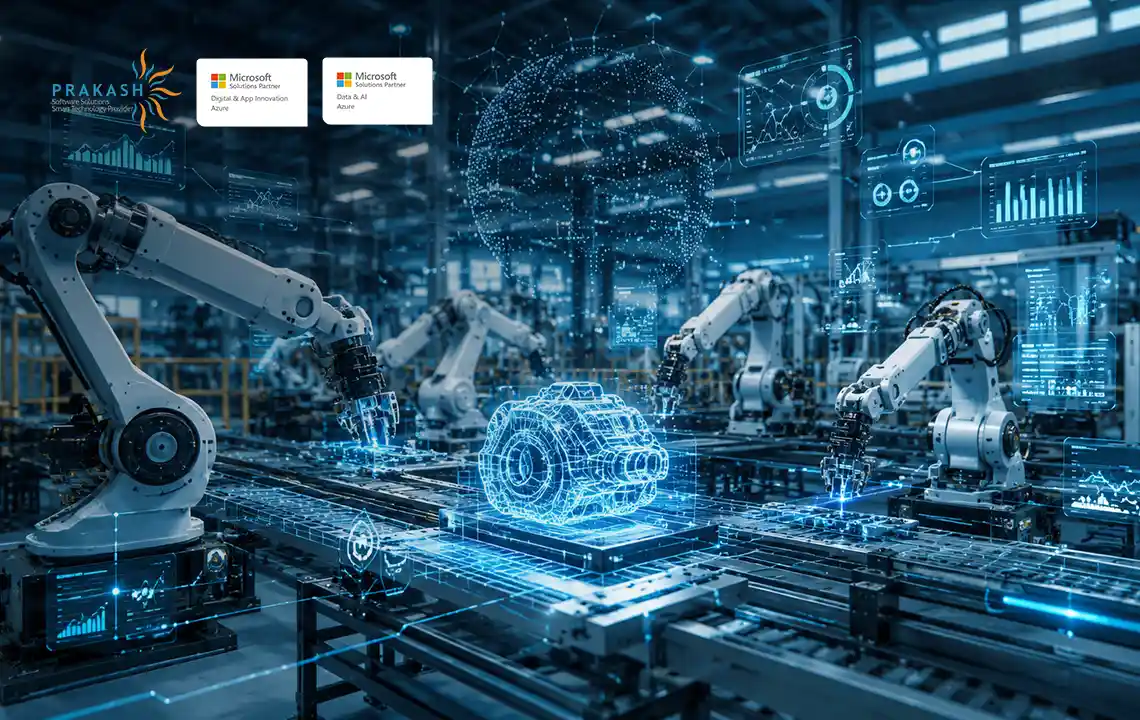
Generative AI for Manufacturing: How Smart Factories Are Rewriting the Rules of Production
Summarize and save time
Just enter any modern manufacturing plant, and you will see how shop-floor conversations evolve. Just a couple of years ago, the keywords were “automation” and “IoT sensors.” Today, everyone from manufacturing managers to quality assurance engineers and supply chain executives is buzzing about one topic only — generative AI.
And not in vain — behind the scenes, manufacturers in industries like automotive, electronics, industrial equipment, and consumer goods are already transforming their planning, production, and logistics workflows around generative AI.
In case you work in manufacturing and your perception of artificial intelligence is still connected with “that tool which predicts machine breakdowns,” take note.
Generative AI not only predicts but also creates. It can design a new part, write a maintenance document in natural language, simulate a hundred possible scenarios of production overnight, or provide a response to a technician’s questions on faulty codes as if it was done by a senior engineer. In other words, the meaning of generative AI for manufacturing is much more than a simple capability to automate tasks based on pre-defined rules.
In this blog, we’ll walk through what generative AI actually looks like on a factory floor, where it’s already delivering value, the different ways manufacturers are bringing it into their operations, and what it takes to do this right. If you’re evaluating generative AI for manufacturing as part of your own digital transformation plan, this should give you a grounded, practical starting point.
Why Manufacturing Is a Natural Fit for Generative AI?
The manufacturing process is also responsible for generating massive amounts of information – sensor readings, photographs taken during quality check process, maintenance records, supplier information, CAD drawings, production plans – much of which has been sitting idly in storage, never used at all.
Classic analytics will tell you about what has happened in the past. Using generative AI, the same information can now be put to use in the form of a recommendation, a change in the design, a written report, or even a prediction story.
This is yet another factor that makes manufacturing the perfect environment for generative AI to develop. The incredible variety of decision-making situations that take place there every day is the key element here. Production planners have to balance machine availability, materials delivery, shifts, and customer requests simultaneously.
Quality engineers struggle to find out the reasons behind increased defect rates on some lines but not others. Maintenance technicians face new error codes every now and then. This type of problem cannot be solved by just having a dashboard available.
It certainly doesn’t hurt that the technology behind all this has developed so rapidly. With large language models, image generation models, and multimodal models that can handle interpreting both sensor readings from a graph and images of an incorrectly manufactured product simultaneously, the technology is finally ready to handle the messiness that manufacturing data presents. This is certainly one reason for the rapid rate of adoption in recent years.
Also Read: Generative AI Development Services: How Retrieval-Augmented Generation Is Shaping Enterprise AI
Where Generative AI Actually Shows Up on the Factory Floor?
When considering this process, it makes sense to look at it within the whole production cycle of planning, manufacturing, and shipping because AI does not exist in one niche of production.
(1) Product design and prototyping
Now, instead of working with an empty CAD system, design engineers can write down the requirements: maximum weights, material restrictions, price targets, and use a generative algorithm to come up with several solutions that need to be considered. This does not mean that design engineers are no longer needed but reduces the time of designing by several weeks. Physical prototyping takes much time and money; therefore, it would be wise to try virtual variants first.
(2) Quality control and defect detection
The vision-based AI generative models can be used to teach what “normal” components look like and detect any deviations that could be in the form of scratches, misalignment, warping, and improper welding in real-time — something that would often go unnoticed by the human inspectors, particularly on the fast-moving assembly line. In some cases, some manufacturers are even employing AI models to generate synthetic imagery of uncommon defects.
(3) Predictive and prescriptive maintenance
Predictive maintenance will tell you when a device is expected to fail. What generative AI does is take that one step further and come up with a solution for the problem, which may range from an explanation on how to fix the device to the list of spare parts needed or a certain period of time when maintenance should be performed.
(4) Production planning and scheduling
Changeover of lines, unforeseen machine stoppage, shortage of raw materials – production scheduling is forever being interrupted. Models of generative AI can process real-time information and recommend revised schedules taking into account throughput versus limitations in resources, which used to take planners hours to revise manually.
(5) Supply chain and inventory management
Generation AI is capable of making use of demand signals, past performance of the supplier, and macro trends to recommend reordering points, identify at-risk suppliers, and even compose procurement correspondence. Its main advantage lies in its applicability in scenario planning, such as “What if the lead-time of the supplier doubled?” and receive an answer within minutes.
(6) Knowledge capture and workforce support
This specific use case is relatively overlooked. Every business has a number of people in-house who have tribal knowledge – they know how to maintain a very old machine; they recognize some of its noises – and this information is never captured anywhere. Generative AI can be trained on maintenance logs, operational instructions, and even interviews with veterans in order to build a conversational agent for newer employees who will give advice right away. With the retiring of the veteran generation, this knowledge capture has actually turned into a competitive advantage.
(7) Energy optimization and sustainability reporting
Generative models have the ability to understand the energy usage trends at the facility level and propose certain changes to reduce wastage, while also streamlining the growing complexity of creating sustainability and compliance reports.
(8) Customer-facing operations
On the business end, generative AI makes order tracking bots, personalized product suggestions, and automated documents such as invoices, certificates of compliance, and ship notices that once took days to prepare.
Three Ways Manufacturers Are Bringing Generative AI Into Their Operations
There isn’t a single “right” way to adopt generative AI, and the path a company chooses usually comes down to its internal technical maturity, budget, and how mission-critical the use case is.
Building custom, in-house solutions:
Some manufacturers, especially those that are larger and have good engineering resources within them, opt for building models customized to their proprietary data. Such an approach gives full control and best fitting with the company processes; however, it requires substantial investments both in terms of human resources and infrastructure.
Adopting point solutions:
There are others that begin small by implementing ready-made generative AI systems that solve one specific issue such as a defect detection system, a maintenance support bot, or a demand forecasting solution. The advantage of this approach is that it quickly demonstrates the value of implementing something bigger.
Partnering for a platform-based approach:
An increasing number of companies are collaborating with an expert partner to develop and implement a comprehensive generative AI layer which would connect production data, ERP and MES systems, suppliers’ data, and quality records into one integrated layer governed by the same rules and security controls. Such a way usually pays off the best in the long run since it helps to avoid the problem of connecting disparate point solutions, however, it takes a partner who is knowledgeable about AI development and manufacturing processes.
Regardless of which approach an enterprise chooses, what remains the same is that the difficult aspect is no longer the technology itself. The difficulty lies in the integration of such technology into existing MES, ERP, and SCADA systems in a manner that would not affect the process of production and comply with all regulations. This is exactly were working with a specialized partner for generative AI development services makes the difference between a promising pilot and a system that actually runs reliably at scale.
Measuring Whether It’s Actually Working
The success of generative AI application cases is always something that is easy to talk about, but difficult to measure. Companies that do this right typically focus on both hard and soft KPIs:
- Downtime and maintenance expenses — are the periods of unplanned downtime really reducing, and is the machine’s lifetime increasing?
- Defect rate and reworking costs — is the quality improving, and are there fewer defective units or products requiring reworking?
- Stock level accuracy — are there fewer instances of under or overstocks?
- Employee efficiency and retention — are employees completing tasks faster, and are new ones learning their job faster due to assistance from AI technology?
- Time to market — how fast are the new variants of products being developed?
This takes time. Many firms get the greatest value by starting with small-scale pilots — one production line, one type of defects, one maintenance process — rather than trying to implement their generative AI project on a grand scale all at once. It is in this way that most generative AI projects fail.
The Real Challenges Nobody Skips Past
A misconception regarding this is that it is seamless technology. There are some issues that companies using AI experience when assessing it:
Legacy integration problems:
There are many facilities out there currently running on machinery and software from over a decade ago. Connecting the new technology to the legacy MES and SCADA systems without disturbing the ongoing production process is truly challenging.
Data quality and availability:
The effectiveness of generative AI systems depends heavily on the type of data used in training them. Poor-quality and inaccurate data obtained from sensors and poor-quality labels for high-quality images are some of the factors that hinder their effectiveness.
Data privacy and IP protection:
Data obtained from manufacturing processes may include intellectual property. Therefore, there should be guidelines regarding what data is to train a system, where the data is stored, and who accesses it.
Regulatory and compliance pressure:
The type of industry in question – aerospace, automotive, medical devices – determines the standards of traceability and validation to which any AI recommendation must comply.
Workforce trust and adoption:
Undoubtedly, the biggest underestimated problem. Unless operators trust an AI recommendation, they won’t implement it even if the algorithm behind it is absolutely correct. The key here is transparency in the algorithm and involvement of the workforce from the very beginning.
Working with a team that has hands-on experience delivering AI development services for industrial environments helps manufacturers navigate these issues instead of learning them the hard way through a failed pilot.
Also Read: Modern AI: Generative AI vs. Agentic AI vs. AI Agents – Understanding the Future of Intelligence
What’s Coming Next?
The direction of travel is fairly clear even if the exact timeline isn’t. Generative AI for manufacturing is moving from isolated point tools toward more autonomous, connected systems.
Assistance systems will continue to get smarter because automation engineers are already using generative AI to create PLC codes and configurations, which saves a lot of engineering time.
Recommendation systems will become more prescriptive because instead of just raising an alarm, these systems will generate instructions on how to fix things when sensors detect a problem. In addition, there will be more autonomy because robots handling materials will understand human language, production processes will adjust themselves to the real-time demand, and quality control systems will generate their own training data to continuously improve themselves.
And there is also a gradual merging between generative AI and other industrial technologies such as digital twins, edge computing, and augmented reality.
The use of digital twin technology in combination with generative AI makes it possible for engineers to perform tens of process modifications virtually without changing anything on the real production line. Thanks to edge computing, AI systems can quickly adjust any system without having to send data to the cloud. Finally, AR systems will allow workers to see AI guidance in action on the actual equipment.
All this does not mean that human expertise becomes less necessary; on the contrary, it is even more crucial but used in a slightly different way. Those people who were involved in repetitive work like analysis and troubleshooting will have time to make judgments instead of spending many hours on routine tasks.
How This Plays Out Differently Across Manufacturing Verticals?
Another thing that should be noted at this point is the fact that generative AI does not have a universal form because not all industries in manufacturing face the same challenges.
For example, in automotive and heavy machinery manufacturing, the benefits of implementing generative AI will likely be seen primarily in predictive maintenance and production line optimization because of the high level of capital expenditure and the importance of minimizing any potential downtimes. An hour of downtime on a stamping line cost more than several months of subscription to AI.
In electronics and semiconductor fabrication, there is more focus on defect detection and yield improvement. The tolerances of the parts are so tight that even small improvements in the accuracy of the inspection process may lead to huge savings. And the ability of the generative artificial intelligence to synthesize training datasets on rare defects is especially valuable here since those defects happen quite rarely.
In industrial equipment and machinery, knowledge capture tends to matter more than almost anywhere else. Such plants have equipment and machinery that is very specific and old, which means that very few experienced people know how to use it. Therefore, AI assistants can make a big difference when it comes to workforce resiliency.
In consumer goods and CPG manufacturing, generative AI’s design and personalization capabilities get more attention, since these industries move faster on product variation and need to respond quickly to shifting consumer preferences.
It’s not a question of one type of vertical advantage being better than another, but rather that a vanilla off-the-shelf solution won’t usually work as effectively as a tailored one designed for particular industry economics and failure points. And this is yet another reason why partnering with someone who understands both the intricacies of artificial intelligence engineering and the industry can be beneficial.
A Quick Note on Governance
Governance is one thing that sets apart manufacturers who are able to scale their usage of generative AI technology from those who only reach the pilot phase. Governance is the unsophisticated but necessary process of determining who gets access to which data, how model results will be verified before they affect the final decision-making process and how the system will be supervised after its implementation.
The reason why governance is crucial in manufacturing is because of the significance of such an activity; unlike other sectors, manufacturing cannot take incorrect recommendations, as an erroneous maintenance recommendation could lead to the malfunctioning of the machinery; erroneous calibration of quality recommendations would mean that the manufactured item delivered to consumers is defective, while an incorrect supply chain recommendation may lead to the company being at financial risk by having the wrong inventory tied up.
This means that in reality, there is human intervention in decision making, audit trails are maintained on the discrepancies between the recommendations offered by AI and human decisions, as well as reviews of the model’s effectiveness.
Getting Started the Right Way
In conclusion, there is one thing that should be learned from all the points raised above, and that is to avoid boiling the ocean. The companies that have managed to experience return on investment for their generative AI tools did not do everything at once, but they pinpointed a single point of friction – a quality control problem, maintenance issue, and planning challenge, solved it, showed its value, and proceeded to move forward.
However, the technical foundation for implementation is no less important than the choice of application. The data pipelines should be clean and easily accessed. The systems have to work together. The security and compliance aspects have to be taken into account from the get-go. And the AI itself requires constant monitoring and improvement.
This is exactly the kind of work PSSPL specializes in. With deep experience across enterprise AI engineering and manufacturing operations, PSSPL helps manufacturers move from scattered experiments to production-grade generative AI systems that are actually built to run reliably on the shop floor — from custom model development and MES/ERP integration to ongoing optimization and governance.
If your team is exploring what generative AI could look like inside your own plant, PSSPL’s generative AI services team can help you identify the right use cases, design a practical integration approach, and build a solution tailored to your existing systems rather than forcing you to rip and replace what already works. And if you’re looking more broadly at how AI fits into your wider technology roadmap — beyond generative AI alone — PSSPL’s AI development services team can help you build a strategy that scales with your business, not just your current pilot project.
Since time immemorial, manufacturing has been revolutionized by leveraging the technologies which enable humans to accomplish their tasks more efficiently and with less error — from the assembly line, to robotics, all the way to generative artificial intelligence. It is these companies which view such technologies as capabilities, rather than mere experiments, that will lead the industry into the future.
Looking to bring Generative AI for Manufacturing to Your Factory Floor?
Cut downtime. Boost quality. Move faster. PSSPL’s Generative AI Development Services and AI Development Services help manufacturers turn AI pilots into real production wins.
Through my experience managing content in a variety of B2B and B2C programs, I’ve learned a few things about the content pieces that actually work – they’re technically correct, they answer the questions the user came to ask, and they were crafted with being discovered in mind. Writing something polished isn’t difficult – there are lots of people out there who know how to do that. The difficult part is aligning it with actual intent, ensuring all facts are correct, and ensuring that the piece fits into a larger story. Many content programs forget about this, and that’s where I concentrate.