AI in Manufacturing Australia: A Complete Guide to Transforming Industrial Operations
Summarize and save time
A new era of productivity and innovation in supply chains and manufacturing is being propelled by artificial intelligence (AI). AI-powered solutions are streamlining operations, cutting expenses, and improving decision-making across a variety of industries, from automated shipping to predictive maintenance. There is a fundamental shift in the manufacturing sector of Australia. Today, AI in manufacturing Australia is no longer a futuristic concept. It is a useful, goal-oriented strategy that helps companies maximize output, improve quality, and create robust supply chains. Early adopters of AI are not just increasing productivity but also establishing new standards for operational excellence.
This blog examines how AI is changing manufacturing in Australia, as well as its main applications, advantages, and difficulties. It also discusses why partnering with expert providers of AI consulting services in Australia—like PSSPL—can accelerate your success.
Manufacturing in Australia: Why AI Is No Longer Optional
Australia’s manufacturers are negotiating a terrain that presents both opportunities and growing obstacles. Given the current climate, it is becoming impossible to overlook the significance of AI in manufacturing Australia as more companies rely on smart solutions to remain competitive.
Growing expenses and ongoing uncertainty
Australian firms are constantly under pressure from rising energy costs and persistent supply chain problems. Cost optimization is becoming increasingly important due to economic unpredictability, which AI may greatly help with.
Progress is slowed by disconnected systems
Many businesses continue to rely on antiquated technologies and manual workflows that are ineffective at communicating. Decision-making is delayed and real-time visibility is restricted due to this lack of integration. Adopting AI in manufacturing Australia facilitates system unification and the release of useful insights.
Increasing needs for security and compliance
Manufacturers must maintain strong governance in light of the more stringent laws pertaining to cybersecurity, data protection, and traceability. Businesses may create secure, future-ready, and compliant systems by utilizing AI consulting services in Australia.
Persistent lack of skills
The lack of skilled workers in Australia is still a problem, which puts further pressure on already-existing teams. Organizations can do more with less thanks to AI-driven automation and intelligent technologies, increasing productivity without overtaxing employees.
Efficiency is now essential in today’s production environment, not only a competitive advantage. Businesses may develop resilience, boost productivity, and ensure long-term growth by integrating AI in manufacturing Australia and collaborating with the best AI consulting services in Australia.
According to recent industry insights:
- Around 68% of Australian businesses have already implemented AI technologies, with many more planning adoption
- AI initiatives have delivered up to 30% time savings across operations
- AI is becoming essential to offset labour shortages, rising costs, and supply chain disruptions
The Role of AI in Manufacturing
AI is transforming production processes by increasing overall efficiency, decreasing downtime, and boosting quality control. Among the most important applications are:
Predictive maintenance reduces expensive downtime by using artificial intelligence (AI) to analyze data from sensors and machinery to predict issues before they occur.
Quality Control and Defect Detection: Real-time defect detection via machine learning algorithms assures better product quality and reduces waste.
Process Optimization: By optimizing industrial workflows, AI-driven analytics lower energy usage and improve resource allocation.
Robotics and Automation: AI-driven robots improve worker safety, speed, and accuracy by streamlining assembly lines.
Real-World Impact: AI in Action
The value of AI becomes even clearer when we look at real-world implementations. As highlighted in PSSPL’s AI in Manufacturing: Revolution & Case Studies, AI is already transforming manufacturing operations through practical, results-driven applications.
AI is assisting manufacturers with demand forecasting, intelligent quality control, and predictive maintenance.
- Determine which production procedures are inefficient.
- Use data-driven insights to enhance product quality
- Reduce operating expenses and maximize resource use
- Improve the responsiveness and planning of the supply chain
This shows that AI is more than just an idea; it is actually producing quantifiable business results. Manufacturers now have a long-term competitive advantage because to technologies like machine learning and reinforcement learning, which allow systems to continuously learn, adapt, and optimise performance over time.
Key Use Cases of AI in Manufacturing Australia
AI is transforming every layer of the manufacturing value chain—from design to delivery.
1. Predictive Upkeep
AI evaluates machine data to anticipate malfunctions before they happen. This increases asset longevity, minimises downtime, and avoids expensive malfunctions.
Impact:
- Lower maintenance expenses
- Enhanced uptime of equipment
- Enhanced continuity of production
2. Quality Assurance and Defect Identification
AI-powered computer vision allows for more accurate real-time product inspection than manual inspections.
Impact:
- Decreased flaws
- Enhanced uniformity of the product
- Reduce waste and redo
3. Intelligent Supply Chain Enhancement
Manufacturers can estimate demand, optimise inventory, and simplify logistics with the aid of AI.
Impact:
- Decreased understocking and overstocking
- Quicker cycles of delivery
- Improved collaboration with suppliers
Supply networks powered by AI are more resilient in erratic markets because they can dynamically adjust to disruptions.
4. Automation and Robotics
Robots with AI capabilities carry out difficult jobs including material handling, packaging, and assembly with accuracy.
Impact:
- Enhanced output
- Increased safety at work
- Decreased human error
Additionally, by reducing dangerous manual jobs, AI and robotics can create safer surroundings.
5. Digital Twins and Simulation
By building virtual versions of production systems, digital twins enable businesses to model procedures and maximize efficiency.
Impact:
- Quicker decision-making
- Decreased hazards associated with operations
- Constant improvement
6. Sustainability and Energy Management
AI helps manufacturers save operating expenses and carbon footprints by tracking and optimizing energy use.
This is consistent with Australia’s shift to net-zero and sustainable manufacturing.
To successfully implement AI, manufacturers need more than just tools—they need the right strategy, expertise, and execution partner. PSSPL’s Manufacturing IT Services and Solutions are designed to help organizations modernize operations and unlock the full potential of AI.
With a strong focus on AI in manufacturing Australia, PSSPL enables businesses to:
- Modernise and digitise outdated industrial systems
- Use analytics and automation powered by AI.
- Easily integrate data platforms, IoT, and ERP
- Create secure and scalable digital ecosystems
By leveraging AI consulting services in Australia, we help manufacturers move beyond experimentation and achieve real, scalable impact—from pilot projects to enterprise-wide transformation.
Adoption of AI is predicted to boost the Australian economy by up to $112 billion by 2030, with manufacturing projected to be one of the largest winners, according to research by Google and the Australian Industry and Innovation Association (AIIA).
In actuality, AI has the potential to generate an estimated $142 billion in total economic value yearly, comprising $112 billion from increased adoption, $18 billion from the expansion of domestic AI-driven industries, and $11 billion from export prospects.
Beyond its financial effects, AI is expected to have wider economic advantages, such as a 7% rise in earnings overall and a potential 35% boost in pay for women. Furthermore, a 6% increase in productivity across industries and up to 22% higher productivity increases are anticipated.
Benefits of AI in Manufacturing
(1) Increased Output
AI removes inefficiencies and simplifies processes. According to studies, AI can greatly increase productivity in a variety of industries, promoting long-term economic growth.
(2) Cutting Expenses
Automation maximizes resource usage, avoids waste, and lowers labor expenses.
(3) Better Decision-Making
Every level of the company may make data-driven decisions thanks to AI’s real-time insights.
(4) Quicker Time to Market
AI speeds up the processes of production, prototyping, and product design.
(5) Greater Adaptability
AI-driven solutions allow manufacturers to quickly adjust to shifting market demands.
(6) Improved Client Experience
Businesses may better understand client needs and provide tailored solutions with the use of AI-powered analytics.
The future of AI in manufacturing:
Future developments in AI in manufacturing are anticipated to be shaped by the following trends:
Smart factories
The next stage of the evolution of manufacturing is represented by smart factories. These facilities will enable fully automated and adaptable production environments through the integration of AI, IoT, and advanced robotics. To ensure optimal efficiency, smart factories can autonomously manage supply chains, optimise processes, and modify production plans.
Developments in AI algorithms
More advanced algorithms that can handle challenging tasks will result from ongoing AI research. These developments will improve manufacturing’s automation, productivity, and decision-making even further.
Sustainable manufacturing
Regulators and customers alike are starting to prioritize sustainability. By optimizing resource consumption, cutting waste, and increasing energy efficiency, AI can support sustainable industrial methods. AI-driven green manufacturing techniques will proliferate as firms work to lessen their environmental effect.
Human-AI cooperation
AI and humans will work together more in production in the future. Humans will concentrate on making strategic decisions and managing AI systems, while AI will undertake regular and hazardous activities. The ability to deal with AI effectively will be crucial for the workforce of the future.
Why Choose PSSPL for AI in Manufacturing?
At PSSPL, we go beyond implementation—we deliver measurable business outcomes.
What Sets PSSPL Apart:
- Deep expertise in AI in manufacturing Australia
- End-to-end AI development and deployment
- Strong focus on scalability, security, and compliance
- Proven track record across global manufacturing clients
Our Approach:
- Discover – Understand your business challenges
- Design – Create tailored AI solutions
- Develop – Build and test scalable models
- Deploy – Integrate seamlessly into operations
- Optimise – Continuously improve performance
Building an AI-Driven Manufacturing Strategy
Manufacturers should take a methodical approach in order to properly implement AI:
Step 1: Establish Specific Goals
Pay attention to quantifiable results like lower costs, more productivity, or better quality.
Step 2: Begin with Use Cases with High Impact
Start with areas such as quality control or predictive maintenance.
Step 3: Make Data Infrastructure Investments
Make sure your data is organised, accessible, and clean.
Step 4: Work Together with Professionals
Leverage AI consulting services in Australia to implement AI more quickly and efficiently.
Step 5: Gradually Scale
Once early success is attained, expand AI projects throughout the entire firm.
Conclusion
AI is reshaping manufacturing, not simply changing it.
The challenge for Australian manufacturers is now not whether or not to use AI, but rather how fast and efficiently they can do so. In terms of efficiency, creativity, and scalability, those who take action now will have a major competitive advantage.
Businesses may unlock new performance levels and future-proof their operations by utilizing AI in manufacturing Australia and collaborating with seasoned AI consulting services in Australia.
Frequently Asked Questions
The size and complexity of the project will determine how long it takes to integrate AI in manufacturing. Businesses can begin to see returns in four to nine months for smaller, more targeted use cases, such as workflow automation or predictive maintenance.
However, the procedure usually takes nine to twelve months or more for bigger, enterprise-wide projects that include integrating legacy systems, consolidating data, and assuring compliance. The secret is to start small, demonstrate value, and then progressively increase.
On the manufacturing floor, generative AI is rapidly emerging as a useful tool. It is being used by manufacturers to streamline complicated material, transforming technical manuals into simple troubleshooting instructions for technicians.
In situations when real-world data is scarce or sensitive, it is also utilized to create synthetic data and automate compliance reporting, which aids in training AI models.
To put it briefly, generative AI is facilitating more intelligent teamwork by improving access to knowledge and streamlining procedures.
The size of the company and the complexity of the solution determine how much AI implementation in manufacturing Australia will cost.
Investments might range from AUD 70,000 to AUD 120,000 for pilot projects or smaller companies, particularly for specific use cases like process automation or AI-powered monitoring solutions.
Predictive analytics and quality inspection systems are examples of mid-sized implementations that can cost between AUD 120,000 and AUD 350,000.
Costs can surpass AUD 700,000 for large businesses considering full-scale transformation with sophisticated automation and infrastructure changes.
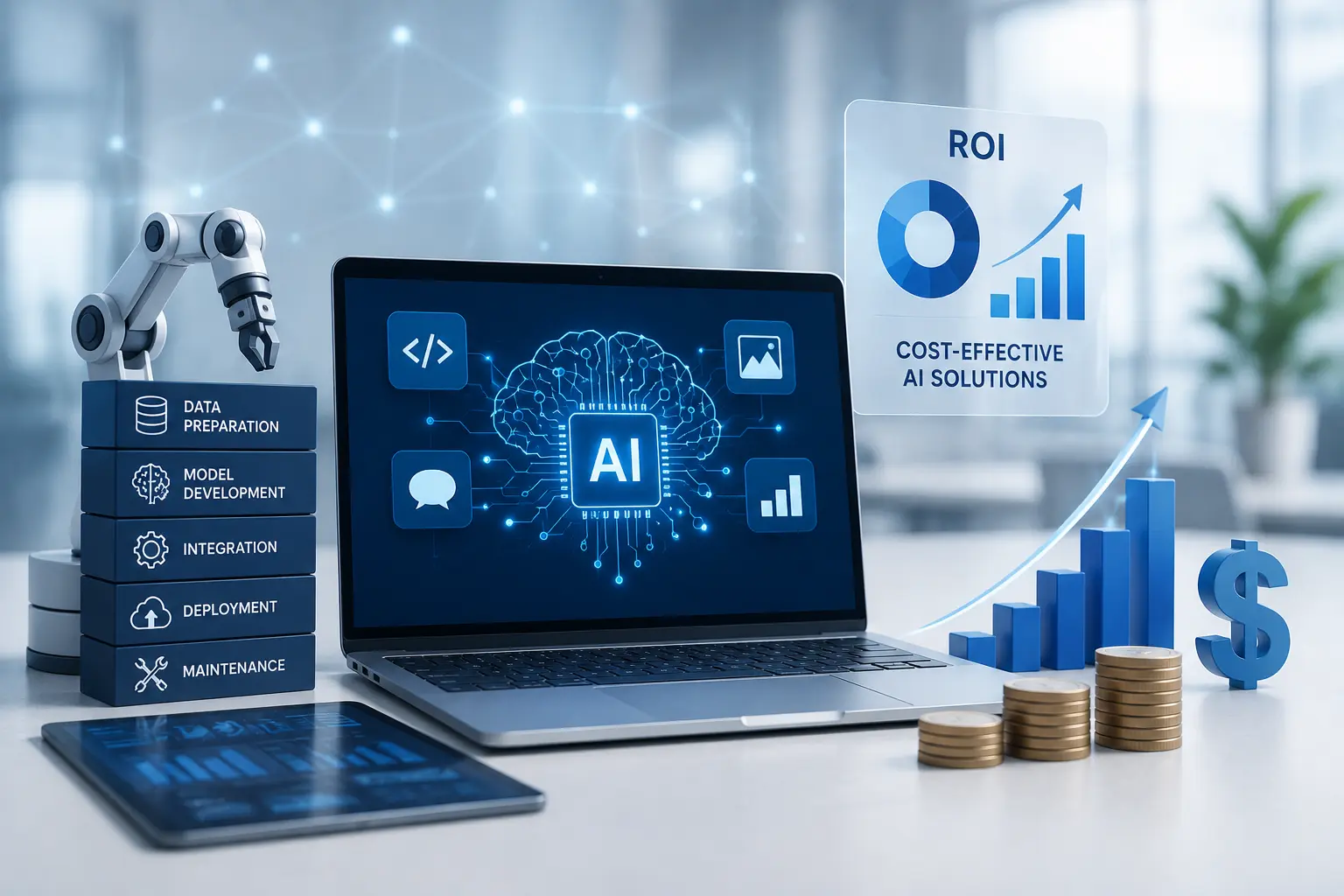
In order to assure that these investments are in line with a definite return on investment and long-term scalability, it is helpful to collaborate with seasoned AI consulting services in Australia.
Businesses in Australia are already reaping significant benefits from their AI investments. Due to increased productivity, decreased downtime, and decreased operational waste, businesses often claim a return of 15–20%.
In fact, when AI is used effectively, many organizations are seeing a full return on investment in 18 to 24 months. AI provides long-term value through enhanced operational resilience, better decision-making, and higher quality in addition to financial rewards.
Being involved in building a significant amount of generative AI applications I can say that the success of these apps lies in one thing — their model is integrated into a user’s workflow and people trust their results. Building some LangChain agents or ML models in a notebook? Piece of cake. The real deal is to build something useful in production, to ground it so that it won't start hallucinating and doing stuff for no reason. This is where most demonstrations fail silently, and this is what we concentrate on the most.