


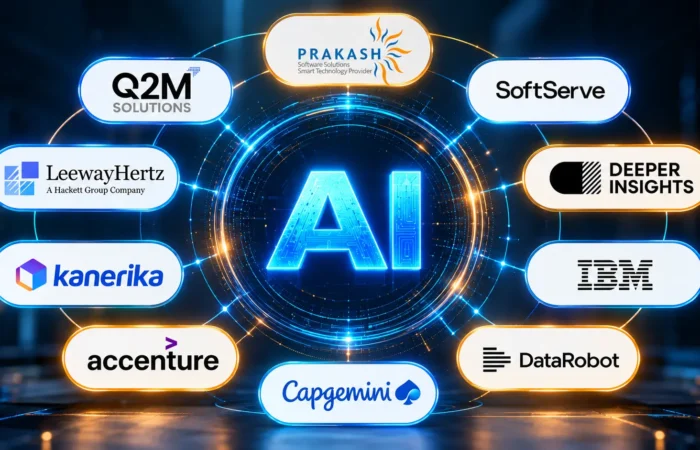
Top 10 AI Consulting Companies to Consider in 2027
Key Takeaways: AI consulting companies assist startups and enterprises in converting AI experiments into measurable business outcomes with the right

Looking for collaboration for your next project? Do not hesitate to contact us to say hello.

AI capabilities
AI by industry
Enterprise AI
Agentic AI
AI That Gets Work Done
Intelligent AI agents that plan, reason and execute workflows.
Computer Vision
See Beyond the Visible
Turn images and video into actionable intelligence.
Smart Glasses & AR
Intelligence in Your Sight
Hands-free guidance and real-time assistance for frontline teams.
SharePoint
Dynamics 365 ERP
Dynamics 365 CRM
MS Teams
Power Platform
Azure & Cloud
Microsoft Dynamics 365
Connect Every Business Function
Unify sales, finance, operations and customer relationships.
Microsoft Power Platform
Turn Ideas Into Action
Build apps, automate workflows and unlock business insights.
Azure & Cloud Solutions
Build Your Cloud Advantage
Modernize applications, data and infrastructure with Azure.
SERVICES
Design
Backend / Open source
Frontend tech
Mobile
Digital Marketing
When you need to train, manage, and govern your own models, Azure Machine Learning and Azure Databricks are the right tools. We build custom ML and deep learning models with reliable MLOps, and we’ll recommend Foundry agents when they’re a better fit.

Yes, it is. Microsoft Foundry is most commonly used to build genAI apps and agents using existing pre-built models. It isn’t used for tasks or processes such as training a custom model or handling traditional ML tasks.
Microsoft Azure Machine Learning services and Azure Databricks continue to be important when it comes to training, managing, or tuning a custom model. Azure ML often best suits tasks like model tracking, monitoring, and deployment, whereas Databricks works best for enterprise-scale data and model training.
A common enterprise setup comprises Databricks for data and model training, Azure ML for managing custom models, and Foundry for building AI agents and GenAI apps around them.
Typical Use Case:
There are numerous use cases of Databricks; some of the most common ones are Mosaic AI, Unity Catalog governance, Lakehouse-scale data engineering, and ML/GenAI training.
Well suited for:
Azure Databricks is the best choice when it comes to feature engineering, large-scale training, and data-first teams.
Typical Use Case:
AzureML use cases comprise AutoML, full MLOps, and custom model training.
Well suited for:
It is best suited for classical ML and DL with governed, repeatable pipelines.
Typical Use Case:
Their use cases include pre-built models, generative AI apps, and agents with proper governance.
Well suited for:
It works best for GenAI & agents – Foundry Models / Foundry IQ.
With the help of AutoML, businesses can speed up initial stages of model development, while custom models make sense when off-the-shelf options don’t fit right.
When it comes to complex tasks such as image recognition or natural language processing, deep learning powers those apps efficiently.
These models learn from customer behavior to suggest content, products, or the next best action.
Models can flag unusual patterns or suspicious activities, helping businesses detect potential fraud or other issues as they happen.
Organizations can use historical data to forecast demand, revenue, inventory needs, and capacity.
From customer churn and credit risk to pricing and demand, these models assist businesses in making more informed, data-backed decisions.
A model only turns out to be useful when it can work reliably in production. We develop the processes necessary to efficiently deploy, manage, monitor, and update models over time.
Prepare data and create reusable features with Fabric or Databricks, keeping training and production data consistent.
Train models, test different approaches, and track experiments with MLflow so results are easier to compare and reproduce.
Version models and manage approvals, access, and model history through MLflow and Unity Catalog.
Deploy models via online endpoints for real-time predictions or batch endpoints for large-scale scoring.
Track model performance, data quality, and drift, with alerts when something needs attention.
Set up automated retraining and CI/CD pipelines to keep models accurate as data and business needs change.
A common enterprise setup comprises Databricks for data and model training, Azure ML for managing custom models, and Foundry for building AI agents and GenAI apps around them.
Azure Databricks:
It handles large datasets, data processing, feature engineering, and model training.
Azure Machine Learning:
Azure Machine Learning services work with prepared data and features to create and train models.
Azure Databricks:
Databricks uses Unity Catalog to seamlessly manage data, models, and access.
Azure Machine Learning:
It provides model registration, versioning, access control, and governance.
Azure Databricks:
Databricks supports fine-tuning, model serving, vector search, and GenAI workflows via Mosaic AI.
Azure Machine Learning:
AzureML connects with Foundry to bring custom models into GenAI and agent-based apps.
Azure Databricks:
Databricks deploys models using Mosaic AI Model Serving.
Azure Machine Learning:
It provides managed online and batch endpoints for model deployment.
Azure Databricks:
Databricks is best suited when the main focus is on data, analytics, and large-scale training.
Azure Machine Learning:
It is a strong choice when the priority is model deployment, management, and MLOps.
Create features once and reuse them across various models and teams, instead of recreating the same feature logic repeatedly.
Use the same feature definitions during training and live predictions to avoid differences that can affect the model’s accuracy.
Keep frequently used features ready for quick access, with online serving and autoscaling for real-time workloads.
Support fairness, explainability, documentation, approvals, and secure access with tools such as Unity Catalog, Azure ML, Entra ID, and Key Vault.
Use the right compute resources, automatic scaling, and scheduled shutdowns to keep model training and deployment expenses under control.

Trained models only make a difference when they actually support workflows in real time and help streamline them. Custom models can be connected easily to Microsoft Foundry agents and GenAI apps through endpoints. For instance, a vision model can review any claims, or a forecasting model can support a planning assistant. This helps to bring traditional ML and agentic AI under one roof.
Leverage historical data to predict future sales, demand, inventory, and other business needs.
Identify customers who may leave or show buying intent, helping teams take action at the right time.
Assess transactions and other real-time data to flag suspicious or unusual patterns.
Use IoT and machine data to detect early signs of equipment issues and lower downtime.
Develop explainable models for credit decisions and risk assessment, with the governance necessary for sensitive use cases.
Use customer behavior and preferences to suggest relevant products and content.
Whether you’re starting with a new model or moving an existing one into production, get the right platform, deployment approach, and MLOps setup for your use case.
If you want to train and operate your own models with full MLOps, use Azure Machine Learning services and Databricks. For pre-built models and agents, use Microsoft Foundry, although it helps to keep in mind that it doesn’t provide broad training compute or tabular AutoML. Most organizations use both; our experts help you decide as per your use case.
Databricks is a good fit for working with huge volumes of data and training models at scale. Azure ML, on the other hand, primarily focuses on the management, deployment, and monitoring of ML models. Most firms use both together—Databricks for data and training and Azure ML for MLOps and deployment.
We build Classical ML (classification, regression, clustering), forecasting, deep learning (computer vision, NLP), recommenders, and anomaly/fraud detection.
Of course, we do. We offer feature stores, MLflow tracking, model registry/Unity Catalog, CI/CD, and managed online and batch endpoints.
It helps you define features as reusable resources, materialize them on a schedule, and serve them with low latency online, thereby enhancing training or serving consistency. It turns out valuable once more than one model or team shares features.
Use online endpoints for fast, real-time predictions and batch endpoints for processing large volumes of data. AutoML models can also be deployed without writing extra scoring code.
Our team monitors data/prediction drift, data quality, performance, and responsible AI signals, with alerts and automated or scheduled retraining.
Yes, we expose models through endpoints so Foundry agents and genAI apps can call them.
Training and data stay within your Azure or Databricks environment. Security and access are managed via tools like Entra ID, RBAC, Key Vault, and Unity Catalog or Azure ML.
Yes, LLMs, or simply large language models, can be easily fine-tuned and deployed with the help of tools such as Databricks Mosaic AI. They are also connected to retrieval systems and AI agents, while Foundry models can be used when a ready-made model is the best fit.
Adding {{itemName}} to cart
Added {{itemName}} to cart