


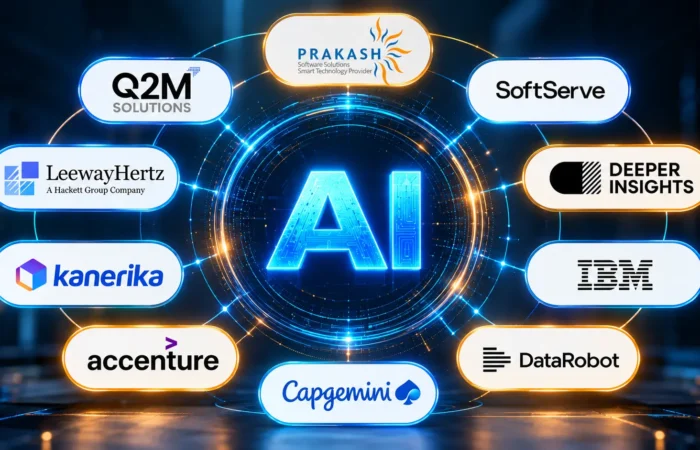
Top 10 AI Consulting Companies to Consider in 2027
Key Takeaways: AI consulting companies assist startups and enterprises in converting AI experiments into measurable business outcomes with the right

Looking for collaboration for your next project? Do not hesitate to contact us to say hello.

AI capabilities
AI by industry
Enterprise AI
Agentic AI
AI That Gets Work Done
Intelligent AI agents that plan, reason and execute workflows.
Computer Vision
See Beyond the Visible
Turn images and video into actionable intelligence.
Smart Glasses & AR
Intelligence in Your Sight
Hands-free guidance and real-time assistance for frontline teams.
SharePoint
Dynamics 365 ERP
Dynamics 365 CRM
MS Teams
Power Platform
Azure & Cloud
Microsoft Dynamics 365
Connect Every Business Function
Unify sales, finance, operations and customer relationships.
Microsoft Power Platform
Turn Ideas Into Action
Build apps, automate workflows and unlock business insights.
Azure & Cloud Solutions
Build Your Cloud Advantage
Modernize applications, data and infrastructure with Azure.
SERVICES
Design
Backend / Open source
Frontend tech
Mobile
Digital Marketing
Bring AI into your business workflows, AI agents, and applications with Azure AI Services and Microsoft Foundry Tools. PSSPL helps you use document processing, multimodal AI, speech, voice, language, translation, and secure automation across your Azure environment.
Microsoft Solutions Partner (Data & AI) | Document AI · OCR · IDP | Speech · Vision · Language | ISO 27001 · Responsible AI

Azure AI Services, formerly known as Azure Cognitive Services, are ready-to-use AI capabilities from Microsoft. They let businesses integrate features into their systems such as translation, language understanding, speech recognition, document processing, and image analysis without explicitly needing to develop AI models from scratch.
In 2026, many of these capabilities are being brought together under Microsoft Foundry as Foundry Tools. This includes tools for Speech, Translator, Language, Document Intelligence, Content Understanding, and Face, while some Azure AI capabilities continue to have their own product names.
PSSPL leverages these tools for use cases like intelligent document processing (IDP) and multimodal AI and connects them with RAG, copilots, agents, and enterprise workflows.
How it fits together: Azure AI services are ready-to-use AI capabilities that are available via Microsoft Foundry as Foundry Tools. These include Speech, Translator, Language, Document Intelligence, Content Understanding, and Face. However, not every Azure AI capability has been renamed, and some continue to keep their own product identity.
These managed AI services can be added to applications through APIs, so businesses can use AI without training models from scratch. They can also work alongside generative AI.
Document Intelligence focuses on structured and reliable data extraction from documents. Content Understanding uses LLM-based reasoning to work alongside documents and other types of content. They can be used separately or together, depending on the use case.
Foundry Tools can work with Azure AI Foundry Models like Azure OpenAI, Foundry IQ through Azure AI Search, and Foundry Agent Service to build complete AI apps and workflows.

Turn business documents into structured data that can move directly into your systems. Automate routine processing, use confidence scores to flag uncertain outcomes, and keep human review where it’s required.
We use the generally available Content Understanding 1.0 API for production development and content workflows. It supports structured outputs, custom schemas, and grounding, making extracted information easier to use in RAG and AI agent workflows.
For more advanced use cases, we can test Content Understanding 2.0 preview features like synchronous document processing, semantic chunking, advanced classification, contextualization, and agentic document reasoning. These features are treated as pilots until they become generally available.
Use Document Intelligence when you need predictable field, table, layout, and OCR extraction from known document types. Consider Content Understanding when the workflow involves variable layouts, unstructured content, multimodal inputs, cross-document reasoning, or outputs that must power AI agents and RAG. PSSPL can benchmark both approaches against your real documents and define confidence-based human-review rules.
| Capability | Best for | What it helps with |
|---|---|---|
| Azure Document Intelligence | Structured and templated documents | Extract invoice data, forms, tables, fields, and layouts |
| Azure Content Understanding | Complex and multimodal content | Understand contracts, document sets, images, audio, video, and unstructured content |
| Foundry Models | AI generation and reasoning | Build copilots, assistants, and business-specific AI workflows |
| Foundry IQ / Azure AI Search | Search and grounding | Turn processed content into searchable, source-based AI knowledge |
| Foundry Agent Service | AI agents and automation | Take actions, connect to APIs, handle exceptions, and automate multi-step tasks |
These capabilities are especially useful for insurance, finance, tax, procurement, logistics, healthcare administration, and legal workflows.
Speech-to-text, text-to-speech, live transcription, translation, and custom voices for voice assistants, accessibility, and call-center applications.
Tools for image analysis, OCR, object and product detection, and video analysis. Most common uses are quality checks, workplace safety, and retail.
Capabilities for extracting information, classifying text, summarizing content, detecting sentiment and PII, and translating languages.
Face detection and verification for identity and access use cases, with Microsoft’s responsible AI requirements in place.
Convert customer calls into accurate transcripts during or after the call, across multiple languages.
Generate call summaries and suggest further steps.
Check the call’s quality, follow workflows, and find out the underlying compliance issues.
Support agents during ongoing calls with real-time translation, information, and recommended responses.
Turn conversations into meaningful insights that help product and service teams understand the trends and what a customer is currently looking for.
Find out sentiment, topics, intent, and patterns that may lead to escalations.
Turn PDFs, scans, tables, diagrams, images, audio, and video into structured, searchable knowledge. Content Understanding can help prepare this data for Azure AI Search, Foundry IQ, enterprise copilots, and AI agents.
Allow AI agents to efficiently read, classify, and understand business documents before taking any action. These agents can update platforms, route exceptions, or send cases for approval with the help of Azure AI Foundry Models and Foundry Agent Service.
Pull data from invoices, contracts, claims, and forms and send it to the right system.
Transcribe calls, understand customer sentiment, check the quality of the call, and assist agents.
Create voice-based experiences with the help of speech recognition, text-to-speech, and translation.
Use computer vision to identify defects, check compliance, and support workplace safety.
Process documents, images, audio, and video to create useful data for RAG and AI agents.
Help customers and employees communicate across languages with real-time translation.
Automate document-heavy processes such as KYC, onboarding, insurance, and lending while keeping human review where needed.
Recognize products and assess shelves and video to support retail operations.
Extract useful information from emails and attachments and automate follow-up workflows.
Safeguard AI workloads via tools such as Entra ID, managed identities, private endpoints, Key Vault, RBAC, logging, and monitoring. Data retention and regional requirements can also be built into the architecture.
Automate routine tasks, but keep people in the loop for sensitive or uncertain cases. High-confidence results can be processed automatically, while others can be sent for a review. Feedback from reviewers can then fine-tune the process.
Measure document-processing accuracy with the help of real business data and track results over time.
Use logs, traces, and dashboards to monitor extraction quality, system performance, and processing volume.
Use the right models, along with batching and caching, to keep AI processing efficient and costs predictable.
From document processing and multimodal AI to speech, vision, translation, RAG, and AI agents, we help connect the right Azure AI tools to your business workflows. Tell us what you’re trying to create, and we’ll test the right approach using your real data.


Yes, they are. They have been renamed to Azure AI services, and their capabilities are available. Azure AI solutions are unified within Microsoft Foundry as Foundry Tools. Our experts analyze existing implementations and plan the right modernization path.
Document Intelligence is well suited for quick and reliable extraction of text, tables, or templated documents. Content Understanding helps add LLM-based reasoning for complex, multimodal content such as images, videos, audio, and documents with custom schemas, confidence scores, and grounding.
Of course. With the help of Content Understanding, docs, images, audio, and similar types of media or documents can be processed. It is best suited for downstream RAG and agent workflows.
Yes, Azure AI Services work with Foundry Models, including Azure OpenAI, Foundry IQ / Azure AI Search, and Foundry Agent Service, to combine prebuilt AI, generative AI, search, and AI agents in one solution.
Yes. We build document-processing systems for invoices, contracts, and other documents with the help of extraction, classification, exception handling, and integration with business systems.
Adding {{itemName}} to cart
Added {{itemName}} to cart