


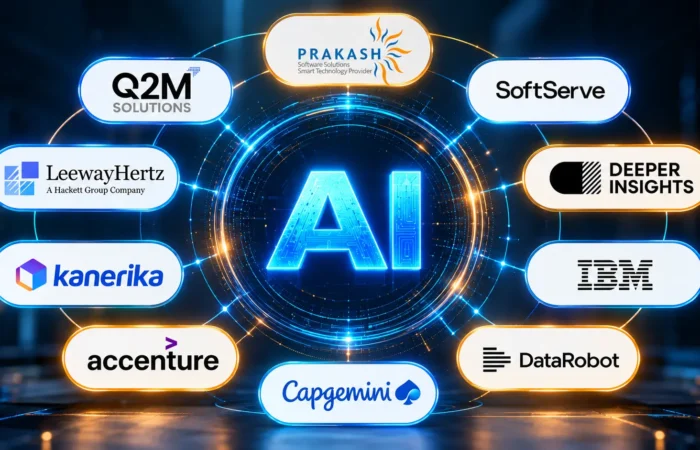
Top 10 AI Consulting Companies to Consider in 2027
Key Takeaways: AI consulting companies assist startups and enterprises in converting AI experiments into measurable business outcomes with the right

Looking for collaboration for your next project? Do not hesitate to contact us to say hello.

AI capabilities
AI by industry
Enterprise AI
Agentic AI
AI That Gets Work Done
Intelligent AI agents that plan, reason and execute workflows.
Computer Vision
See Beyond the Visible
Turn images and video into actionable intelligence.
Smart Glasses & AR
Intelligence in Your Sight
Hands-free guidance and real-time assistance for frontline teams.
SharePoint
Dynamics 365 ERP
Dynamics 365 CRM
MS Teams
Power Platform
Azure & Cloud
Microsoft Dynamics 365
Connect Every Business Function
Unify sales, finance, operations and customer relationships.
Microsoft Power Platform
Turn Ideas Into Action
Build apps, automate workflows and unlock business insights.
Azure & Cloud Solutions
Build Your Cloud Advantage
Modernize applications, data and infrastructure with Azure.
SERVICES
Design
Backend / Open source
Frontend tech
Mobile
Digital Marketing
Reliable AI starts with finding the right information. We use Azure AI Search to help your agents find relevant content via hybrid, semantic, and agentic retrieval. The outcome is straightforward: better-grounded answers, clearer citations, and access based on user permissions.
Microsoft Solutions Partner (Data & AI) Hybrid + semantic + agentic retrieval Permission-aware & evaluated

Azure AI Search is Microsoft’s enterprise search and retrieval service. It supports keyword, vector, hybrid, semantic, and agentic search, making it a core part of a majority of enterprise RAG systems.
In 2026, Azure AI Search became the foundation of Foundry IQ, Microsoft’s managed, permission-aware knowledge layer for AI agents in Microsoft Foundry. This gives agents a ready-to-use retrieval foundation rather than needing teams to develop RAG from scratch.
Prakash Software Solutions specializes in Azure AI Search development services, creating custom Azure AI Search pipelines and Foundry IQ knowledge bases.
AI agents are only useful when they can find the correct information. Foundry IQ provides agents with a shared way to access enterprise knowledge without explicitly needing to build a separate RAG setup for every project.
Bring your business data into permission-aware knowledge bases that multiple agents can use. Set it up once and reuse it across projects. Connect your business data to knowledge bases that many agents can use at the same time. Set it up just once and continue to reuse it across different projects.
Foundry IQ doesn’t just return matching results. Agents can search across sources, establish a connection between related information if suitable, and create a more complete answer.
Foundry IQ handles ingestion, chunking, and vectorization for supported sources, reducing the search infrastructure your team needs to manage.
Foundry IQ is known for managing organizational knowledge, while Fabric IQ handles business data and Work IQ delivers workplace context.
The Azure AI Search context provider connects Microsoft Agent Framework with Foundry IQ, making it easier for agents to retrieve the information they need for each task.
Permission controls, source citations, and logging help keep knowledge access secure and make agent responses easier to trace.
“Just harness the power of RAG” is no longer enough. The quality of AI response depends on how information is being retrieved. Azure AI Search provides you with a variety of retrieval options. The right mix often depends on your data and the questions your users usually ask.
| Method | How it works | Best suited for |
|---|---|---|
| Keyword (BM25) | Finds and ranks exact or matching terms | Names, codes, acronyms, and specific terms |
| Vector search | Finds results on the basis of meaning and similarity | Concepts, paraphrased questions, and multilingual queries |
| Hybrid (RRF) | Combines keyword and vector search | A strong default for balancing precision and recall |
| Semantic ranker | Re-ranks results to identify the most relevant passages | Getting the best result at the top of the page |
| Agentic retrieval GA (2026-04-01 API) | Breaks complex questions into smaller searches and gives combined results | Multi-part and multi-step questions |
Our experts also tune metadata filters, strictness, and chunking. These details can have a huge impact on the quality of the final answer.
Most enterprise RAG projects often fail to meet expectations not because of the model itself, but because of retrieval. Here are some of the most common issues we see and how we solve them.
| What usually goes wrong | How we address it |
|---|---|
| The model answers confidently but with wrong answers | We combine hybrid search, semantic ranking, and strictness controls, with groundedness checks to filter out all the weak results. |
| The answer is in the documents, but the chatbot fails to find the same | We use better chunking and vector coverage to make relevant content easier to retrieve. |
| Answers tend to rely on outdated information | Our experts ensure that your indexes are always up-to-date with incremental updates, recency filters, and source versioning. |
| Complete questions get incomplete answers | We utilize agentic retrieval to break down questions into smaller searches and combine the results. |
| Users can see content they shouldn't | Apply document-level security with Entra ID so users only retrieve content they're given access to. |
Documents, sites, and intranets, with existing permissions kept in place.
Structured business data from the Microsoft ecosystem.
Files and data from SQL and NoSQL databases.
Reuse and build on your current search indexes.
Curated external sources for latest information.
Connect data and tools via Model Context Protocol connectors.
Connect systems like Dynamics 365, Salesforce, and support platforms.
Prepare PDFs, images, and other types of documents or media for retrieval with Content Understanding.
We don’t launch RAG without extensively testing it. We use real user questions to build an evaluation set, measure response quality, and keep checking performance post-launch.
Check whether claims are supported by retrieved sources and flag answers that aren’t.
Make sure retrieval finds the right information without returning too much irrelevant content.
Check whether the response answers the question clearly and includes the right source.
Track quality, response time, and cost post-launch, and rectify any kinds of problems before they become bigger nuisances.
Leverage Entra ID and document-level permissions to ensure that agents only access information that the user is allowed to see.
Protect sensitive data with PII detection, private networking, encryption, Key Vault, logging, and retention controls that fit your security and compliance needs.
| Option | Best when you need… |
|---|---|
| Azure AI Search | Complete control over indexing, ranking, custom skills, and the search pipeline |
| Foundry IQ | A managed knowledge layer that multiple agents can share |
| Both | Foundry IQ for shared knowledge and custom Azure AI Search indexes for specialized retrieval |
Our Azure AI Search development services help businesses design, build, and optimize safe retrieval pipelines for enterprise AI apps.
Design and develop RAG solutions that give AI responses the right context, with grounding and citations.
Create permission-aware knowledge bases that your agents can reuse across projects.
Fine-tune chunking, hybrid, semantic, and agentic retrieval, along with filters and strictness.
Connect retrieval to your agents via the Microsoft Agent Framework.
Measure groundedness and response quality, then monitor performance post-launch.
Identify what’s holding an existing search or RAG system back, make necessary fixes, or move it to a better setup.
Provide agents access to approved, permission-aware information with citations for review and audits.
Assists agents in finding answers and resolving issues with the help of the latest knowledge and documentation.
Search large document collections and answer complex questions across multiple sources.
Give teams grounded answers from product specs, runbooks, and internal wikis.
Identify relevant information from previous proposals and product data, with sources to back it up.
Support high-stakes use cases with tighter permissions, reliable retrieval, and up-to-date information.
Share your data sources and the questions your agents need to answer. We’ll help you design the right retrieval setup, test its quality, and keep access secure.


No. Azure AI Search enhances Foundry IQ. You can leverage it directly when it’s necessary and when you want far better control. Foundry IQ is often used for shared, permission-aware knowledge bases. They can also be used together.
Agentic retrieval breaks down complex questions into smaller searches, runs them side by side, and combines the results. It is designed for RAG and AI agent workflows and is generally available in the 2026-04-01 REST API.
Keyword search matches terms; vector search matches meaning. Hybrid search is a combination of both, and semantic ranking re-ranks the results to find the most relevant ones. Hybrid with semantic ranking is a common production setup.
There are plenty of reasons as to why they deliver such responses. Some of the most common are usually poor chunking, weak retrieval, outdated content, and missing filters. Our experts address them by better chunking, hybrid and semantic search, filtering, freshness controls, and groundedness checks.
We keep retrieval permission-aware by using Entrance ID, document-level permissions, and security trimming. This allows both users and agents to only retrieve content they are given access to. Foundry IQ knowledge bases support permission-aware retrieval by design.
Adding {{itemName}} to cart
Added {{itemName}} to cart