
Generative AI in Retail: Transforming Customer Experience and Operations in 2026
Summarize and save time
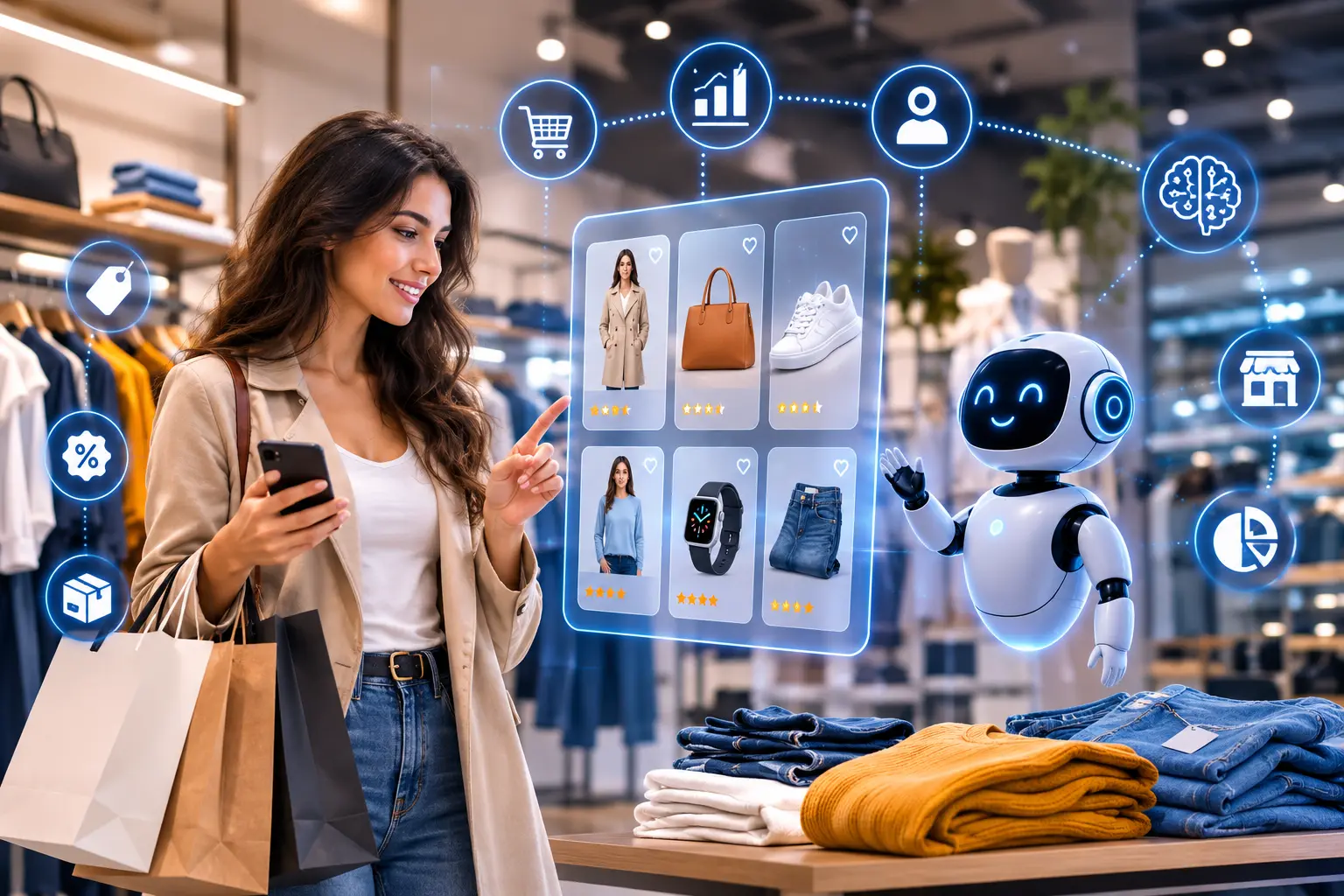
The shift towards generative AI in the retail industry is seeing a major spike, resulting from the rising competition and the transforming user expectations. The market is in a phase where there is growing pressure on retailers to ensure operational efficiency along with a customized user experience. Generative AI goes beyond traditional automation and coding, facilitating the delivery of personalized recommendations, real-time inventory optimization, unique product descriptions, and intelligent virtual assistants.
This subset of AI focuses on designing products and services around specific customer preferences. Retail businesses implementing customized generative AI solutions are experiencing a valuable increase in their ROI with quantifiable cost reduction and improved customer satisfaction.
If you want numbers to showcase this rising demand for generative AI in retail industry, let’s look at the following key statistics to get a market outlook of the rapid adoption and tangible business impact.
Executive Summary:
- The generative AI for retail market is expected to soar from $1.11 billion in 2025 to $5.85 billion by 2030, with Asia-Pacific being the key growth region.
- Nearly 4 in 5 retailers have generative AI implemented somewhere in their production line, and about 80% of retail companies are now actively using generative AI.
- The 2026 market size of generative AI in retail industry is USD 18.64 billion, with IBM, Microsoft, Google, and AWS being the leading players.
- According to the March 2026 estimates from McKinsey, generative AI could add $400-$660 billion in annual value in the retail sector, with 98% of retailers planning to invest.
The Generative AI Revolution in the Retail Industry
What seemed like a manifestation is now a reality with the power of generative AI. Back in time, who knew that you could have an entire product recommendation list specifically curated for you or that 24/7 human-like customer service could be offered without the need for manual intervention or that overstocking or understocking could be prevented by optimizing inventory in advance.
All this now seems to be common following the generative AI revolution in the retail industry. Generative AI has totally revamped the way businesses operate, and customers shop by offering options of dynamic pricing, automated content generation, personalized shopping experiences, and demand forecasting.
Besides the retail sector, AI has transformed business operations in every industry, and to experience its value you can reach out to Prakash Software Solutions to avail AI solutions for businesses. We offer a wide range of enterprise-grade AI solutions and services that are tailored to distinct business needs and user expectations.
What Is Generative AI in Retail and Why Does It Matter?
Generative AI refers to artificial intelligence systems that can generate new automated content, such as images, videos, text, and code, based on an interpretation of the insights from existing business data. When considering generative AI in retail industry, it can generate customized product descriptions, provide intelligent shopping assistants, power virtual try-on experiences, and even design new products.
Generative AI for retail matters because retailers face numerous challenges, such as thin profit margins, intense competition, complex supply chains, changing customer expectations, and so on. These challenges can be effectively addressed with the help of generative AI solutions in the following ways:
- Enhancing the level of personalization offered so that every customer feels unique and understood.
- Automating repetitive routine tasks and customer service to reduce operational costs and improve efficiency.
- Designing large product catalogs with automated and customized content.
- Improved demand forecasting and inventory optimization for better operational efficiency.
- Providing smart product recommendations and dynamic pricing to drive revenue growth.
Popular Use Cases of Generative AI for Retail
The implementation of generative AI in retail industry has expanded with several use cases that bring measurable benefits and improvements. Some of the highly rated uses of generative AI by retail businesses include the following:
| Areas of Use for Retailers | How Generative AI Helps |
|---|---|
| Personalized product recommendations | Retail shoppers or users are looking for customized product recommendations that are better aligned with their needs instead of generic recommendations. Generative AI can offer individual recommendations by learning from previous data of user behavior, purchase history, and real-time data of evolving market trends. |
| Virtual try-ons and visual search | Virtual try-on experiences have become the new way of having users experience the product in real-time. This is very common in fashion and beauty industry where generative AI allows customers to visualize the product look and value before making the purchase decision. Visual search on the other hand is that extension of generative AI where users can upload similar images of the products, they are looking for better product match and user engagement. |
| Conversational shopping assistants | AI-powered chatbots and virtual assistants are trained to automatically handle customer inquiries and respond with human-like responses. These assistants under the user intent via natural language processing and curate relevant responses 24/7. |
| Automated product-related content generation | If you have a large product catalog, to manually write product descriptions can be time-consuming and laborious. That is why several retail businesses make use of generative AI to draft SEO-optimized descriptions, saving the manual time and effort. |
| Dynamic pricing | By gathering market information on demand, inventory levels, pricing strategy, and user segments, AI algorithms adjust the real-time price points to offer maximum business revenue. |
| Demand forecasting and inventory optimization | Generative AI for retail predicts the demand and market trends with integration of external signals and provides accurate forecasting. This helps to maintain optimum inventory levels to prevent instances of overstock or understock. To better understand the role of generative AI in inventory optimization, you can read our blog on Transforming ERP with AI Agents. |
| Personalizing marketing content | Based on the distinct user preferences and buying behavior, generative AI creates and delivers personalized email campaigns and marketing content to the target customers. This replaces generic marketing campaigns with personalized content that is aligned with specific user preferences and behavior. |
| Automating customer service | Generative AI can automate several tasks such as email responses, support tickets, and guide for troubleshooting, reducing the ongoing support costs. |
How Generative AI Transforms the Customer Shopping Experience?
There has been a rapid evolution in the customer shopping journey where present-day customers demand seamless, hyper-personalized, and convenient experiences. Generative AI in retail makes this possible in distinct ways:
Customized shopping experience
Generative AI helps retailers offer a personalized shopping experience to customers. It adapts the product recommendations to the individual user’s preferences and their buying journey in real-time. Every interaction is curated for the specific user, from tailored content to email campaigns.
24/7 customer support
AI shopping assistants and virtual chatbots make it possible to provide round-the-clock customer assistance. They generate automated responses that sound human-like using natural language processing, improving user satisfaction with reduced support costs.
Automated product discovery
Visual search and AI-powered visual try-on experiences automate the process of identifying the right product for users. Instead of browsing through the large list of product catalogs, users can easily discover the product they want using AI.
Seamless experience across all channels
Generative AI offers a unified experience across online as well as offline platforms. This consistency and personalization help a user to easily browse the products online, try them in-store, and make a final purchase from your mobile app.
Key Considerations in Using GenAI for Retailers
Implementing generative AI for retail businesses is not simply about adopting the latest technologies. It’s way more than that, as retailers need to evaluate several strategic factors for ensuring seamless deployment of the solutions and measurable ROI.
Some of the key considerations that every retailer needs to pay attention to include:
-
Data Readiness and Quality
Successful deployment of AI solutions depends on the quality of data to a great extent. Data quality is one of the main reasons ensuring seamless integration of generative AI in retail operations. This is why scattered, fragmented, unstructured, and inconsistent data is a potential red flag resulting in the underperformance of the AI solutions.
-
Integrating with Existing Systems
Most retail businesses operate on legacy systems, ERP, and CRM infrastructure, which restricts what AI can access and act on. A strategic approach that can help bridge the gap is to begin with AI solutions that can be seamlessly integrated with the existing tech stack.
-
Cost Vs. ROI
Cost is one of the other dominating reasons that acts as an AI adoption barrier among retail businesses. The estimated projections don’t tally with the actual implementation expenses, and the seasonal price shifts also result in budget surprises. As a result, it’s better to begin with pilot projects that are focused on high-impact and low-risk use cases.
-
Privacy, Ethical, and Governance Policies
AI data privacy and compliance requirements are another reason that slows down the implementation of generative AI in retail industry. Therefore, some key considerations that every retailer must pay attention to include:
- Transparency in AI usage with the customers from the start.
- Implementing strong data governance rules.
- Ensuring fair and unbiased data systems.
- Build the AI governance framework alongside the AI deployment.
-
Measuring Success by Outcomes
Retailers must measure the impact of AI execution and not just the ease of deployment when it comes to monitoring success. The key metrics that can help measure the success of your generative AI solutions include:
- Revenue following personalization.
- Cost reduction due to automation.
- Customer satisfaction score.
- Improvements in employee productivity.
-
Impact Vs. Feasibility Assessment
Each AI solution has a distinct business value to deliver, which is why retailers must prioritize the AI initiatives based on:
- Measurable and high-volume workflows.
- Repetitive, rule-based tasks that have clear success metrics.
- Speed of delivering quick results.
Implementation Challenges and How to Overcome Them
Despite the clarity of a range of benefits that generative AI in retail industry can offer, there are several roadblocks that can hamper the implementation and the success of these solutions. Here are some of the most common challenges and ways to overcome them:
| Challenges | Ways to Overcome |
|---|---|
| Quality of data and ease of integration | High-quality and well-structured data serves as a prerequisite for effective implementation of generative AI in retail industry. Many retailers are faced with the issue of inconsistent data formats, data stored across multiple files, or poor data governance. Solution: Before deploying the AI solution in the real-world environment, invest in proper data cleanup, integration, and governance. |
| Change management and adoption | A lot of the times employees and other team members hesitate to adopt AI, due to fear of replacement or lack of understanding. Solution: Such scenarios can be prevented by providing adequate training, explaining the benefits clearly, and involving employees in the process to ensure transparency. You must position AI in a way that gives them the assurance that it will complement their skills and not replace them. |
| Uncertainty of Cost and ROI | AI designing and implementation can seem expensive with no immediate ROI or value-addition. Solution: A strategic approach can be to begin with pilot projects that focus on high-impact and low risk use cases. Measure results and scale based on the ROI evaluation of the generative AI solutions. |
| Technical complications | To implement generative AI in retail businesses you need specialized expertise in machine learning, data engineering, and cloud infrastructure. Solution: If you don't have an in-house team with this expertise, you can partner with experience generative AI development companies like Prakash Software Solutions (PSSPL). At PSSPL, our generative AI development services can provide the required guidance and support from end-to-end development and implementation. |
| Ethical and privacy issues | Data privacy and ethical concerns are an alarming requirement, especially among retailers dealing with sensitive user data and confidential financial information. Solution: Implement strong data privacy protocols, access controls, encryption policies, and be transparent about the data usage to ensure fair and unbiased generative AI solutions. |
| Matching the pace of rapid innovation | The AI landscape keeps evolving rapidly, which is why it becomes difficult to stay current and updated. Solution: Stay on top of AI trends by partnering with companies like PSSPL, where we adopt new technologies as they emerge. |
Future Trends of Generative AI to Consider
There is a rapid evolution in response to the evolving market and user needs in the generative AI market. Here are the top 5 trends you must watch out for if you are considering generative AI for retail:
Multimodal AI
For delivering rich and more immersive shopping experiences, future AI systems are expected to combine images, text, audio, and video into one.
Agentic AI and Autonomous Assistants
AI agents will be able to perform more autonomous actions, such as automating complex tasks of planning entire shopping trips, managing subscriptions, price negotiation, etc. All this will be facilitated without any human intervention, purely using AI systems and tools.
Need for Personalization
Customers are expecting personalization in every stage of the buyer journey, which is why retailers will have to design more sophisticated AI models.
Voice and Conversational Commerce
Voice-enabled shopping and interactive user interfaces will become increasingly prevalent. This adds convenience and accessibility to the shopping experience for users.
Edge AI
AI processing will move closer with edge computing, fostering real-time customization and analytics in physical storefronts.
Why Partner with PSSPL for Generative AI in Retail?
Successful implementation of generative AI in retail demands the right level of experience, use of cutting-edge technologies, and the ability to scale with the rising business needs. This is possible when you partner with a generative AI development company like Prakash Software Solutions.
At PSSPL, we have a team of AI engineers who are competent in designing, implementing, and integrating enterprise-grade generative AI solutions. They can help you navigate the AI transformation in retail industry with their expertise in machine learning, artificial intelligence, cloud computing, natural language processing, and generative AI.
Here’s why partnering with PSSPL can benefit your generative AI journey in the retail world:
End-to-End AI Services
PSSPL serves as your end-to-end development partner, from consulting to deployment and maintenance. We offer a comprehensive range of services covering all aspects of generative AI through each stage of the development lifecycle.
Proven Expertise
PSSPL has a portfolio of successfully delivering generative AI for retail businesses, including a global client base. As an ISO 9001:2015 & ISO 27001:2022 certified Microsoft Solutions Partner, PSSPL experts have the experience of successfully delivering 500+ enterprise-grade AI solutions.
Focus on Real Business Impact
PSSPL focuses on ensuring that the AI solutions not only work in the test environments but also in the real-world production environment without disrupting operations. This ensures long-term impact instead of short-term pilot wins.
Cost-Effective and Scalable Solutions
PSSPL delivers scalable and cutting-edge AI solutions with uncompromised quality or pricing. With a transparent and competitive pricing approach, their team can help with cost optimization by recommending the right tools, technologies, and infrastructure.
Commitment to Innovation
By staying updated about the latest AI innovations and participating in global tech events like Ai4 2026, PSSPL stays at the forefront of AI evolution.
Final Thoughts
In a nutshell, generative AI in retail has become a present-day reality and necessity, not a futuristic concept. From personalized recommendations to virtual try-ons, generative AI has powered the retail sector with innovation and transformative user experiences. Generative AI in retail industry is a rapidly growing phenomenon gaining widespread traction and adoption with significant ROI.
Whether you are starting with the AI initiative or scaling the existing integration, careful planning is the key to success. Partner with PSSPL and let us take up this transformation for your retail business, while you and your team focus on counting the tangible profits. We can help turn your AI idea into real business value by harnessing the power of AI in 2026 and beyond.
Frequently Asked Questions
Here are the high-impact use cases of generative AI in retail:
- Personalized marketing with product recommendations.
- Automated product descriptions and content creation.
- Customer service automation.
- Virtual try-on and visual search experience.
- Conversational commerce and demand forecasting.
The cost of implementing generative AI for retail varies substantially based on a range of factors, such as project timeline, scope, complexity, etc. Average cost estimations are something like:
- Generic tools cost $50 to $500 monthly.
- Building a single workflow production can be $35,000 to $80,000+.
- Multi-workflow systems can be $80,000 to $200,000+.
Most retailers witness ROI within 60-90 days for quick-win generative AI solutions like chatbots, recommendations, etc. Full-scale deployment of generative AI in retail industry can show results within 6-12 months.
Some of the most common challenges of implementing generative AI for retailers include:
- Difficulty in integrating legacy systems.
- Issues with data quality.
- Uncertainty of cost.
- Data privacy and compliance challenges.
- Employee resistance to AI adoption.
PSSPL provides a comprehensive range of generative AI solutions for businesses with expertise in:
- Strategic planning and implementation.
- Customized AI agent development.
- Seamless integration with existing business systems.
- Best practices to ensure data governance and AI implementation.
- Long-term support and optimization.
I've been involved in the delivery of enterprise software solutions for more than 20 years now, and those which have succeeded were due to the fact that decisions taken during the first week of project development – regarding architecture, scope, and delivery structure – are identified and fixed before becoming costly. Staffing and initiating an engagement are the easy part. Maintaining consistency during delivery scaling, aligning expectations of what a client needs and what a client asked for, and ensuring that investment in AI and cloud technologies actually provides a delivery benefit rather than being just buzzwords, is where most engagements fail. As Head of Delivery & Operations of Prakash Software Solutions (PSSPL), this is what I focus most of my energy on.